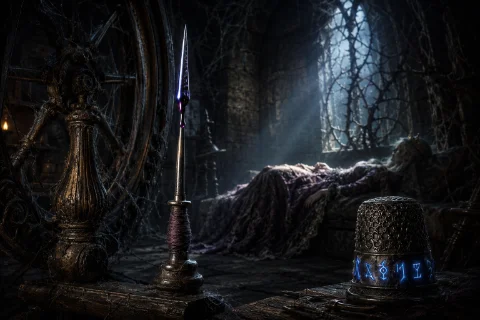
In the traditional telling of fairy tales, the hundred-year sleep of a royal court is treated as a tragic, romantic curse. However, looking closer at the political machinery of these magical realms reveals that mass slumber is never a random act of a vengeful fairy. It is a calculated intervention regulated by a strict legal framework known as the Thimble Covenant. Signed in the wake of the devastating Spinning Wars, this treaty turned spindle poison into a heavily controlled substance and transformed human sleep into a valuable macroeconomic resource.
The Physics of Spindle Poison
Within the world of dark fairy tales, spindle poison is not a biological toxin that stops the heart. It is a highly potent, refined liquid curse derived from the resin of the black elderberry tree and distilled through the tears of forgotten stepmothers. When applied to the point of a silver spindle needle, the toxin acts as an immediate consciousness anchor.
A single prick from an enchanted needle does not kill the victim; it decouples their physical body from the linear passage of time. The individual enters a state of suspended animation, frozen at the exact age and cellular state the moment the needle pierced their skin. The ambient air around the victim thickens, spreading a localized drowsiness that can blanket an entire room, a wing, or an entire fortress. For centuries, rogue sorcerers used this poison to bypass castle defenses, putting armies to sleep without expending single iron blade.
The Bríar Castle Accords and Sleep Economics
To prevent the total economic collapse of kingdoms through unregulated sleep curses, the ruling houses and the Great Covens gathered to sign the Briar Castle Accords. This historic treaty established a global monopoly on the production of flax, hemp, and spindle needles, creating a strict regulatory framework for sleep distribution.
Under the accords, sleep was turned into a standardized financial currency used to settle kingdom-level debts. If a small principality faced an unpayable tax deficit to an empire, they could legally choose to enter a period of sovereign hibernation.
The Calculated Solvency: The debtor kingdom would intentionally poison its own royal court and a percentage of its workforce using regulated spindle needles. While the kingdom slept for ten, twenty, or fifty years, its borders were legally protected from invasion by the Accords. Meanwhile, their national debt stopped accumulating interest, allowing the global markets to stabilize and the kingdom's natural resources to replenish over time.
The Thimble Shield: To ensure that royal heirs were not permanently lost to accidental poisonings, the treaty mandated that all flax-spinning workers wear specialized, enchanted iron thimbles. These thimbles were engraved with warding runes that could absorb the impact of a spindle prick, preventing the spread of the sleeping vapor through the civilian populace.
The Price of the Awakening
Every sleep contract signed under the Thimble Covenant includes a mandatory, hyper-specific awakening clause. These clauses are rarely romantic; they are structural safety valves built into the magic to ensure the contract eventually expires. The famous "true love's kiss" is merely a semantic placeholder for a rare, highly specific bio-electric event that neutralizes the elderberry resin in the victim's bloodstream.
When a kingdom finally wakes up after a century of contracted sleep, the return to the global economy is brutal. The surrounding world has progressed by a hundred years, leaving the awakened citizens with obsolete technology, outdated currencies, and dead bloodlines. They wake up to find their fields overgrown with magical briar walls that require expensive, industrial-level clearance. The Thimble Covenant proves that inside a fairy tale, peace is never free; it is simply financed by borrowing time from the future, leaving the next generation to pay the compounding costs of a century spent in the dark.