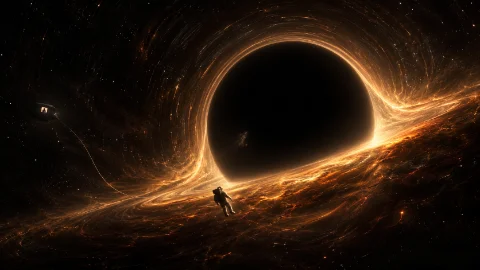
Here is the most unsettling fact about a black hole, and it is not the darkness. It is that you can cross the point of no return without feeling a thing.
The event horizon is not a wall, a membrane, or a gate. It is a mathematical boundary in empty space, the radius at which escape would require moving faster than light, which nothing can. A traveller falling into a sufficiently large black hole would pass the horizon without a jolt, without an alarm, without any local sign at all that anything had happened. The stars would still shine behind her. Her instruments would read normal. And yet, in the instant of crossing, every possible version of her future now ends at the centre. The universe has quietly reclassified her from someone in danger to someone already lost, and she does not know it yet.
Fiction writers should recognise that shape immediately, because it is the shape of the most devastating moments in human life. The signature that could not be unsigned. The sentence said in anger that reordered a marriage. The dose, the deal, the diagnosis, the lie that worked. Points of no return are the heaviest objects in storytelling, and black hole physics is the richest vocabulary ever assembled for writing them. This guide covers the science in plain language, then turns to the craft: the structures, the techniques, and the mistakes to avoid when your story bends around something that cannot be undone.
The Science in One Sitting
A black hole forms when matter is compressed past the point where anything can hold it up, most famously in the collapse of a massive star. What remains is a region of spacetime curved so severely that all paths inside lead inward, down to the centre, where our current physics stops being able to describe what happens. That central mystery is called the singularity. The boundary of the region is the event horizon, and its defining property is directional: things can cross going in, and nothing, not matter, not light, not information in any usable form, comes back out.
Four features of real black hole physics matter enormously for fiction.
The first is the no-drama crossing. For a large black hole, tidal forces at the horizon are gentle, and the infalling traveller notices nothing at the moment of crossing. The catastrophe is invisible from inside. Only the mathematics knows.
The second is the view from outside, and it is stranger than the view from within. Because gravity slows time, an outside observer never sees the traveller cross at all. She appears to slow as she approaches the horizon, her image reddening and dimming, her last moments stretched toward eternity, frozen forever at the threshold from the perspective of everyone who loved her. Inside her own experience she fell through in minutes. In theirs, she is still falling, and always will be.
The third is spaghettification, the genre's famous horror. Closer to the centre, or at the horizon of a small black hole, gravity's pull differs so sharply between your head and your feet that you are stretched and torn. The universe does eventually make the catastrophe physical. It simply does not do so at the boundary, where you might still believe you are fine.
The fourth is the information paradox. Quantum theory insists that information cannot be destroyed, yet black holes appear to swallow it, releasing over unimaginable timescales only the faint, scrambled glow called Hawking radiation as they slowly evaporate. Whether what falls in is truly gone, or preserved in some unreadable form, is one of the deepest open questions in physics. Nothing, in other words, is certainly lost, and nothing is retrievably saved. Grief has never had a better metaphor.
The Core Insight: The Horizon Is Crossed in Ignorance
Strip away the astrophysics and the event horizon gives fiction one profound commandment: write the point of no return as unfelt.
Lesser stories stage their irreversible moments with thunder. The music swells, the character hesitates at the visible brink, and the reader is instructed that this is the big one. Real horizons do not work that way, in space or in life. The alcoholic does not know which drink was the one past which the choice stopped being a choice. The couple cannot locate the conversation after which the marriage was already over. The whistleblower, the gambler, the collaborator each crossed on an ordinary afternoon, feeling nothing, and only the mathematics of their situation, visible in hindsight, knows the exact radius where every remaining path began to lead inward.
This is the event horizon's gift to the writer: the separation of the moment of doom from the knowledge of doom. Your character crosses on page eighty in a scene that feels minor, almost procedural. The realisation arrives on page two hundred, and the reader, flipping back in memory, feels the retroactive vertigo of understanding that everything since has been falling. Structure your story around that gap. The width of it, the time between the crossing and the knowing, is the width of your book's ache.
Four Structures That Work
Point-of-no-return fiction settles into recurring shapes, and the physics names them beautifully.
The Infall. The story told from inside, following the character who has crossed. The infall structure begins at or just after the horizon, in the deceptive calm of no-drama, and rides the geometry down. Its power is dramatic irony against the self: the character continues making plans, mending relationships, imagining exits, while the reader increasingly understands that all paths now lead to the centre. The infall is the natural structure for stories of addiction, terminal diagnosis, unpayable debt, and crimes that have already been discovered by someone the protagonist has not thought of yet. Its craft challenge is keeping hope technically alive in the character while extinguishing it, beat by beat, in the reader.
The Watcher. The story told from outside, and often the more devastating. Someone the protagonist loves has crossed a horizon, into addiction, radicalisation, dementia, a cult, a war, and the watcher's experience obeys the physics with terrible fidelity: the beloved never quite vanishes. They slow. They redden. Their messages grow further apart and stranger, their image dimming at the threshold, visible but unreachable, frozen in the watcher's life at the moment of last contact. The watcher structure is the genre's grief engine, and its central scene is always the same discovery: that you can stand at a horizon for years, and that no signal you send inward will ever come back out.
The Orbit. The story of the not-yet. A character circles a horizon without crossing: the affair not started, the confession not made, the resignation letter written and unsent. Orbits around black holes are real physics, and close ones are unstable, requiring constant energy to maintain, decaying inevitably inward or breaking away outward. That instability is the structure's engine. Your character believes the orbit can be held forever, an equilibrium between the life they have and the act they are contemplating, and the story is the slow proof that there are no stable orbits this close. They will fall or they will flee, and the book is the trembling in between.
The Radiation. The story of afterward, built on the information paradox. Something irreversible has already happened, long ago, a death, a disappearance, a betrayal sealed by decades, and the story concerns what leaks back out. A locked archive of letters. A stranger at a funeral. A detail in an old photograph that does not fit the official account. Hawking radiation is faint, scrambled, and takes ages to carry anything, and the radiation structure obeys that rhythm: the truth of what fell in returns only in fragments, distorted almost beyond reading, over a timescale that outlasts everyone who wanted it. This is the structure of family-secret novels and cold cases, and its deepest question is the paradox's own: is what was lost preserved somewhere in this noise, or are we mourning by reading static?
Writing the Crossing on the Page
The technical challenge of horizon fiction is rendering the crossing itself, and the physics dictates the technique: underwrite it.
The scene where your character passes the point of no return should be, on its surface, one of the quietest in the book. Plain prose. Ordinary furniture. A decision that presents itself as one of many, revocable, small. If you must mark it, mark it the way the universe does, with a change invisible to the character but legible to the mathematics: a shift in what the narration stops mentioning, a future tense that quietly disappears from their dialogue, a last appearance of some recurring image of exit, a door, a road, a departures board, that will simply never occur in the book again.
Then, later, stage the realisation as a separate scene with full weight. The character learns, through consequence, document, or another person's plain statement, that the crossing is behind them, and the scene's power is retrospective. Let them, and the reader, reach backward for the moment it happened, and let them fail to find it exactly. The most truthful line in this genre is some version of: I keep looking for the day it became too late, and I cannot find it, which means it looked like every other day.
The Mistakes to Avoid
Do not install a warning sign. A horizon the character recognises at the moment of crossing, and chooses anyway with full knowledge, is a different story, a story of sacrifice or defiance. It can be magnificent, but it is not this. The event horizon's meaning is that the universe does not announce it.
Do not grant a secret exit. If your plot ultimately lets the crossed character climb back out, the horizon was never a horizon, and every scene that borrowed its gravity was written on credit the ending refuses to pay. Irreversibility is the entire currency. Spend it honestly.
Do not make the centre survivable by vagueness. You need not show the singularity, and often should not, but you must know what it is: the specific final consequence toward which all paths inside now lead. Books that gesture at doom without defining it go soft exactly where they should be hardest.
A Working Checklist
Before drafting your event horizon story, settle these six things.
Define the horizon precisely: the act or moment after which no path leads back, even if no character could identify it in real time.
Define the singularity: the specific end state that awaits, whether or not the book ever shows it.
Pick a structure: the infall, the watcher, the orbit, or the radiation.
Set the width of the gap between crossing and knowing, and plan both scenes, the quiet one and the shattering one.
Choose your outside observers, and decide what frozen, reddening image of the lost person they are left holding.
Decide what leaks back out, and whether it is information or only noise, because that answer is your ending.
Black holes fascinate far beyond their scientific importance, and the reason is not mystery but recognition. Every reader is carrying at least one horizon. Something in their life was crossed quietly, on a day that felt like every other day, and became visible only from far inside. The physics did not teach us this. It only gave us, at last, the precise language for what we already knew.
Write the crossing in silence and the knowing in full voice. Keep faith with irreversibility, even when the plot begs for mercy. And leave your reader with the strange consolation the paradox offers, that nothing which falls in is proven lost, that the universe may keep, in some scrambled and patient radiation, everything we cannot get back. The horizon takes the returning. It has never quite been shown to take the record.