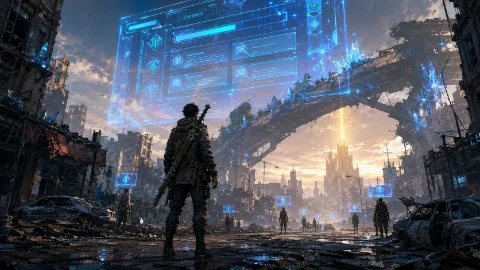
One morning, everyone on Earth wakes up with a blue box floating in the corner of their vision, and nothing is ever ordinary again.
The LitRPG apocalypse begins with that single image: the Interface arriving uninvited, overlaying reality with health bars, skill trees, and quest notifications, and turning seven billion people into level one characters in a game nobody agreed to play. Grandmothers receive class options. Accountants discover mana pools. Somewhere, a notification chimes to announce that the Integration is complete, and thanks humanity for its participation.
This guide is for writers building worlds rewritten by the Interface. We will look at why the System works best as a silent god, how classes and tiers reorganize human society within weeks, and how to keep the numbers from strangling the story. Because the LitRPG apocalypse is not really about stats. It is about what people become when the rules of reality are suddenly visible, quantified, and very obviously written by someone else.
The First Rule: The System Is a God That Only Speaks in Menus
The most important character in your LitRPG apocalypse never appears on the page. The System has no face, no voice, and no throne. It communicates exclusively through notifications, tooltips, and the occasional system-wide announcement written in the cheerful, liability-proof tone of a software update.
That tone is your greatest weapon. When the Interface informs a grieving man that his wife's death has awarded him 300 experience points and a new title, the horror is not in the loss. It is in the chirpy font. The System applies game logic to human tragedy with the serene indifference of an automated email, and every writer in this genre should study that register until they can produce it on demand.
Resist the urge to explain the System. The moment your book reveals who built it, why Earth was integrated, and what the endgame is, your silent god shrinks into a villain with a customer service department. The strongest works in the genre hold the mystery for volumes, feeding the reader only fragments: a patch note that references a previous world, a deprecated skill whose description mentions users that no longer exist, an error message in a language no one recognizes that appears for one frame and never again.
The System is scripture without a church. Let your characters build the theology themselves, wrongly, the way humans always have.
The Second Rule: The Class Is a Mirror, Not a Costume
When the Interface offers your protagonist their class selection, it is offering the reader a character study disguised as a menu.
The lazy version hands the hero a rare sword class and moves on. The rich version understands that the class offer is the System's assessment of who this person already is. The burned-out nurse is offered Combat Medic, Plague Warden, and one strange, greyed-out option called Triage Saint that unlocks only after she chooses who to save in chapter three. The retired con artist receives Merchant, Illusionist, and a hidden class the System simply labels Honest Man, with a question mark for its description. The quiet teenager who has spent his whole life watching gets Scout, Archivist, and something called Witness that no guide on the new forums has ever documented.
Classes reveal. They also trap. A person who accepts the class the System offers is agreeing, on some level, with the System's reading of their soul, and the genre's best character arcs grow from that agreement curdling. The Tank who no longer wants to stand in front. The Assassin whose class evolves in directions his conscience refuses to follow. The healer who realizes her tier advancement is quietly gated behind letting some patients die, because triage is the skill, and the System grades it.
Write the class menu as a mirror scene. Everything the character does for the next four hundred pages is negotiation with what they saw in it.
The Third Rule: Tiers Rebuild the Class System Within a Month
Here is the genre's sharpest social observation, and the one too many drafts leave on the table. The Interface does not just gamify reality. It makes power legible, and legible power reorganizes society at terrifying speed.
Before the Integration, human hierarchy was blurry. Wealth, charm, credentials, and luck tangled together, and a person's true capabilities were arguable. After the Integration, a level floats above every head. Within a week, nightclubs have minimum level requirements. Within a month, the wealthy districts have rebranded as high-tier zones, and the checkpoint guards do not check papers anymore, they check character sheets. Within a year, there are marriages arranged around class synergies, schools that admit by stat distribution, and a thriving black market in appraisal-blocking amulets for those who would rather not be read.
The old elites experience this as catastrophe or coronation, depending on how they leveled. The former hedge fund manager who ignored the tutorial is now a level four nobody whose gardener, a former soldier who grinded the early zones, has just been offered his house at a fair price. The genre's readers love these reversals, and they deserve better than a paragraph. Give the new hierarchy institutions: tier courts, guild charters, level-gated citizenship, and the grim category of the Unclassed, people whose bodies rejected the Interface and who now live as undocumented ghosts in a world where everyone else is a public number.
Your protagonist rises through this order. Make sure the order is worth describing.
The Fourth Rule: The Grind Is Where the Character Lives
Every LitRPG apocalypse contains hundreds of pages of grinding, and this is not a flaw to minimize. It is the genre's equivalent of the training montage, the sea voyage, and the campfire scene combined, and it is where your characterization actually happens.
The grind reveals values. One survivor grinds efficiently, optimizing experience per hour, and his spreadsheet is a portrait of a man who copes with apocalypse by refusing to feel it. Another grinds socially, always in a party, always talking, because the dungeon is the only place her hands stop shaking. A third undergrinds deliberately, staying low-tier on purpose, because she has noticed that the System gives harder quests to higher levels and she has children.
The grind also produces the genre's texture: the small economies of loot, the etiquette of party formation, the arguments over drop distribution that are never really about the drops. A party that splits loot by contribution is telling you its philosophy. A party that carries its weakest member is telling you another. When the betrayal comes, and in this genre it always comes, it should happen over an item, because the item has become the visible unit of trust.
Keep the numbers honest but sparse on the page. The reader needs to feel progression, not audit it. One clean stat block per major milestone outperforms a ledger on every page, and the moment a reader begins skimming your blue boxes, the boxes have failed.
The Fifth Rule: The Quest Is Never Neutral
The System issues quests, and the quests are where its silence becomes sinister.
Early quests read as tutorials. Kill ten of the small ones. Reach the shelter. Craft a weapon. But as your story deepens, the quests should begin to imply an agenda no one can see whole. A city-wide quest offers massive experience for clearing a forest that, the druids of the new world quietly note, was the only thing holding back something worse. A chain quest maneuvers three guilds into conflict with a precision that no random generator would produce. A survivor reads the fine print of a divine-tier quest and realizes the objective, stripped of its flavor text, is a census.
The characters who notice this become your plot. Every LitRPG apocalypse eventually divides its cast into those who play the game and those who study it, and the second group is where the sequel lives. Give one character a notebook of every quest the System has issued in their region, and let the patterns they find be disturbing in proportion to how much experience everyone has cheerfully accepted.
The System pays well. That is precisely what should worry everyone.
The Sixth Rule: Humanity Is the Anomaly the Numbers Cannot Hold
The final rule is the one that gives the genre its heart. In a world where everything is quantified, the story's power lives in the things the Interface cannot measure.
The System has no stat for the old man who feeds unclassed refugees at his noodle stall and waves away the experience points a gratitude quest keeps trying to award him. There is no tier for the guild that takes the dungeon slowly so its newest member, terrified since the Integration, never has to fight alone. When your max-level protagonist stands over the final boss and the victory notification blooms across her vision, promising a legendary class evolution, the genre's truest ending is the pause before she accepts, when she looks back at her party, at the people the numbers said were suboptimal, and understands that everything the System measured about her was the least important part.
LitRPG readers love the numbers. But they return, book after book, for the moments the numbers fail. Build toward those moments deliberately. The blue box is the genre's language, and the human act it cannot parse is the genre's poetry.
Building Your Own System Apocalypse
Before you draft your LitRPG project, work through this quick checklist.
Write your System's voice first. Draft ten notifications in its exact register, cheerful, precise, and liability-proof, and never let it explain itself.
Design the class menu as a mirror. Give your protagonist three options that each say something true about them, and one greyed-out option that says something they are not ready to hear.
Rebuild society around legible power. Invent the institutions, tier courts, level-gated districts, the Unclassed, and let your hero's rise move through them.
Use the grind as characterization. Decide what each party member's grinding style reveals, and stage the betrayal over loot.
Make the quests add up to an agenda. Keep a private document of what the System is actually accomplishing, and leak it in patterns, not speeches.
Plant the unmeasurable early. Choose the human act the Interface cannot parse, and build your ending on it.
The System Pantheon endures because it literalizes a suspicion modern readers already carry: that life has become a set of metrics designed by someone else, optimized for purposes no one explained, and gamified just enough to keep us grinding. The LitRPG apocalypse takes that suspicion and gives it a blue box, a level cap, and a cheerful chime.
Write the Interface as a silent god. Write the classes as mirrors and the tiers as a new aristocracy. Spend the grind on character, read the quests for agenda, and save your finest scene for the moment a human being does something the numbers cannot hold. The world has been rewritten. The story is about what refuses to be.