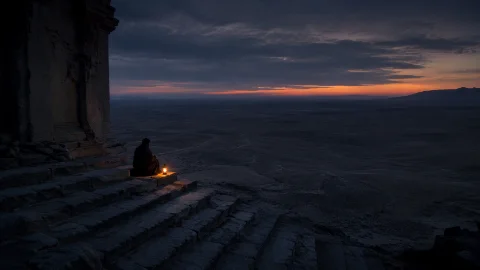
Almost every story we are taught to write is built around hope. A character wants something, believes they can get it, and fights. Even the darkest tales usually keep a candle burning somewhere, a promise that if the hero tries hard enough, things might turn out all right.
But there is a rarer, stranger kind of story that begins on the other side of that candle. It opens after the last rescue failed to arrive, after the cure was never found, after the survivors stopped scanning the horizon because they finally understood that no one is coming. These are stories that begin when hope has already died, and they ask a question most fiction avoids. What do people do, and who do they become, when there is nothing left to hope for?
This is difficult territory to write well. Done poorly, it is just relentless misery. Done well, it is some of the most quietly powerful fiction there is. Here is how to write it.
Why Start After Hope Is Gone
Beginning a story after hope has died is a radical choice, and it changes everything about how the narrative works. There is no ticking clock counting down to salvation, no chosen one who will set the world right. That absence frightens some writers away, but it is exactly where the richness lives.
When hope is off the table, you strip the story down to something more essential than plot. You are no longer asking whether the characters will win. They will not, and everyone knows it. Instead you are asking how they choose to live in the meantime. That question is far more intimate and far more human than any survival mission. It moves the story from the external to the internal, from what happens to who these people decide to be when the future has been taken from them.
This kind of story also carries a strange honesty. Most of us will never save the world. But nearly all of us will one day face a loss we cannot fix, a grief that will not resolve, a situation with no happy ending available. Fiction that begins after hope has died speaks directly to that private human experience, and readers feel the truth of it even when the setting is fantastical.
Replacing Hope With Something Sturdier
If hope is not driving your story forward, something else must, or the narrative will simply lie down and stop. The mistake is to assume the only alternative is despair. There are quieter, sturdier forces that can carry a story through the dark.
Purpose without expectation of reward
A character can act with total commitment even when they expect nothing in return. A doctor keeps treating patients they cannot save. A teacher keeps teaching children with no future. This is purpose stripped of payoff, and it is deeply moving precisely because it is unrewarded. The character is not doing it to win. They are doing it because it is who they are, and that refusal to abandon their nature becomes its own kind of quiet heroism.
Small mercies and daily rituals
When the big future is gone, the small present grows enormous. A shared meal. A song remembered. The care taken to bury a stranger properly. These modest rituals become the load-bearing beams of a hopeless world, the things that let people remain people. Fill your story with them, and you give the reader something tender to hold onto even as everything else falls away.
Love that persists anyway
Love does not require hope to survive. A parent loves a doomed child. Two people love each other in the certain knowledge that it will end in loss. This love is not naive. It sees the darkness clearly and chooses connection anyway, and that choice is one of the most powerful engines a hopeless story can run on. It gives the reader a reason to keep turning pages that has nothing to do with rescue.
Meaning made, not found
In a world where no external meaning survives, characters must create their own. They decide what matters, invent their own reasons, and build significance out of nothing. Watching a person construct meaning inside a meaningless world is one of the most quietly thrilling things fiction can offer, and it gives your story a forward motion that despair alone never could.
Avoiding the Trap of Relentless Misery
The greatest danger in this kind of story is exhaustion. If every page is unbroken suffering, the reader goes numb, and numbness is the enemy of feeling. A story that begins after hope has died must work harder, not less, to remain emotionally alive.
The solution is contrast. Grief lands hardest against a moment of beauty. A single act of kindness shines brightest in a cruel world. Let light into your darkness, not to promise rescue, but to remind the reader what is being lost. A sunset that is genuinely beautiful. A joke that genuinely lands. A moment of peace that is real even though it cannot last. These moments do not betray the bleakness. They give it meaning, because you cannot mourn what was never lovely.
Remember too that people in terrible situations do not spend every waking hour despairing. They adapt. They joke, they argue about small things, they find odd comforts. This is not a failure of realism. It is realism. Human beings are astonishingly good at building ordinary life inside extraordinary darkness, and showing that resilience keeps your characters believable and your reader breathing.
Finding the Ending That Fits
A story that begins after hope has died cannot end with hope suddenly restored. That would betray everything the reader has invested in. But it also does not have to end in total darkness. The endings that work best in this territory are quieter and stranger than either.
An ending might offer acceptance rather than victory, a character finding peace with what cannot be changed. It might offer meaning rather than survival, a life that mattered even though it ended. It might offer continuity, the sense that although these particular people are lost, something human carries on beyond them. None of these are happy endings in the conventional sense, yet all of them can leave the reader with a strange, hard-won sense of grace. The goal is not to lie about the darkness. It is to find the dignity inside it.
A Simple Exercise to Try Today
Take a character from your work in progress and remove their last hope entirely. No rescue, no cure, no way out, and let them fully know it. Now write a single scene in which that character does something that matters to them anyway. Not to survive, not to win, just because it means something. Watch what they choose to do when the future is gone. That choice, whatever it turns out to be, is the true heart of your story, and it will tell you more about your character than a hundred pages of action ever could.
It takes courage to begin a story on the far side of hope, in the place most fiction is desperate to avoid. But that is exactly why these stories stay with us. They do not comfort us with the promise that everything will be fine. They do something braver. They show us how people remain human when they know it will not be, and in doing so they offer a truer, deeper comfort than any rescue ever could.
Write the story that begins after the end. Let hope die on the first page, then spend the rest of the book discovering everything that refuses to die with it. That is where the most unforgettable fiction lives, in the quiet, stubborn light that keeps burning long after the reader was sure the darkness had won.