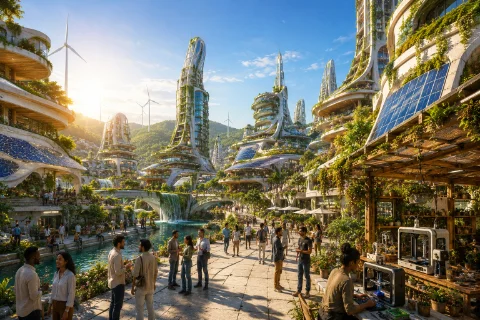
In the architectural landscape of solarpunk fiction, the dystopian, smog-filled cities of the past are replaced by vibrant, self-sustaining urban ecosystems. Power is not extracted from the earth through coal or oil; it is harvested harmoniously from the sun, wind, and kinetic human movement. The Sunlit Assembly operates as a decentralized, democratic network of neighborhood councils, balancing rapid technological innovation with ancestral ecological wisdom. In this society, status is not measured by personal wealth or corporate capital, but by your net-positive contribution to the community grid and local biodiversity.
The Stewards of the Canopy: Biophilic Architects and Grid Engineers
Because a solarpunk society relies entirely on decentralized infrastructure, power and political governance are intrinsically linked to the immediate environment.
The Biophilic Architects: These designers work alongside botanists to construct living infrastructure. High-rise apartment buildings are built from self-healing bio-concrete, cross-laminated timber, and root-grafted living trees. The architects manage the microclimates of individual city blocks, ensuring that vertical farms and roof gardens produce maximum crop yields while naturally cooling the urban canopy without the need for energy-heavy air conditioning.
The Grid Engineers: Power in a solarpunk metropolis is distributed through a neighborhood-level smart microgrid. The Grid Engineers maintain the organic photovoltaic glass panels that wrap every window, the kinetic pavements that capture energy from footsteps, and the massive community battery banks. A neighborhood that produces an energy surplus can trade credits with neighboring sectors to fund public restoration projects, making grid optimization a central civic duty.
The Mechanics of Abundance: Repair Cafés and Maker Communes
Unlike consumerist societies built on planned obsolescence, solarpunk operates on a strict open-source, circular economy. Throwing an item away is viewed as a failure of design and a social taboo.
The Repair Guilds: Every community features a centralized Repair Café. Here, senior engineers and younger apprentices disassemble, modify, and fix everything from solar tablets to automated hydroponic pumps. Items are designed with universal, modular parts, ensuring that a water filtration system can be easily repaired using components 3D-printed from biodegradable hemp plastics.
The Seed and Soil Banks: The true vaults of a solarpunk community do not hold gold; they guard genetic diversity. The Seed Banks protect thousands of heirloom crops, native plant species, and pollinator-attracting flowers tailored to different urban microclimates. The Keepers of the Bank allocate seeds to community gardens based on soil testing and local weather predictions, ensuring absolute food security for the collective population.
The Law of Restoration: Reciprocity and the Ecological Debt
Without central courts or oppressive police forces, the Sunlit Assembly handles civil disputes and corporate legacy crimes through the principle of restorative justice, focusing entirely on healing damage done to the community or the ecosystem.
If an individual or a collective accidentally pollutes a communal water system or damages a vertical farm through negligence, the punishment is never isolation or incarceration. Instead, the offender enters a binding agreement known as an Ecological Rebalancing. The individual must dedicate their labor to the physically demanding work of soil bioremediation, planting heavy metal-absorbing fungi, or rebuilding disrupted pollinator corridors. Until the local ecosystem registers a full recovery on the community’s biometric monitoring sensors, the individual remains under the guidance of the Assembly, transforming a harmful act into a lasting relationship of environmental stewardship.