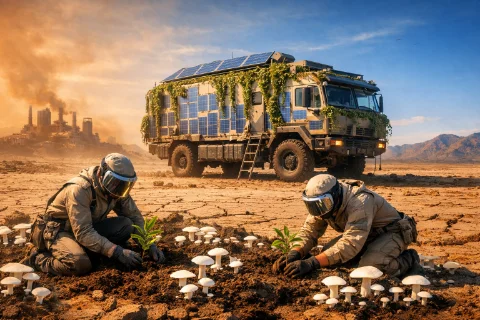
Beyond the thriving, solar-powered borders of the green metropolises lie the Scars—vast stretches of irradiated badlands, depleted topsoil, and chemical dead zones left behind by the collapsed corporate empires of the old world. While the cities focus on local sustainability, the survival of the global biosphere depends on a different faction. The Nomadic Re-Wilding Crews are mobile communities of ecological specialists, field biologists, and heavy-machinery hackers who live on the road, traveling from one environmental disaster zone to the next to jumpstart the slow process of planetary healing.
Life on the Caravan: Mobile Labs and Seed Arks
Re-wilding crews do not settle in permanent towns. They live in massive, solar-hybrid vehicle caravans constructed from retrofitted industrial trucks, military transport vehicles, and bio-diesel trains.
The Fleet Matriarch: The flagship of a re-wilding caravan is typically a massive, converted cargo hauler that functions as a mobile laboratory and seed bank. This vehicle is kept under strict environmental controls, housing thousands of strains of hyper-accumulator fungi, genetically resilient mosses, and deep-rooting grasses capable of surviving in toxic soil profiles.
The Scout Outriders: Operating ahead of the main fleet, these scouts utilize hydrogen-powered dirt bikes and long-range drones to map the chemical makeup of the badlands. They test water tables, analyze soil toxicity levels, and locate subterranean concrete foundations left behind by old factory complexes, identifying the optimal zones to begin the restoration process.
The Alchemy of the Wasteland: Bioremediation and Fungal Warfare
Healing a corporate waste site requires a systematic, multi-staged approach that uses nature’s own defense mechanisms to break down synthetic pollutants and heavy metals.
Mycoremediation Deployment: The first wave of an ecological assault involves fungi. The crew seeds heavily contaminated areas with specialized mushroom spores. These fungal networks break down complex petroleum hydrocarbons and isolate heavy metals like lead, mercury, and arsenic from the soil, storing the toxins safely within their fruiting bodies so they can be harvested and safely melted down by the crew's metallurgists.
The Drone Inoculation: Once the initial toxic load is reduced, the crew deploys swarms of autonomous drones loaded with seed pellets. These pellets are encased in a nutrient-rich shell made of compost, charcoal, and symbiotic bacteria. Dropped across thousands of acres of barren land, these pellets rapidly germinate after the first seasonal rains, establishing a hardy pioneer ecosystem of nitrogen-fixing weeds and deep-rooted native grasses.
The Code of the Road: Scavenger Rights and the Nomadic Peace
Because the badlands are lawless territories often populated by desperate raider clans or isolationist survivalist communities, the re-wilding crews operate under a strict diplomatic code to ensure their safety and the success of their mission.
The fundamental law of the wastes is the Right of Rejuvenation. Even the most aggressive scavenger clans rarely attack a re-wilding caravan, recognizing that the crew's success will ultimately bring clean water, edible vegetation, and returning wildlife to their hunting grounds. In exchange for safe passage and local security, the nomads offer medical aid, water filtration hardware, and open-source farming tutorials to the local populations. For a re-wilding crew, the goal is not to conquer or settle the land, but to make it habitable enough that they can eventually pull up stakes, pack their mobile laboratories, and drive off toward the next horizon, leaving a self-sustaining forest where a concrete wasteland once stood.