The universe should be shouting. Instead, it holds its breath, and nobody knows why.
That is the Fermi paradox in a single sentence, and it began, as legend has it, with the physicist Enrico Fermi at lunch in 1950, interrupting a conversation about aliens with a question that has never been answered: where is everybody? The arithmetic behind the question is brutal. Our galaxy holds hundreds of billions of stars, most of them older than our sun, a vast fraction hosting planets. Even if intelligent life is rare, even if interstellar travel is slow, a single expanding civilisation could seed the entire galaxy in a few million years, a heartbeat in cosmic time. The galaxy has had thousands of such heartbeats. Someone should have been here long before us. The sky should be crowded with signals, ruins, and neighbours.
It is not. Decades of searching have returned nothing but noise. And that silence, the deepest anticlimax in the history of science, happens to be one of the greatest gifts fiction has ever received. This guide covers the paradox and its proposed solutions in plain language, then turns to the craft: how to write stories about cosmic loneliness, why the silence hurts more than any invasion, and the four structures that turn an empty sky into an unforgettable book.
The Science in One Sitting
The paradox stands on two legs. The first is probability. In 1961 the astronomer Frank Drake proposed an equation that estimates the number of communicating civilisations in the galaxy by multiplying a chain of factors: the rate of star formation, the fraction of stars with planets, the fraction of planets that could host life, and so on down to the average lifespan of a civilisation. Most of the factors are uncertain, but nearly every honest attempt to fill them in produces a galaxy that should contain company.
The second leg is time. The galaxy is roughly thirteen billion years old, and Earth only four and a half. Civilisations could have arisen billions of years before ours, and even at sluggish speeds, expansion across the galaxy takes only millions of years. The window for someone to have arrived, or at least called, is staggeringly wide. The paradox is the collision of these two legs with the observed fact of silence.
The proposed solutions are where the fiction lives, and a writer should know the major families. Perhaps life is common but intelligence is vanishingly rare, and Earth is a freak. Perhaps a Great Filter stands somewhere on the road from chemistry to starships, a step so improbable or so lethal that almost nothing survives it, and the terrifying question is whether humanity has already passed the filter or is approaching it. Perhaps civilisations destroy themselves reliably, and the silence is a graveyard. Perhaps everyone is hiding, because in a dark forest the one who calls out reveals their position to hunters. Perhaps we are early, among the first, and the loneliness is temporary but real. Perhaps they are here and we are quarantined, watched but never contacted, a wildlife preserve with one confused species inside. Or perhaps the signals are everywhere and we are simply listening for drums while the galaxy communicates in something we have not imagined.
No solution has evidence behind it. Every one of them is a novel.
The Core Insight: The Silence Is the Character
Here is what separates profound Fermi fiction from stories that merely lack aliens. The silence must be active. It cannot be background. It has to press on your characters the way heat presses in desert fiction and dark presses in horror, a constant, shaping presence that every person in the story has developed a relationship with.
Because that is the truth of the paradox as lived experience: the silence is not an absence of information. It is information we cannot decode. Every night of no signal is data. Every empty survey is a sentence in a message whose language we do not know, and the humans in your story, like the real scientists who run the real searches, will be unable to stop reading meaning into it. Some will hear indifference. Some will hear a warning. Some will hear grief, a galaxy in mourning for civilisations that did not make it. And some will hear a test, a door that opens only for species that endure the quiet long enough.
The craft move is to give every major character a private interpretation of the silence, and to let those interpretations do what religion does in other fiction: shape choices, divide families, found institutions, and break hearts. In Fermi fiction, cosmology is characterisation. Tell me what a person believes the silence means, and I will tell you what she does in act three.
Four Structures That Work
Stories of the silent sky settle into recurring shapes. Here are the four that carry the most weight.
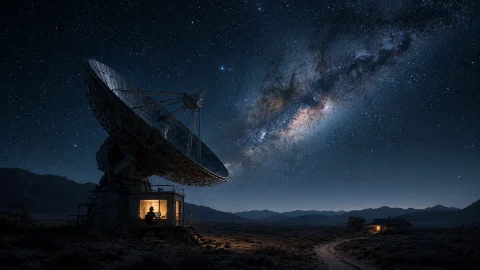
The Vigil. The listening story. Its heroes are the keepers of the search: the radio astronomer on the night shift, the underfunded institute, the generational project handed from mentor to student like a lamp. The vigil structure is about devotion without feedback, faith practised against an instrument that returns nothing, and its natural dramas are quiet and enormous. The false alarm that ages everyone a decade in a week. The funding hearing where a senator asks what forty years of nothing has purchased. The candidate signal that must be checked, and checked, and checked, because the one thing worse than silence would be crying out in error. The vigil's deepest scene is almost always the same: a character alone with the hiss of the cosmos in their headphones, realising they have spent their life in conversation with someone who may not exist, and choosing, again, to keep listening.
The Ruin. The archaeology story. Humanity finally finds them, and they are long dead. A hollowed moon, a drifting megastructure, a planet of glassed cities a hundred million years cold. The ruin structure converts the paradox into grief: the galaxy was never empty, only late, and every discovery is a funeral. Its craft engine is translation, the slow reading of an extinct civilisation through its garbage and its monuments, and its emotional payload arrives when the ruin becomes a mirror. Somewhere in the excavation, your characters will find the thing that killed them, and the reader must be allowed to recognise it.
The Filter. The story of the test. Built directly on the Great Filter concept, this structure follows characters who have understood the paradox's darkest implication: that the silence may mean almost nobody survives some step, and that humanity cannot know whether the step is behind us or ahead. Filter stories thrive on dramatic irony at species scale. The breakthrough technology that the reader slowly realises is the filter itself. The moment of discovery, a fossil of simple life on another world, that should be a triumph and is instead the worst news in history, because if life is common, the filter is ahead of us. The filter structure is the paradox at its most suspenseful, and its best endings do not resolve the question. They hand it, heavier now, to the reader.
The Answer. The most dangerous structure, and the one requiring the most restraint. The silence breaks. A signal arrives, or a ship, or a whisper in a dataset, and the story becomes about what contact costs a species that has organised its entire self-image around being alone. Write the before with as much care as the after: the vigil-keepers who do not know how to stop grieving, the religions that collapse and the ones that are founded by nightfall, the strange mourning for the loneliness itself, which was, after all, an identity. And if your answer is the dark forest, if the silence turns out to have been everyone else hiding, then let the horror land where it truly lives: not in the hunters, but in the retroactive rereading of every joyful signal humanity ever sent.
Writing the Scale Without Losing the Reader
Fermi fiction fails most often at the problem of size. The paradox operates across billions of years and hundreds of billions of stars, and human hearts do not natively feel numbers like that. The writer's job is conversion, turning cosmic scale into domestic weight, and there are reliable tools.
Anchor the immensity in one ritual. A woman who steps outside every clear night of her life and looks up for exactly one minute has made the whole silent galaxy into a personal habit, and the reader can hold a habit. Anchor it in one object: the printout of the closest thing to a signal the project ever received, framed on a wall, half embarrassment and half relic. Anchor it in succession: the vigil handed from a dying mentor to a student, so that deep time becomes a relay of human lifespans, each one brief, each one choosing to pass the question forward.
And always return the sky to the body. After every passage of stellar arithmetic, put a character in a kitchen, a car park, a hospital corridor, feeling the size of what they just calculated. Cosmic loneliness only exists in fiction when a single nervous system is carrying it.
The Mistakes to Avoid
Do not fill the silence too early. The paradox is your story's negative space, and every premature answer spends it. If contact must come, make the reader earn it through the full weight of the quiet, and make the characters pay for it in identity.
Do not write the silence as neutral. A sky that is merely empty is scenery. The silence must be interrogated, feared, loved, and argued over. If two of your characters have never fought about what it means, you have not begun.
Do not let humanity be the obvious answer. Fiction that resolves the paradox with a wink, we were the monsters, we were the filter, we were the aliens all along, has been written many times, and can still work, but only if the reveal reorganises the book's emotions rather than merely its plot. A twist the reader can predict from the title is not a solution to the paradox. It is a shrug.
A Working Checklist
Before drafting your silent sky story, settle these six things.
Choose your solution, or your refusal of one, and know it even if the book never confirms it.
Give every major character a private theory of the silence, and let the theories collide.
Pick a structure: the vigil, the ruin, the filter, or the answer.
Build one ritual, one object, and one succession to carry the cosmic scale at human size.
Write the silence as active pressure, present in every act, felt in the body.
Decide what your story believes loneliness is for, because every Fermi tale is secretly about whether the waiting itself has worth.
The Fermi paradox endures because it is the largest possible version of an experience every reader already knows: sending a message and watching the quiet where the reply should be. The unanswered letter. The friend who stopped calling. The room after the door closes. The silent sky is that ache, scaled to the width of a galaxy, and fiction built on it borrows a loneliness the reader has been in training for their entire life.
Write the vigil with devotion and the ruins with grief. Keep the silence loud on every page. And whether or not your sky ever answers, let your characters arrive where the paradox has always quietly pointed: that a species which keeps listening to an empty universe, night after night, generation after generation, has already proven something about itself worth finding.