
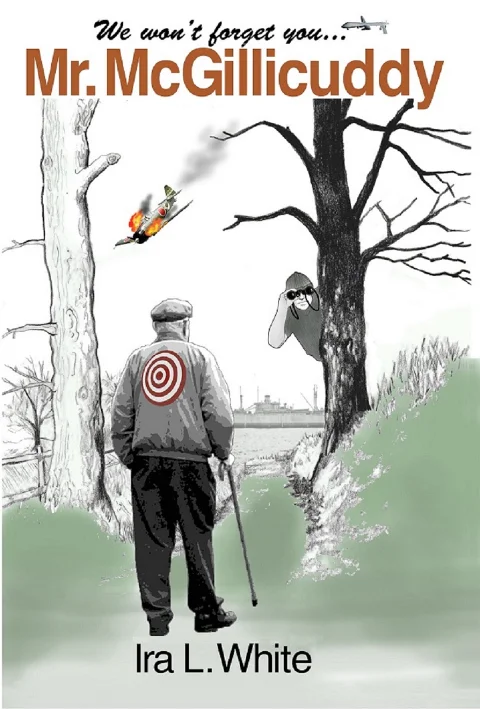
When I started McGillicuddy, I needed a cast of characters. I was living the story as I wrote. At the time I was involved in caring for my dad who had dementia. When I was faced with choosing who I would people my novel with, I looked at my family. My father became Gill and I became Robert. That was easy. After the first two were selected, it followed that the rest of my family would serve as models for other characters in the book.
As models, the characters that wound up in the novel were not totally like their real-world counterparts, but they did follow many of their traits. I modified them to fit the story line. This proved to be an easy fix—take people you know and use them as templates for characters. The story did follow some of the events that took place in real life, and this made things even easier. The birthday party for Gill was one episode that really happened, and the road trip that got the family the name of “the bumpy road family,” was another. Although I did get a complaint from one family member who did not like the part they were given or the way it was portrayed (you can’t please everyone!), the descriptions of the characters and their actions became almost automatic as the story progressed.
It seemed an easy course to take. I would just follow the family and its adventures and challenges and everything would be fine. Along the way, I invented a few characters for cameos in the side stories. They were all composites of people I had known and worked with. Since they were just on for a cameo, I didn’t need to flesh them out more than was needed for the scene they appeared in. Then I finished the book or thought I had.
With my emotions gushing and feeling like I had produced a masterpiece, I handed the book to my number one beta reader. He read the book but despite my attempts to get him to talk, he refused to comment on it. I was perplexed. I re-read the book myself. It seemed as if all was in place. I read it again, and this time I let a couple of weeks go by before I sat down to read.
With the passage of time, my writer’s flush was gone. I was able to look at the manuscript with a more discerning eye. That eye told me something very important. There was no conflict. Nothing was there to drive the story forward. Parts of the story were interesting. Some were even funny. The overall story was, however, flat. Nothing drove the reader to keep turning the pages. There was no villain.
The financial strain, the fact that Robert was a widower, and the side stories related to his blogging did not give enough of a push to keep the reader interested. That was when I decided Fedder, an enemy from the past with a grievance against Robert, would step into the story. I didn’t fashion him after any one person I knew. Not that I’ve never known people as evil and willing to carry a grudge for long periods of time. What I did to construct him was to make him a composite of people I had known.
Fedder’s insertion into the story made it more compelling. However, there was still a piece missing. I couldn’t flesh this guy out without someone to reflect his flaws against. It was then that Reggie stepped up and introduced himself. He turned out to be a perfect mirror to view Fedder through. He also turned out to be a hero.
Now my novel became a compelling read. The choice of characters was easy in comparison to my next novel, The Children of Raven’s Reach, where I had to construct most of the characters from scratch. But that’s another story. I hope you enjoyed this conversation. Please visit www.irawhite.com and check out my free writings and more information on my novels. Thank you for reading!