There is a unique magic in a story that begins with a look backward. When a narrator says, "Looking back now, I see where it all went wrong," an instant contract is signed with the reader. We know the storyteller survived the ordeal, yet we are suddenly desperate to know how the ordeal transformed them.
This is the foundation of the retrospective narrative. It is a technique used in some of the most celebrated novels in history, from The Great Gatsby to To Kill a Mockingbird.
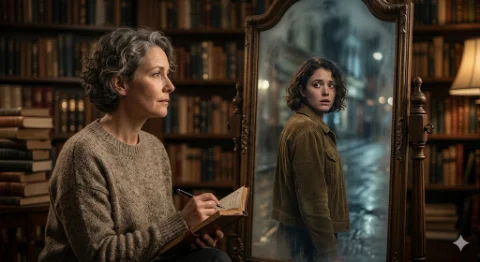
In advanced creative writing workshops, this structure is studied as a problem of dual consciousness. You are not dealing with just one protagonist; you are dealing with two distinct versions of the same person. There is the narrating self (the older, wiser storyteller in the present) and the experiencing self (the younger, naive character living through the events in the past).
Balancing these two identities requires extreme precision. If the present-day narrator speaks too much, they kill the immediate dramatic tension. If they disappear entirely, the story loses its reflective depth.
Here is how you can successfully balance the scales between the past and the present in your fiction.
1. Map the Distance of Time and Wisdom
Before writing a single line, you must establish the exact temporal and emotional distance between your two characters. A narrator reflecting on a mistake they made yesterday will sound completely different from a narrator looking back on a childhood tragedy from forty years ago.
The greater the distance in time, the greater the potential for a shift in wisdom. Your present-day narrator should have a fundamentally different worldview than their past self. They understand the consequences of actions that seemed meaningless to them as a youth. Use this gap to create a layer of maturity, grief, or nostalgic tenderness that colors the prose.
2. Avoid the Over-Intrusive Narrator
The biggest pitfall in a retrospective draft is when the older narrator refuses to let the younger character breathe. If a scene is building high dramatic tension, the reader wants to stay grounded in the past.
The Trap: Interrupting a high-stakes moment with present-day commentary. For example: "As I reached for the doorknob, I had no idea that opening it would ruin my life for the next decade. If only I had known then what I know now."
This kind of heavy-handed intrusion breaks the illusion of the scene and insults the reader's intelligence. Instead, let the younger character experience the moment with raw, unfiltered ignorance. Trust the reader to feel the tension without the older version constantly pointing out the foreshadowing.
3. Weaponize Strategic Dramatic Irony
Dramatic irony occurs when the audience knows a vital piece of information that the character on stage does not. The retrospective structure is a factory for this specific type of tension.
Because the present-day narrator knows the ending, they can carefully arrange the puzzle pieces of the past to create a sense of inevitable destiny. They can highlight small, seemingly trivial choices made by their past self, choices that the reader now recognizes as catastrophic errors.
The younger self thinks they are just attending a casual dinner party; the reader, guided by the older narrator's subtle framing, knows this is the exact night the family empire begins to crumble.
4. Establish Clear Ground Rules for Transitions
To keep your reader from experiencing narrative whiplash, you must establish clear linguistic signals when shifting between the past and the present.
You can manage these transitions by utilizing specific shifts in verb tense and tone.
- The Reflective Frame: Use the present tense and a mature, analytical vocabulary when the older narrator is speaking directly to the reader at the beginning or end of a section.
- The Immersive Scene: Transition completely into the past tense when dropping into a scene. Allow the vocabulary to match the age and emotional state of the past self during dialogue and immediate action.
Words like "then," "at that time," or "in those days" act as quick, painless anchors that tell the reader exactly where they are standing in the timeline.
The Power of the Double Lens
Mastering the retrospective narrative allows you to tell a story through a powerful double lens. You give your readers the visceral, high-stakes excitement of a character experiencing life for the first time, combined with the profound, philosophical weight of an older soul processing their own history. By giving both versions of your protagonist their proper space, you create a narrative that resonates across time.