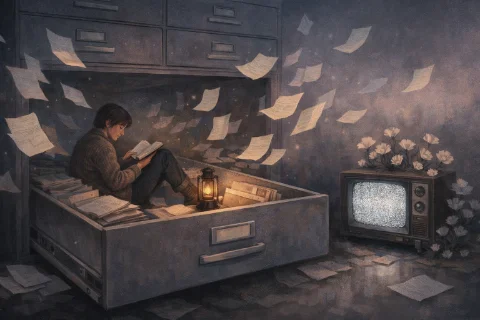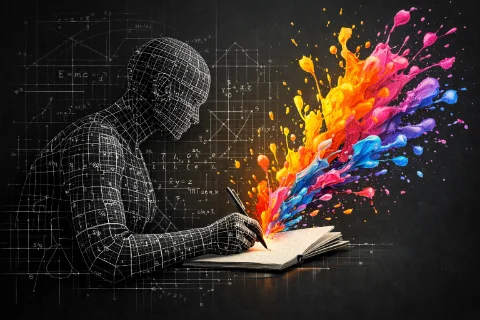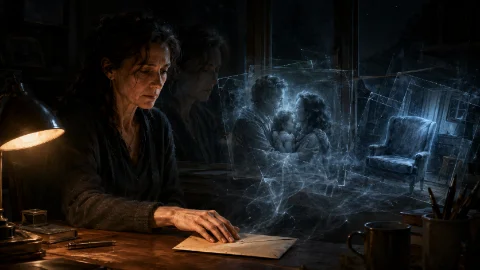
There is a moment in every life when looking stops being innocent. The doctor reads the scan. The wife opens the phone. The detective lifts the sheet. Before the look, the world held several possibilities in suspension. After it, there is only one, and the person who looked is now part of what they saw.
Quantum mechanics has a name for this wound. It is called the measurement problem, and it sits at the unresolved heart of the most successful physical theory humanity has ever produced. Unmeasured, a quantum system exists in superposition, holding multiple states at once. Measured, it snaps into a single definite outcome. What nobody has settled, in a century of argument, is what measurement actually is, why it changes everything, and where the boundary lies between the watched world and the watching one.
Fiction writers should be circling this like wolves. The measurement problem is a physics puzzle on the surface, but underneath it is the oldest question storytelling knows: what does the witness do to the witnessed? This guide covers the science in plain language, then moves to the craft of writing observer characters, the people whose looking is never neutral, whose attention collapses possibility, and who carry the burden of every outcome their gaze made real.
The Science in One Sitting
You need three pieces to write this material with confidence.
The first is superposition. Before measurement, a quantum system does not have one secret value that we simply have not checked yet. It genuinely occupies multiple states at once, described by a mathematical object called the wavefunction that assigns a probability to each possibility. This is not ignorance. It is the actual condition of the unobserved system, confirmed by decades of experiments that rule out the comfortable alternative.
The second is collapse. When a measurement occurs, the superposition ends. The system presents one definite outcome, and the other possibilities vanish from our branch of events. The famous thought experiment is Schrödinger's cat, sealed in a box with a quantum trigger, described by the mathematics as both alive and dead until the box is opened. Schrödinger designed it as a protest, an absurdity meant to show something was missing from the theory, and the absurdity has outlived every attempt to resolve it.
The third piece is the honest uncertainty, and it matters most for writers. Physics has never agreed on what causes collapse. The Copenhagen interpretation says measurement is fundamental and draws a line between quantum and classical worlds without quite saying where. Decoherence theory says interaction with any environment, a stray photon, a molecule of air, effectively destroys superposition, no mind required. Other interpretations deny collapse entirely. What almost no working physicist believes is the popular myth that human consciousness is the magic ingredient, that the universe waits for a mind. The equipment counts as an observer. A speck of dust counts. The romantic version is wrong, and your fiction will be stronger, not weaker, for knowing exactly which liberty it is taking when it takes one.
Because here is the license the genre grants. Fiction is allowed to move the boundary. You may write worlds where attention truly matters, where the look does collapse the possibility, provided you build the rules and pay their costs. You are trespassing on an open question, which is the best kind of trespass there is.
The Core Insight: Looking Is an Act
Strip away the physics and the measurement problem gives fiction one commandment: there are no innocent witnesses. Observation is intervention. The look is a deed, with consequences and therefore with guilt.
Ordinary fiction already knows this in its bones. The journalist whose presence changes the protest she came to cover. The anthropologist whose village performs itself for his notebook. The mother whose worried watching turns a child's stumble into a condition, and the condition into an identity. In each case, the observer arrives believing they stand outside the system, and the story is the discovery that there is no outside. The act of measuring redrew the thing measured, and the measurer owns a share of the result.
The measurement problem lets you write this truth at any intensity you choose. Played realistically, it yields literary fiction about witnesses, diagnosticians, and chroniclers. Played speculatively, it yields worlds where the effect is literal, where unwatched things stay plural and the gaze is a loaded instrument. Both modes run on the same fuel: a character who must look, a world that cannot survive being looked at unchanged, and the burden that transfers, in the instant of seeing, from the seen to the seer.
Before you build anything, decide what your observer's look destroys. Not what it reveals. What it destroys. Revelation is what the character thinks observation does. Destruction of the other possibilities is what it actually does, and the gap between those two is your story.
Four Structures That Work
Observer fiction settles into recurring shapes. Learn these four before inventing a fifth.
The Witness. The purest form. A character sees an event, and the seeing changes it, or changes what it becomes. The bystander whose testimony collapses a chaotic night into one official story, closing forever the other accounts that were equally true to those who lived them. The child who watches a marriage and, by watching, alters how the marriage behaves, until no one can say what it was when unobserved. The witness structure turns on a terrible discovery: the character believed they were the camera, and learns they were a participant, and that the record they produced is not the truth but one collapsed version of it, chosen partly by where they stood and what they needed to see.
The Diagnostician. Observation as naming. The doctor, the psychiatrist, the inspector, the algorithm: figures whose professional gaze converts ambiguity into category. Before the diagnosis, the patient held many futures in superposition. After it, one word organises everything, and the others quietly cease to be available, not because the word was false but because words are measurements and measurements collapse. The diagnostician structure is the genre's gift to medical fiction, school stories, and any tale of institutions, and its central figure is the professional who begins to suspect that some of what they find, their finding created, and who must keep looking anyway, because refusing to measure has costs too.
The Chronicler. Observation at the scale of a community. Someone arrives to record: a census taker, a documentary crew, a folklorist with a recorder, a satellite. The village that was many things becomes, under documentation, one thing, and begins performing its own description. The chronicler structure works across decades and generations, and its deepest move is the archive scene, where a character reads the old record and realises the record did not describe their community. It manufactured it, and everyone since has been living inside a measurement.
The Unmeasured. The inversion, and often the most haunting. A character who understands the cost of collapse and refuses to be observed, or refuses to observe. The mother who will not open the letter, because while it stays sealed her son is still, in some real sense, alive. The recluse who has kept herself unwitnessed so long that she has stayed plural, unfixed, free in a way the measured world cannot be, and lonely in exact proportion. The unmeasured structure asks the genre's tenderest question: is there a form of love that consists of not looking, of guarding another person's superposition? And its tragedy is that life eventually forces every box open.
Writing the Collapse on the Page
The technical challenge of observer fiction is rendering the moment itself, the instant when plural becomes singular. A few disciplines help.
Write the superposition first, and write it fairly. Before the look, give the reader the multiple states with equal conviction. The scan that could be shadow or mass. The husband who is faithful in the morning scenes and unaccountable in the evening ones, both written true. If the reader secretly knows the answer early, there is no collapse, only a delay.
Then make the measurement physical and small. Collapse in fiction should arrive through an ordinary action: an envelope's tear, a door's width of view, the two seconds of a downloaded file. The disproportion between the tiny act and the total consequence is the effect. Do not decorate the moment. The prose should be at its plainest exactly when the world is being decided.
Afterward, write the exclusion. This is the step most drafts miss. Collapse does not just select an outcome; it deletes the others, and your character should feel the deletion. The futures they had been half living in do not merely fail to occur. They become retroactively naive, and the character must grieve possibilities that now look like they were never real, though they were, right up until the look.
The Mistakes to Avoid
Do not write the myth as fact without knowing it is a myth. Fiction may absolutely explore worlds where minds collapse reality, but a story that presents this as settled science will lose every reader who knows better. The elegant move is a character who states the accurate picture, that environment and interaction do the collapsing, that consciousness is not required, and a world that then quietly, unnervingly, declines to behave.
Do not let your observer stay clean. The entire engine of this material is complicity. An observer character who witnesses, records, and diagnoses without ever bearing a cost for it is a camera, and cameras are furniture. Every act of measurement should leave a residue on the measurer.
Do not resolve the measurement problem. Physics has not, and your novel should not either. The strongest endings in this tradition hold the question open: was the outcome always going to be this, or did the looking make it so? The character cannot know. The reader should not be allowed to either.
A Working Checklist
Before drafting your observer story, settle these six things.
Choose your observer and their instrument: an eye, a test, a camera, a word.
Decide what their look destroys, and write the destroyed possibilities as vividly as the surviving one.
Pick a structure: the witness, the diagnostician, the chronicler, or the unmeasured.
Set the rules of collapse in your world, realistic or literal, and fix what a look costs the looker.
Stage each measurement as a small physical act with total consequence, and write the grief for the deleted futures.
Refuse the resolution. Leave the boundary between watcher and watched exactly where physics left it: unfound.
The measurement problem endures because it is not really about particles. It is about the suspicion, older than science, that attention is a force, that the world is different for being watched, and that every witness is an author who will not admit it.
Write the look as a deed. Charge the seer for what the seeing settles. Guard, where you can bear to, the superpositions of the people your characters love. The box is always eventually opened, in physics and in fiction alike. The story is the hand on the lid, the breath before, and the long afterward in which the observer learns what every measurement has always meant: you were in the experiment the whole time.