The dead do not write the rules of zombie fiction. The living do.
Every truly great story in this genre eventually stops being about the shambling horde and starts being about the wall someone built to keep the horde out, the person appointed to watch that wall, and the impossible decision that gets made the first time a stranger appears at the gate carrying a child. The infected are the pressure. The settlement is the story.
This guide is for writers building the fortified communities that survive the outbreak. We will look at how walls become identities, why watchtowers create the most interesting protagonists in the genre, and how the unwritten rules of the living generate more drama than any horde ever could. Because once you understand the settlement, the horde becomes a weather system, and the story becomes about the people who have to live in it.
The Wall Is the First Character You Introduce
Before your protagonist speaks, before the first infected shambles into frame, the wall has already told the reader who these people are.
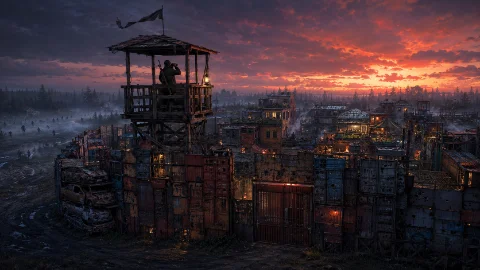
A wall built from repurposed shipping containers welded together in three days says a community formed under immediate threat and never had time to make it pretty. A wall of stone reinforced with rebar, with a proper gatehouse and a working portcullis, says these people have been here for years and expect to be here for many more. A wall made of cars stacked and chained together, half-buried in dirt on the outside, says the settlement learned the hard way that shamblers pile up against solid surfaces and the pressure eventually pushes through.
Every wall should answer three questions on the page without stating them aloud. When was it built. What was it built to stop. And what has already tried to come over it.
The scars on the wall are the settlement's autobiography. Bullet holes in the outer plating tell a story about a raider clan. Bite marks on the wooden inner braces tell a story about a breach. A patched section that looks newer than the rest tells the reader that whatever happened there, no one wants to talk about it. Let the wall speak first. Your characters will have plenty to say later.
The Watchtower Produces the Best Protagonists
If you are looking for the character with the most story potential in a fortified settlement, look up.
The watchtower guard is the one person in the community whose job is to see. They see the horde coming before anyone else. They see the wanderers approaching the gate. They see the smoke on the horizon that the council has not been told about yet. They see the couple sneaking out at night for reasons they can guess. And they see the first sign of infection in the shoulder of a returning scavenger before the scavenger sees it themselves.
This position creates a natural moral engine. The watchtower guard is constantly in possession of information the community has not yet processed. Every shift produces a small decision. Do I ring the bell now, or do I wait until I am sure. Do I report what I saw, or do I let the family have one more night. Do I shoot the runner outside the wall, or do I trust the medic to make the call.
If you want a zombie protagonist who does more than survive, put them in the tower. Give them binoculars, a radio, and a rifle they hope not to use, and let the story unfold in the space between what they see and what they choose to say.
The Gate Is Where the Story Actually Happens
Walls do not have doors by accident. Every settlement in your world has to open at some point, and the gate is where every important scene in your book will eventually be set.
Someone has to go out for water. Someone has to come back with news. A stranger arrives asking for shelter. A child sneaks in from a nearby ruin, and no one can prove where they were bitten. A trusted member of the community returns from a supply run alone, and the mission departed with four.
The gate is a stage, and the protocols around it are the choreography. Write those protocols into your setting early. How many people must be present to open the outer door. How long must a returning scavenger stand in the airlock while a medic examines them. What happens if a family member refuses to comply. Who has the authority to override the protocol, and who has the authority to override that override.
Once your protocols exist, the plot writes itself. Every scene at the gate becomes a small trial with rules the reader already understands, which means every violation of those rules will land like a hammer.
The Council Is Not the Villain, It Is the Wound
Zombie fiction has a lazy habit of turning settlement leadership into the real threat. The sheriff who has lost his mind. The doctor who has been running experiments. The mayor who is secretly hoarding food. These stories can work, but they miss a richer possibility.
The council of a functioning settlement is usually made up of decent people who have been forced to make indecent decisions for so long that the decisions have started to look like character. The nurse who authorized the mercy killing of six patients during the outbreak still sits on the council. The old teacher who voted to expel a family whose son turned inside the walls still sits on the council. The former sergeant who executed a beloved friend at the gate still sits on the council.
Their competence is the wound. They know how to do this because they have done it. Their protagonists trust them because the settlement is still standing, and their protagonists distrust them because the settlement is still standing.
Write your leadership as people who lost a piece of themselves to keep the community alive, and every meeting they hold will crackle. The horde outside is only ever half the story. The other half is the room where survival gets decided.
The Rules No One Prints on the Bulletin Board
Every fortified settlement runs on two sets of rules. The official ones are pinned to the noticeboard by the mess hall. Curfew begins at dusk. All returning personnel must report to Medical. No firearms may be discharged inside the walls except in defense of life.
The real rules are the ones no one writes down.
You do not use the word cure in front of anyone who lost family in the first year. You do not ask a scavenger what they had to do to come back with a full pack. You do not comment on the empty seat at the widow's table. You do not sing the songs from before at communal meals, because someone always cries and no one wants to explain why. You do not use children as lookouts, even though every settlement has, at least once, in an emergency.
Scatter three or four of these unwritten rules through your opening chapters and the reader will feel a culture that has been living this way for years. Then, when your protagonist violates one, you will not need to explain the reaction. The whole room will know, and so will the reader.
The Horde Is a Season, Not an Enemy
Here is the counterintuitive craft point. The infected themselves should feel less like antagonists and more like a climate.
A settlement that has been fortified for three years does not panic every time a shambler stumbles out of the treeline. They have a protocol. Someone in the tower marks it, someone at the gate handles it, and the community continues its evening meal. The horror is not the individual walker. The horror is the seasonal migration, the moment when the treeline produces not one shambler but two hundred, moving as a pressure front toward the wall.
Treat your infected the way apocalyptic fiction treats weather. There are calm days. There are storm warnings. There are years when the herd flows one direction and years when it flows another, and old-timers can tell you what it was like when the winter of the big push swept through and took out the north gate.
This gives your reader something more valuable than fear. It gives them dread. And dread is the emotion the genre was built for.
The Outside World Still Exists
The final layer, and the one many drafts forget, is that your settlement is not alone.
Somewhere out there, another wall is standing. Another watchtower is manned. Another council is meeting. When a wanderer arrives at your gate with news of a settlement three days east that has finally fallen, the horror is not just their fall. It is the knowledge that your settlement is now one closer to being the last.
Radios crackle occasionally. Bonfires burn on distant ridges as signals. A trader circuit still runs between two or three communities that trust each other enough to exchange antibiotics for ammunition. Someone in your settlement remembers a cousin they have not heard from in six months and cannot stop thinking about tonight.
The outside world gives your protagonist somewhere to go if the wall falls, and it gives your reader the sense that the story extends past the last page. That extension is what separates a survival story from a memorable one.
Building Your Own Fortified Settlement
Before you draft the first chapter of your zombie project, work through this quick checklist.
Design your wall as an autobiography. Describe how it was built, what it has survived, and where it has been patched.
Put a character in the watchtower and give them one piece of information every chapter that they have to decide whether to share.
Write the gate protocol in enough detail that your reader will feel every violation.
Give your council a shared wound they never speak about, and let it govern their votes.
Scatter three unwritten rules through the first act, and break one of them by the end of the second.
Treat the horde as weather, and the season of the big push as the storm your settlement has been quietly preparing for since page one.
The fortified settlement is the beating heart of zombie fiction. The dead are only the pressure that reveals it. Walls tell the reader who these people were forced to become. Watchtowers give you the eyes through which the story is best seen. Gates create the trials. Councils carry the wounds. Unwritten rules do the quiet work of culture. And beyond the wall, other settlements are burning bonfires the reader cannot quite see, but knows are there.
Write the wall first. Write the tower second. Trust the horde to arrive on schedule. The rules of the living are strict, but they are the reason your survivors are still alive, and the reason your readers will follow them all the way to the last patched section of the eastern wall.