The Indie Publishing Landscape Is Changing Faster Than Ever
If you are an indie author, you have probably noticed that the ground keeps shifting beneath your feet. What worked last year might not work this year. What feels like a sure thing today could be obsolete tomorrow. But here is the good news. Change brings opportunity. And 2027 is shaping up to be a year of massive opportunity for independent authors who know where to look.
Let us break down the biggest trends, shifts, and openings that every indie author should have on their radar.
Readers No Longer Care Who Publishes Your Book
Let us start with the most fundamental shift of all. Readers have stopped caring about whether a book is traditionally published or self-published. According to a recent survey of over 1,000 readers, a stunning 51 percent actively want to support indie authors, while only 17 percent still prefer traditionally published books. That is a seismic shift in reader behavior.
What do readers actually care about? The same survey found that 66 percent choose books based on genre or topic, and 46 percent rely heavily on personal recommendations. This means your book can compete with traditionally published titles if you clearly communicate its genre, themes, and emotional appeal. Clarity is becoming more valuable than marketing scale.
For indie authors, this is incredibly empowering. You no longer need a big publisher's stamp of approval to reach readers. You just need a great book and a clear way to tell people about it.
Direct Sales Are Exploding and Romance Is Leading the Way
One of the most exciting trends in indie publishing is the explosion of direct-to-reader sales. Authors are bypassing retailers entirely and selling books directly from their own websites. And this is not a niche trend. It is a structural shift in how publishing economics work.
Romance authors are leading this charge. The genre was perfectly positioned for this shift because romance readers are fiercely loyal, deeply invested in their favorite authors, and eager to support them directly. But what happens in romance rarely stays in romance. Other genres are already starting to follow.
Why does this matter for you? Direct sales offer higher margins, greater control over your pricing and promotions, and a closer relationship with your readers. The strongest model in 2026 and beyond is hybrid: combining direct-to-reader sales with traditional retailer listings to get the best of both worlds—the reach of platforms and the margins of direct.
If you have not started building your own direct sales channel yet, 2027 is the year to begin.
Audiobook Royalties Are Changing in a Big Way
The audiobook market continues to grow at a staggering pace. The global audiobook market was valued at about $11.18 billion in 2025 and is projected to reach approximately $14.15 billion in 2026. Some projections suggest it could exceed $35 billion by 2030. For indie authors, this represents a massive opportunity.
But there is a catch. Starting in 2027, Audible is ending its legacy royalty model for self-publishing authors and moving to a pooling royalty model. This means your royalties will be affected by how much an Audible member consumes in a month, rather than being based on a fixed percentage per sale. The audiobook world is starting to look a lot more like the music industry.
What does this mean for you? It means you need to pay attention to where and how you distribute your audiobooks. Spotify has entered the U.S. audiobook market and is changing the conversation around pricing and distribution. Indie authors now have more options than ever, with lower production barriers and more affordable audiobook services. The key is to diversify your distribution and not rely solely on Audible.
AI Tools Are Becoming Indispensable (If You Use Them Wisely)
Artificial intelligence is no longer a futuristic concept for indie authors. It is here, and it is becoming an essential part of the indie author toolkit. By 2027, experts expect tighter AI integration inside mainstream writing apps, along with more guardrails around copyright and plagiarism claims.
But here is the thing about AI. It is not about replacing your creativity. It is about amplifying it. Tools like Google's Gemini allow indie authors to conduct up-to-date market research, analyze trends, and write with a deep understanding of genre shifts and reader behavior. Other AI tools can help with drafting, editing, publishing, and marketing without losing your voice, originality, or standards.
The smartest indie authors are treating AI as an assistant, not a replacement. They are using it to write faster, publish more consistently, and build sustainable careers. But they are also being transparent about their use of AI, as more awards and platforms are requiring proper attribution. The authors who thrive in 2027 will be the ones who embrace AI ethically and strategically.
Kindle Unlimited Keeps Growing and So Does the Competition
Since January 2020, Amazon's Kindle Unlimited has paid out a cumulative $2.58 billion directly to self-publishers and small presses. Not to the Big Five. Not to literary agents. To independent authors. In cash. Every month. Without fail.
The monthly payout in January 2020 stood at $28.2 million. In February 2026, it stood at $58.3 million—a 107 percent increase in just over six years. Six years. Six annual records. Kindle Unlimited is not going anywhere.
But the competition is fiercer than ever. Amazon's algorithm now prioritizes engagement over page sales. Page reads matter more than purchase counts. Kindle Unlimited authors are winning because Amazon rewards engagement, not just transactions. This means series strategy is now critical. Hook readers with book one, often priced low or enrolled in KU, and retain them through the series.
Some authors are reevaluating their relationship with Kindle Unlimited due to shifting sales patterns and concerns about piracy. Others are choosing to go wide, distributing across multiple platforms to maximize direct sales revenue. There is no one right answer. The key is to understand the data and make strategic choices based on your specific situation.
Traditional Publishers Are Coming to You
Here is a trend that would have been unthinkable a decade ago. Traditional publishers are actively courting successful indie authors. In July 2026, Simon & Schuster announced it would relaunch its Pocket Books imprint specifically to sign self-published authors to print deals. The imprint expects to launch two to three titles per month starting in January 2027.
This is not an isolated case. Numerous other publishers have tried this approach of moving self-published stars, most of them ebook authors, to print, with companies like Sourcebooks and Zando enjoying huge success. The reimagined Pocket Books will focus on romance, romantic thrillers, dark romance, and horror, with standard trade paperback sizing and traditional pricing.
What does this mean for indie authors? It means that building a successful indie career can now be a pathway to a traditional print deal, not a replacement for one. You no longer have to choose between indie and traditional. You can start indie, build an audience, and then leverage that success into a partnership with a major publisher.
Community-Driven Discovery Is Replacing Corporate Marketing
Readers are increasingly relying on recommendations from online communities rather than corporate marketing campaigns. Physical bookstores still hold influence, with around 50 percent of readers discovering books through them. But younger readers are changing how books gain visibility. Forty percent of Gen Z readers discover books through social media, and 35 percent of Millennials find their next read online.
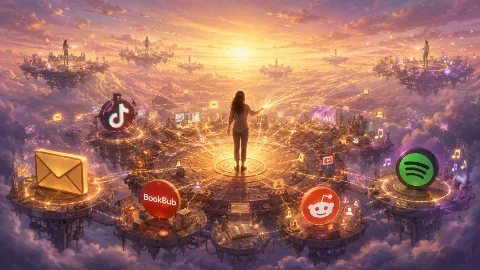
Platforms like TikTok, Instagram, YouTube, and online book communities are now powerful discovery engines. TikTok's #BookTok community has been responsible for driving thousands of book sales, including many indie titles. TikTok's algorithm pushes book content to readers who do not follow you yet, making it uniquely suited for authors trying to reach new audiences without an advertising budget.
For indie authors, this is incredibly important. Traditional publishing relies heavily on distribution networks. Self-publishing thrives through community connection and digital visibility. Social media is not just promotion anymore. It is becoming part of the publishing ecosystem itself.
Special Editions and Collectibles Are Gaining Momentum
Another trend worth watching is the rise of special editions and collectible print formats. Hardbacks and collector's editions are gaining momentum. Readers want ownership, not just access. They want something physical and beautiful to add to their shelves.
This presents a unique opportunity for indie authors. You can create premium editions of your books—signed copies, special covers, sprayed edges, illustrated editions—and sell them directly to your most devoted readers. These high-margin products can become a significant revenue stream and a way to deepen your connection with your audience.
Diversification Is No Longer Optional
If there is one theme that runs through all of these trends, it is diversification. The old success maps are breaking down. The authors who will thrive in 2027 are not the ones with a single strategy. They are the ones who blend multiple revenue streams, multiple formats, and multiple platforms.
More than 80 percent of indie authors now run their own websites with direct sales in mind. Those who diversified across formats and geographies substantially outperformed those who relied on a single channel. Success hinges on strategic diversification: blending high-margin direct sales, premium special editions, ethical AI use, and reader-centric marketing.
What This Means for You in 2027
The indie publishing landscape in 2027 is more complex than ever, but it is also more opportunity-rich than ever. Readers are actively seeking out indie authors. Direct sales are putting more money in authors' pockets. AI tools are making production faster and more efficient. Traditional publishers are opening their doors to indie talent. And community-driven discovery is leveling the playing field.
The authors who will succeed in 2027 are the ones who stay informed, stay flexible, and stay focused on what matters most: writing great books and connecting with readers. The opportunities are there. The question is whether you are ready to seize them.