In the initial years of the undead apocalypse, humanity fought the infected with desperate, reactive violence relying on bullet counts, explosive walls, and chaotic retreats. However, attrition always favored the dead. The turning point for human survival came when military engineers and urban planners stopped treating the undead as monsters and began treating them as a highly predictable fluid dynamics problem. Necro-Logistics is the clinical, macro-level science of managing infected populations, turning the terrifying threat of an extinction-level horde into a predictable traffic management issue.
The Physics of the Horde Fluid
The foundation of modern necro-logistics is the realization that a zombie horde possesses no individual agency. When numbers cross a critical threshold, the infected cease to behave as single predators and begin acting like an unstoppable, low-viscosity fluid driven by sensory input and gravity. They follow the path of least physical resistance, flowing down open city avenues, funneling into highway bottlenecks, and spilling over structural drops.
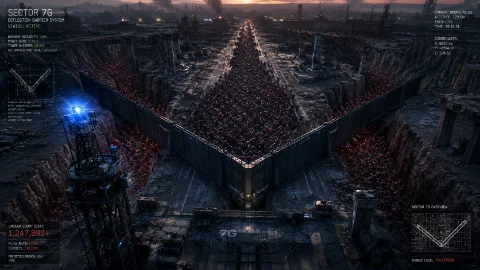
Logistics corps maps these migration corridors using real-time drone telemetry and seismic sensors anchored along major highways. By analyzing the flow rates of a specific horde, measuring how many infected pass a bottleneck per hour, logistics officers can predict exactly when a migratory column will hit a defensive perimeter. If a horde is left unmanaged, the fluid pressure will eventually crush any static concrete wall through sheer compressive mass. Therefore, modern defenses are never built to stop a horde; they are designed to keep it moving.
The Mechanics of Horde Redirection
To control a migratory column, settlement engineers deploy a sophisticated network of non-lethal infrastructure designed to steer the dead away from human populations without expending valuable ammunition.
Kinetic Deflection Barriers: Instead of building flat concrete walls that absorb the full impact of a head-on collision, engineers construct angled, steel-plated V-shaped barriers. These kinetic structures use the horde's own forward momentum against it, gently sliding the leading edge of the dead to the left or right, diverting the entire column down alternate, unpopulated service roads.
Acoustic and Visual Siphons: To draw a horde into an empty kill zone or a deep natural canyon, teams install automated sensory towers along the redirection route. These towers utilize high-decibel, low-frequency subwoofers that mimic the sound of heavy machinery or distant gunfire, pulling the auditory-driven dead along a pre-calculated path like a digital pied piper.
The Sluice Gate System: Major settlement perimeters are ringed with mechanical containment channels. If a wandering herd approaches the outer walls, operators open massive hydraulic steel gates to funnel a controllable fraction of the dead into isolated processing trenches. This pressure-valve system prevents the main defensive wall from being structurally overwhelmed.
The Math of the Migration Threshold
The true danger in necro-logistics is the phenomenon known as the Crossover Event. This occurs when two separate, mid-sized migratory columns collide and merge into a single, multi-million-headed mega-horde. Once a horde crosses this statistical threshold, its internal pressure becomes so immense that the dead at the center are crushed to death by their own companions, creating a rolling carpet of biological matter that can easily bypass standard kinetic barriers.
To prevent crossovers, logistics crews execute highly dangerous field operations to split approaching herds before they meet. Using low-altitude drone swarms or automated firework arrays, they introduce conflicting sensory cues to the flanks of a moving column, fracturing the mass into smaller, manageable fragments. It is a sterile, calculated game of planetary engineering where success is measured not in body counts, but in kilometers diverted, proving that the ultimate weapon against a zombie apocalypse is a clipboard, a map, and an ironclad understanding of fluid dynamics.