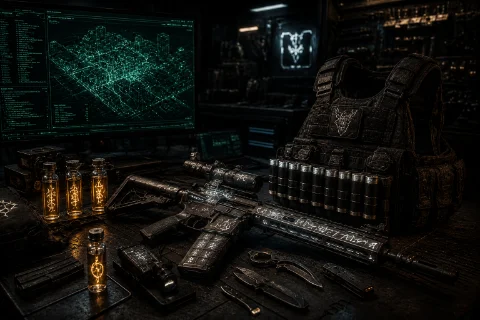
In a world where magic and monsters hide just behind the veil of everyday life, human survival relies on an invisible line of defense. The clandestine guilds of modern monster hunters are no longer disorganized bands of eccentric zealots operating out of van trunks. Today, they are highly professional, globally networked black-market enterprises. They treat the hunting of rogue supernatural entities with the cold efficiency of a corporate supply chain, balancing ancient combat traditions with cutting-edge tactical gear and specialized field medicine.
The Network of the Hunt: Bounties and the Dark Web
Modern hunting guilds operate out of sight from civilian law enforcement, utilizing encrypted dark-web networks to manage their global operations. These digital platforms function as an underground gig economy for lethal specialists.
The Ledger (The Bounty Board): Cryptorunes and deep-web servers host a highly secure, crowdsourced network of open contracts. When a rogue werewolf terrorizes a suburban district or a ghoul nest infests a subway line, anonymous clients—ranging from wealthy human politicians to the Arcane Council itself—post digital bounties. The payout is delivered in untraceable cryptocurrencies or rare magical materials like silver-infused steel or cold iron alloys.
The Handler Network: Hunters rarely interact with clients directly. Guild handlers act as the essential middlemen, verifying the authenticity of a contract, assessing the threat level of the target, and providing critical tactical intelligence, historical weaknesses, and satellite terrain mapping to the operational cells.
Operational Doctrine: Firepower and Field Alchemy
Taking down a supernatural predator requires a precise blend of human ingenuity, modern ballistics, and practical alchemy. Hunter cells are organized into tightly knit tactical units, with each member fulfilling a distinct operational role.
The Ballistics Specialist: These operatives manage the unit's armory, specializing in custom-engineered ammunition. Standard lead bullets are useless against the supernatural; instead, the specialist manufactures magazines loaded with specialized rounds, such as silver-jacketed hollow points for lycanthropes, UV-emitting phosphorus rounds for vampires, and salt-core breaching slugs for spectral entities.
The Field Alchemist: When a hunter is bitten or exposed to supernatural toxins, ordinary trauma kits will not save them. The alchemist utilizes modern pharmacology blended with traditional herbology to synthesize quick-acting anti-vampiric anti-venoms, silver-poisoning flush kits, and temporary sensory-enhancing stimulants that allow human eyes to track creatures moving at supernatural speeds.
The Archivist: Every hunt begins in the archives. The archivist scans local historical blueprints, municipal sewer layouts, and historical missing-persons data to identify a creature's nesting patterns and territorial habits before the tactical team ever steps foot into the hot zone.
The Law of the Blind: The Covert Cleanup
The absolute highest priority for any modern hunting guild is the total preservation of secrecy. If the human public ever discovers the true extent of the monster populace, global panic would fracture society, resulting in a chaotic, unpredictable war that humans might not win.
Because of this risk, a hunt is only considered successful if no one ever finds out it happened. Guilds employ specialized cleanup crews, colloquially known as the Erasers. Operating right alongside the active tactical teams, these units use industrial chemical washes to dissolve supernatural biological matter, deploy high-grade electromagnetic pulses to fry local security camera hard drives, and stage realistic cover stories—such as gas leaks, animal attacks, or structural fires—to satisfy local police departments and media outlets. To a guild, a sloppy hunter who leaves a visible corpse behind is just as dangerous as the monster they were hired to kill.