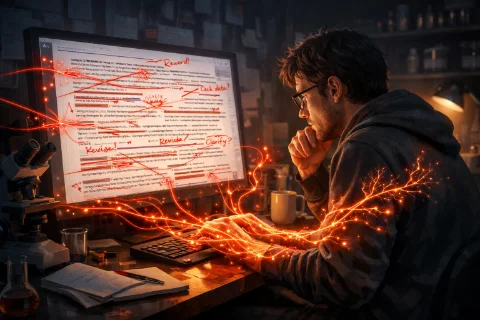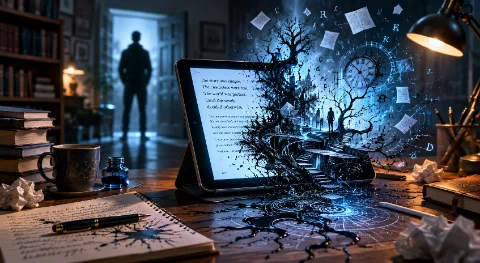
The act of reading is built on a quiet contract: the reader observes the characters from a safe, untouchable distance, completely isolated behind a glass screen or a paper border. However, when the text begins to look back, the security of that barrier dissolves entirely. The phenomenon known as the Marginalia Breach represents the total collapse of narrative layers, turning the very medium of storytelling into a site of active physical invasion.
The Anatomy of Font Corruption
The intrusion begins subtly, manifesting within the structural code of the text itself. The digital typeface ceases to obey standard typesetting guidelines, developing anomalous behaviors that mimic organic decay.
Saccadic Bleeding: Individual serifs on standard fonts stretch downward, forming sharp, vertical lines that pool at the bottom of the paragraph.
Kerning Collapse: The space between letters actively compresses, trapping words into unreadable, dense blocks of solid ink.
The Living Margin: Footnotes and marginal text begin to re-author themselves in real time, shifting from objective commentary to direct observations about your current physical posture.
When the typography of a screen begins to bleed outside its assigned boundaries, the reader is no longer dealing with a passive document, but an active intelligence.
The Screen Inversion Matrix
As the narrative breach deepens, the corruption migrates from the digital code to the physical hardware of the reading device.
[System Font Instability] ➔ [Real-Time Text Alteration] ➔ [Physical Screen Discoloration] ➔ [Anomalous Spatial Intrusion]
The user notices a faint smudge beneath the glass—a dark, wet spot that closely resembles fresh fountain pen ink. Wiping the exterior glass does nothing to clear the mark, as the liquid is actively pooling on the inside of the liquid crystal display. The ink spreads in direct correlation with the progression of the sentences, staining the user's fingers with dry graphite soot despite the lack of a physical book. The narrative is no longer merely describing a story; it is physically printing itself onto your immediate reality.
The Author in the Room
The terminal stage of a meta-fictional intrusion occurs when the reader realizes that the text has shifted from a monologue into a dialogue. The words on the screen begin to describe the exact room in which you are sitting, counting the number of steps between your chair and the door.
True terror is not the discovery of a fictional monster, but the realization that you are merely a character in a chapter that someone else is currently typing. The sound of a keyboard clicking behind you is not an echo from the hallway, but the author finalizing your last line.