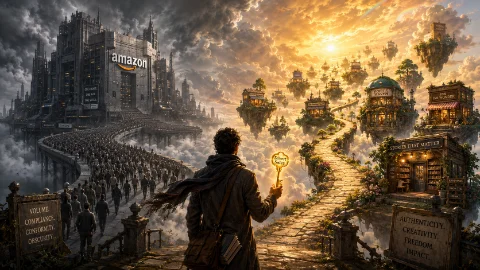
The Myth of the Marketing Budget
Walk into any indie author forum, join any Facebook group, or scroll through any publishing subreddit, and you will find the same conversation playing out on repeat. How much should I spend on Amazon ads? What is the best ROI for Facebook marketing? Should I hire a publicist? Is BookBub worth the investment?
The conventional wisdom is clear. To succeed as an indie author, you need a marketing budget. You need ads. You need a promotional strategy. You need to spend money to make money.
But here is the thing about conventional wisdom. It is often wrong.
There is a quieter, less glamorous, but equally powerful path to indie success. It does not involve ad spend. It does not involve promotional budgets. It does not involve hiring publicists or running complicated marketing campaigns. It involves something far simpler and far more sustainable: writing great books, publishing them consistently, and letting the readers do the rest.
The authors who have walked this path are not anomalies. They are not lucky accidents. They are proof that the most powerful marketing tool an indie author has is not a credit card. It is a completed manuscript. And another one after that. And another one after that.
Here are their stories.
Allen Levi: The 69-Year-Old Debut Who Became 2025's Breakout Hit
In the spring of 2025, something strange happened in the publishing industry. Word started to percolate about "the white book," a self-published novel with a stark, bright cover that was fast becoming one of the biggest sellers of the year. No one knew exactly how it had happened.
The book was "Theo of Golden." It had limited distribution and virtually no publicity or marketing campaign. Its author, Allen Levi, was a nearly 70-year-old man who lived alone on 1,600 acres of family land in Georgia, where he kept honeybees and a blog and posted homespun music videos. That was the extent of his social media footprint.
Levi did not run ads. He did not hire a publicist. He did not build a sophisticated email list or run a launch campaign. He wrote a book, published it, and let it find its own way into the world. And find its way it did.
"I'm writing a book, and it's making me crazy," Levi sang in one clip. The book may have made him crazy, but it also made him a bestselling author. Through nothing more than word-of-mouth, organic discovery, and the sheer power of a story that resonated with readers, "Theo of Golden" became a blockbuster.
The lesson from Allen Levi is simple but profound. You do not need to be young. You do not need to be a social media influencer. You do not need to spend money on marketing. You need a book that connects with readers and the patience to let word-of-mouth do its work. Word-of-mouth is the most powerful marketing force in publishing. It is also the slowest to start. But when it starts, nothing can stop it.
Will Wight: From Zero to a Million-Dollar Kickstarter
In 2013, Will Wight published his first book, "House of Blades," the first in his "Traveler's Gate" trilogy. He expected to sell a few copies to people he knew, friends, family, classmates. Instead, something unexpected happened.
By the time the second book was ready, that trickle of sales had become a flood. Wight sold a thousand copies of book two on release day. His hard work and devoted audience have kept him successfully independent for more than a decade.
Today, Wight is the author of twenty-six fantasy novels, including the beloved "Cradle" series. He has launched his own publishing company, Hidden Gnome Publishing, which has grown to include employees, contracts, and what he jokingly calls a Chief Office Gnome. He has run successful Kickstarter campaigns, including one for a "Cradle" animated feature that raised over a million dollars.
What is remarkable about Wight's journey is not just the scale of his success but how he achieved it. He did not have a marketing budget. He did not have industry connections. He simply wrote books, published them, and built a relationship with readers who loved what he created.
Wight's philosophy is telling. He knew to "treat every series like it's the first." He understood that each new book was an opportunity to reach new readers and deepen the loyalty of existing ones. He did not need ads. He needed consistency, quality, and patience.
Mark Dawson: The Thriller Writer Who Outsold Traditional Publishing
Mark Dawson is a British author best known for his John Milton thriller series, which has drawn comparisons to the works of Lee Child and Robert Ludlum. Before becoming a full-time writer, Dawson worked as a lawyer in London. His early attempts at traditional publishing did not yield success. Rather than giving up, he took control of his own career through self-publishing.
Today, Dawson has sold millions of copies worldwide and earns a seven-figure income from his books. His success has led to major opportunities, including a television adaptation of his John Milton series.
But here is the thing. Dawson did not achieve this through luck or a massive marketing budget. He achieved it through a combination of digital marketing, direct sales, and reader engagement. He built an email list of dedicated fans, regularly engaged with his audience, offered free novellas, and created an ongoing relationship that turned casual readers into loyal fans.
Dawson's approach was data-driven and strategic, but it did not require a massive upfront investment. It required time, effort, and a genuine commitment to connecting with readers. He writes what his readers love. Because he self-publishes, he can release books faster than traditional publishers, keeping his audience engaged and eager for more.
Dawson's story proves that you do not need a traditional publisher to succeed. You need readers. And you can build a readership without spending money on ads. You just have to be willing to put in the work.
Aman Jain: Building a 4.6 Crore Readership Through Independence
In India, Aman Jain is redefining independent publishing. He published his first book, "The Naked Highway," when he was eighteen, without the support of a literary agent or a major publishing house. The early success of the book demonstrated that independent publishing could function as a serious and sustainable pathway for writers outside the conventional literary system.
Rather than moving toward traditional publishing after his initial success, Jain continued working independently and gradually built a consistent readership over time. His readership has expanded gradually through word-of-mouth engagement, especially among younger readers and audiences outside metropolitan literary circles. This organic growth has become one of the defining features of his career, registering over 4.6 crores in sales so far.
Jain's books have found readers not only in major cities but also in smaller towns and regional communities where mainstream English-language publishing often has limited reach. He has built a loyal readership through consistency and long-term engagement rather than conventional literary promotion.
What is striking about Jain's journey is his commitment to independence. By working independently, he has remained involved not only in writing but also in decisions related to editing, publishing, distribution, and reader engagement. This approach has allowed him to build a direct relationship with his audience while preserving the tone and style of his storytelling without external editorial pressures.
Yarro Rai: Fifteen Years of Quiet Persistence
Yarro Rai is an Indian Nepali author who has reached Amazon's #1 Best Seller rank with his emotionally intense novel "Beyond Passion and Dreams". This achievement marks a major turning point for a writer who has spent nearly fifteen years building his presence far from the metropolitan literary centres of India.
Raised in a small tea-garden village along the mountains of Darjeeling, Rai has developed a body of work known for emotional depth, moral complexity, and quiet introspection. Since releasing his first poetry collection in 2013, he has published a total of twelve novels and five poetry collections. Each was written independently, often late at night after household responsibilities and a full-time day job.
Rai's rise did not come through influencer visibility, marketing budgets, or industry connections, but through persistent output and the loyalty of a steadily growing reader community. What sets his path apart is a challenge rarely spoken about openly: Rai is an extreme introvert, a temperament often at odds with today's social-media-driven literary landscape. He rarely appears in videos, avoids the spotlight, and relies instead on word-of-mouth and the strength of his writing.
In an era obsessed with virality, Rai remains committed to writing for "the jagged artist he harbours inside." "The only fear I have is that my book should not be hollow," Rai says. "It can be technically or grammatically bad, but it should never be hollow."
Rai's story is a testament to the power of persistence. Fifteen years. Seventeen books. No marketing budget. Just a quiet, steady commitment to the craft.
Alexis Rose: Making Money in Four Months
Alexis Rose left her job in January 2026 to publish her first fantasy novel independently. Just four months later, she was already making money from her books and building a growing fanbase.
Rose's success came from a strategic approach to self-publishing. She spent months preparing for the leap, writing one-and-a-half books during 2025 because she already knew she wanted to release them close together. Her books form a dark cosy fantasy duology.
Unlike traditional publishing, where readers can wait years between books, self-published authors often rely on "rapid release" schedules to keep audiences engaged. "In traditional publishing, there might be two years between books in a series," Rose explains. "But when you self-publish, readers expect new releases much faster."
Rose is adamant that speed should never come at the expense of quality. "This doesn't mean using AI to churn books out quickly," she says. "Platforms are already cracking down on low-quality AI content, and readers are turning away from authors who rely on it."
Rose's story proves that with the right strategy, consistency, and a commitment to quality, you can build a sustainable income as an indie author without a massive marketing budget.
The Jane Friedman Perspective: The Power of the Long Game
Jane Friedman, one of the most respected voices in publishing, has written extensively about the phenomenon of "silent bestsellers," books that quietly gain traction, slowly building an audience over time.
One indie author, Janee' Butterfield, experienced this firsthand. When she released her first suspense-thriller novel, she poured everything into marketing it, running Amazon ads, posting across social media, and telling every friend and family member. Sales came in, but not at the level she had dreamed of.
Then she published her second book, and something unexpected happened. Readers who discovered her second book went back and bought her first. By the time her third book was out, she had an actual readership, people waiting for her next book.
"One book is an introduction, but multiple books create momentum," Butterfield writes. "Even if your first release doesn't gain traction immediately, don't give up. Keep writing. Each new book is another opportunity for someone to discover your work."
She also discovered the power of Amazon's free promotion days. When she ran a free promo for her first book, a friend decided to host a book club discussion about it. That one small event sparked conversations, led to new reviews, and even brought in sales for her other books. "Giving away books for free might seem counterproductive, but it's one of the best ways to get readers invested."
The Organic Growth Movement: 233% More Visibility Without Spending a Dime
Indie authors who focus on organic promotion are achieving remarkable results. According to analysis of hundreds of book marketing campaigns, authors using organic promotion strategies are achieving 233% more visibility without spending a dime on advertising.
The most successful authors are not the ones spending the most on Facebook or Amazon ads. They are the ones building genuine communities, leveraging content marketing, and creating sustainable promotion systems that compound over time.
Authentic promotion is not about being humble or avoiding marketing. It is about the sequence. Authors who promote authentically build relationships before they make asks.
What These Stories Teach Us
The indie authors who built empires without marketing budgets share common threads.
First, they wrote consistently. Will Wight has twenty-six novels. Yarro Rai has seventeen books. Mark Dawson has built an entire series that spans multiple titles. Consistency creates momentum. Each new book is an opportunity for someone to discover your work.
Second, they focused on quality. Alexis Rose is adamant that speed should never come at the expense of quality. Yarro Rai's only fear is that his book "should not be hollow." Readers can tell when a book has been rushed. Quality builds trust.
Third, they let word-of-mouth work. Word-of-mouth is the most powerful marketing force in publishing. It is also the slowest to start. But when it starts, it creates a momentum that no advertising budget can match.
Fourth, they built relationships with readers. Mark Dawson built an email list and engaged with his audience. Aman Jain built a direct relationship with his readers. Will Wight built a devoted audience that has followed him for over a decade. Readers are not just customers. They are partners in your journey.
Fifth, they played the long game. Allen Levi was nearly seventy when he published his debut. Yarro Rai spent fifteen years building his career. Janee' Butterfield's readership grew book by book. Success in indie publishing rarely happens overnight. It happens through patience, persistence, and a willingness to keep going when the results are slow.
What This Means for You
If you are an indie author without a marketing budget, take heart. You are not at a disadvantage. You are in good company. Some of the most successful indie authors in the world built their careers without spending a dime on advertising.
The path is not glamorous. It is not fast. It does not involve viral moments or overnight success. But it is sustainable, it is authentic, and it works.
Write great books. Publish them consistently. Build relationships with your readers. Be patient. Let word-of-mouth do its work. And remember that the most powerful marketing tool you have is not a credit card. It is a completed manuscript.
And another one after that.
And another one after that.