
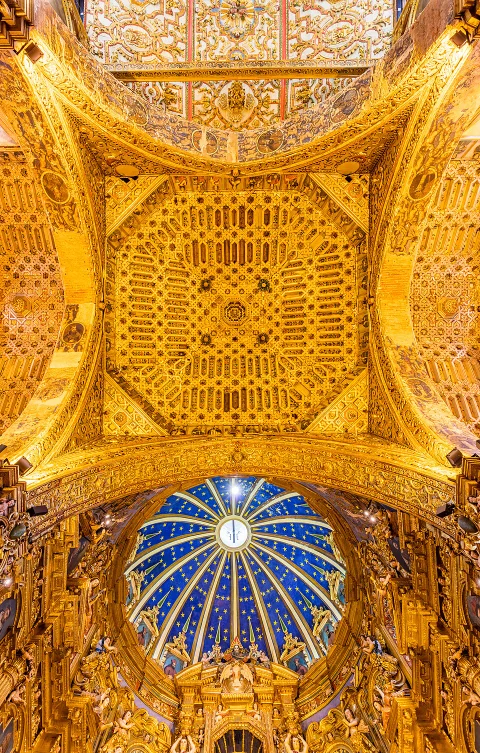
The Hidden Geometry Above Our Heads: The Secret Language of Mudéjar Ceilings
Discover the extraordinary craftsmanship, mathematical patterns, and cultural history concealed in the wooden ceilings of Spain and Ibero-America.
Imagine entering an old church, monastery, or palace.
You admire the walls, the arches, the columns, and the elaborate decorations surrounding you.
But then you look up.
Above your head, an extraordinary universe of interlacing lines, geometric stars, and meticulously assembled wooden elements unfolds across the ceiling.
What appears at first to be an intricate decorative pattern is actually the result of remarkable technical knowledge, mathematical precision, and centuries of artistic transmission.
Welcome to the fascinating world of Mudéjar wooden ceilings.
When Architecture Becomes Geometry
Among the most distinctive features of Mudéjar-related architecture are its sophisticated wooden ceilings, often associated with the tradition known as carpintería de lo blanco.
These structures demonstrate the extraordinary abilities of carpenters who combined construction techniques with geometric design.
Some ceilings incorporate complex interlacing patterns known as lacería, in which repeated lines form stars, polygons, and other interconnected shapes.
The visual result can be mesmerizing.
Patterns appear to extend endlessly, creating a sense of movement and mathematical harmony.
Yet these designs were not simply painted onto a flat surface.
Many were created through the precise cutting, fitting, and assembly of individual wooden components.
Geometry became both an artistic language and a practical tool of construction.
The Craftsmen Behind the Patterns
The production of elaborate wooden ceilings required specialized knowledge.
Carpenters needed to understand proportions, angles, measurements, structural relationships, and the behavior of wood.
Their skills were developed and transmitted through workshops, apprenticeships, and established building traditions.
In medieval Iberia, these techniques evolved within a complex environment of artistic exchange involving Islamic and Christian architectural cultures.
Under Christian patronage, craftsmen continued to employ and adapt technical and decorative practices associated with earlier Andalusi traditions.
The resulting works demonstrate how artistic knowledge could survive political transformations and acquire new meanings.
Behind every geometric composition stood not only an artistic vision, but also generations of accumulated expertise.
What Makes These Ceilings So Extraordinary?
One of the most fascinating aspects of Mudéjar carpentry is the relationship between structural design and ornamentation.
Wooden ceilings could take different forms, from relatively simple beam arrangements to elaborate pitched structures with richly decorated surfaces.
Some featured geometric interlacing, while others incorporated painted motifs, heraldic symbols, or additional ornamental elements.
The term artesonado is frequently used to describe decorative wooden ceilings, although it is important to distinguish between different structural and artistic types.
Not every historic wooden ceiling belongs to the same technical tradition.
What connects many of these examples is the remarkable integration of craftsmanship, geometry, and architectural design.
They invite us to recognize carpentry as an intellectual and artistic achievement rather than merely a construction trade.
A Language That Crossed Religious Boundaries
The history of these ceilings also challenges simplified assumptions about cultural identity.
Artistic techniques associated with Islamic Iberia continued to appear in buildings commissioned by Christian patrons.
Churches, monasteries, royal residences, and private houses could incorporate decorative systems rooted in earlier artistic traditions.
Their use did not necessarily indicate the religious identity of the building's occupants.
Instead, these ceilings reveal how technical expertise and aesthetic preferences circulated across political and religious boundaries.
Such exchanges took place within societies marked by both cultural interaction and profound inequalities.
The resulting architecture reflects adaptation, patronage, skilled labor, and changing relationships of power.
From Medieval Spain to the Americas
The history of these wooden ceilings did not end in the Iberian Peninsula.
Following Spanish expansion across the Atlantic, architectural knowledge and construction practices traveled to the Americas.
Wooden roofing traditions, decorative carpentry, and geometric ornamentation became part of the architectural repertoire of colonial societies.
However, these techniques were not simply reproduced without modification.
In different regions of Spanish America, local materials, available resources, Indigenous craftsmanship, and new building requirements contributed to their transformation.
The architectural heritage that emerged was therefore the result of multiple interactions.
European-derived techniques encountered local knowledge and new conditions of production.
This process helps explain why Mudéjar-related artistic traditions became part of a much broader Ibero-American architectural history.
Why Preservation Matters
Historic wooden ceilings are especially vulnerable to deterioration.
Humidity, insects, structural alterations, fire, and inadequate restoration can threaten their survival.
In some cases, later renovations have concealed original wooden structures beneath newer ceilings.
Their preservation requires more than admiration for their visual beauty.
It also demands an understanding of traditional construction techniques, materials, and historical contexts.
Every surviving ceiling preserves evidence of technical knowledge that might otherwise disappear.
Protecting these works means safeguarding both artistic heritage and the history of the people who created it.
The Secret Above Our Heads
Mudéjar wooden ceilings remind us that architecture contains stories that are not always immediately visible.
Their geometric patterns speak of mathematical reasoning, specialized craftsmanship, and the movement of artistic knowledge across societies.
Their survival also reveals how cultural traditions can be transformed and reinterpreted over centuries.
From medieval Iberia to Ibero-America, these extraordinary structures form part of a history of artistic continuity and innovation.
And perhaps their most important lesson is a simple one:
Sometimes, the greatest architectural discoveries begin when we stop looking straight ahead—and look up.
Discover More
This article concludes a five-part series exploring the architectural connections behind Our Secret Geometry: A Fascinating Journey through Ibero-American Mudéjar Art, by Monserrat Díaz Ortega.
Explore the book and watch its trailer:
Monserrat Díaz Ortega
Independent Researcher and Author | International Relations, Art History and Cultural Heritage