The first time I heard the term “psychic distance,” I was sitting in a draughty community centre at a writing workshop I’d almost skipped. The tutor, a novelist with kind eyes and a no-nonsense manner, drew a simple line on the whiteboard. At one end, she wrote, “A million miles away.” At the other, “Inside the character’s bloodstream.” Then she read the same scene at five different points along that line, and I felt the prose physically shift. The words barely changed. The distance did. And that distance changed everything.
That was the day I understood that psychic distance, also called narrative distance, is the invisible dial that controls how close the reader feels to a character’s inner experience. It’s not about first person versus third person. It’s not about tense. It’s about the granular, moment-by-moment decision of how deep into a character’s consciousness you allow the reader to sink.
When you learn to control this dial intentionally, you stop writing scenes that feel uniformly distant or claustrophobically close. You start writing with a cinematographer’s eye, choosing exactly how intimate or expansive each moment needs to be. This guide is about how to find that dial, how to turn it, and how to use narrative distance control to make your fiction unforgettable.
What Is Psychic Distance? (And Why It’s Not Just Point of View)
Writers often confuse psychic distance with point of view. But the point of view is the who is telling the story, whose eyes we’re looking through. Psychic distance is the degree of closeness or nearness we have to that person’s thoughts, sensations, and raw consciousness.
You can write in a close third-person point of view and still keep the reader at arm’s length. You can write in an omniscient point of view and, in certain moments, plunge the reader directly into a character’s racing heart. The dial is independent of the perspective choice, and it can be adjusted sentence by sentence, paragraph by paragraph.
John Gardner, in his classic craft book The Art of Fiction, described psychic distance as a spectrum. At one end, the reader is looking down on the character from a great height. At the other, the reader is inside the character’s skin. Most fiction lives somewhere in between, shifting constantly, often without the writer being aware of it. Becoming conscious of how close should your reader get is what separates intuitive writing from masterful craft.
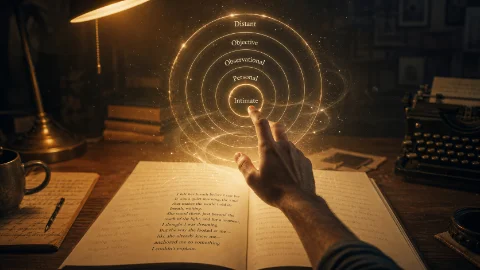
The Five Levels of Psychic Distance (With Examples)
To make this tangible, let’s walk a single moment through five levels of psychic distance, from most distant to most intimate. The scenario: a woman, Elena, has just received a letter that upends her life.
Level 1: The Satellite View
In the year 1842, a woman in the village of Thornwood received a letter that would alter the course of her family’s history.
The reader is in the stratosphere. We’re being told about the event, not living it. This is the distance of history, of legend, of omniscient narrators who see the whole sweep of time.
Level 2: The Observational View
Elena sat at the kitchen table and opened the envelope. Her hands were steady, but her lips were pressed thin.
The reader is watching from across the room. We see actions and external details. We might infer emotion, but we’re not inside it. This is the distance of a camera, not a consciousness.
Level 3: The Psychological View
Elena read the first line of the letter and felt a cold weight settle in her stomach. It was worse than she’d feared. Much worse.
We’re entering her internal experience named emotions, a sense of her thoughts, but the narrator is still mediating. There’s a slight glass wall between reader and character.
Level 4: The Interior View
The letter trembled in her hands. So it was true. All those months of telling herself she was being paranoid, that he would never, and here was the proof in ink that smelled faintly of his study. The cold crept from her stomach up into her throat until she couldn’t swallow.
The glass is gone. The narration has absorbed Elena’s voice, her specific thoughts, her physical sensations. We’re not being told she’s upset; we’re experiencing her upset from the inside. This is deep psychic distance, and it’s the level that creates that “can’t put it down” grip.
Level 5: The Stream of Consciousness
cold hands ink smell liar liar liar she’d known she’d always known why did she pretend the paper tearing she hadn’t meant to tear it but her fingers were fists now and the bird outside was still singing how dare it sing
At the extreme close end, we’re in raw, unfiltered consciousness. Syntax fragments. Sensations blur. The narrator has disappeared entirely. This level is powerful but exhausting; few novels sustain it for long.
Why the Dial Matters More Than a Single Distance
When I first discovered psychic distance, my instinct was to go deep and stay deep. I thought intimacy was always the goal. But I was wrong. Constant extreme closeness can suffocate a reader, just as constant distance can bore them. The magic is in the movement.
Think of the dial as a camera. A film that’s all close-ups feels claustrophobic and loses context. A film that’s all wide shots feels cold and uninvolving. The director’s art is in choosing when to push in and when to pull back. Fiction works the same way.
A battle scene might benefit from the wide shot, the sweep of armies, the geography of the field, before zooming into a single soldier’s terror. A love scene might start with the nervous small talk (observational distance) and then, as the characters finally touch, plunge into interior sensation so intimate the reader forgets to breathe. A revelation scene might earn its power by pulling all the way into stream of consciousness at the exact moment of impact.
Narrative distance control is the writer’s ability to make these shifts feel seamless and intentional rather than random. When done well, the reader doesn’t notice the dial moving. They just feel the story’s rhythms like a heartbeat, accelerating and easing in all the right places.
How to Practise Moving the Dial Intentionally
Here are exercises that helped me develop conscious control over psychic distance, rather than leaving it to instinct alone.
1. The Single-Scene Zoom. Take a scene you’ve already drafted and rewrite it three times. First, stay entirely at Level 1 or 2 distant, observational, no inner thoughts. Then rewrite it hovering at Level 4 deep interiority, character voice saturating the prose. Finally, write a version that starts wide, zooms in at the key emotional moment, and pulls back slightly at the end. Compare. Which version breathes best?
2. The Cinematic Study. Watch a film scene that moves you and pay attention to the camera. When does it go wide? When does it push into a tight close-up? Transcribe the emotional arc of those visual choices into a written scene, using psychic distance as your camera. This exercise bridges visual storytelling and prose in a way that clicks for many writers.
3. Mark Your Manuscript. Print a chapter and use coloured highlighters to code the psychic distance of each paragraph. Green for observational, yellow for psychological, pink for deep interior, red for stream of consciousness. Look at the pattern. Are you stuck in one colour? Are your emotional climaxes landing at the same distance as your transitions? The visual feedback is revelatory.
4. Read with the Dial in Mind. Pick up a novel you love and read five pages watching only for psychic distance. Notice where the author pushes in. Notice where they pull back. Notice how the shifts align with the emotional rhythm of the story. You’ll never read the same way again.
Common Mistakes (And How I’ve Made All of Them)
The flatline. The whole novel is written at one distance, usually Level 2 or 3. The reader never feels bored exactly, but never feels gripped either. The fix: identify your emotional high points and deliberately push the dial deeper. The contrast creates shape.
The whiplash. The distance shifts jarringly one sentence is distant omniscience, the next is deep interior, with no transition. The reader feels unmoored. The fix: use gradual zooming. Move from observational to psychological to interior over a few sentences, letting the reader’s immersion deepen naturally.
The false intimacy. The writer tries to go deep but stays at the level of named emotions (“She felt devastated, betrayed, utterly alone”) rather than rendering the visceral, specific experience of those emotions. The fix: ask yourself what devastated feels like in this character’s body, in this moment. Write that, not the label.
The accidental distance at the wrong moment. A character receives life-shattering news and the prose stays cool and observational. The reader feels cheated out of the emotional experience. The fix: scan your scenes for high-stakes moments and check whether your psychic distance is matching the emotional intensity.
Why Indie Authors Should Master This Dial
Traditional publishing often smooths out psychic distance shifts in the editing process, sometimes in ways that flatten a book’s unique rhythms. Indie authors, by contrast, have full control over their prose. We can make bold choices, zoom in mercilessly, pull back for breathtaking wide shots, and craft narrative distance as a signature of our voice.
In our Indie Reading Community, I’ve seen members transform their fiction by understanding this single concept. A writer shared a before-and-after passage where adjusting the psychic distance at the climax turned a “nice scene” into one that left the beta readers in tears. Another member confessed they’d been writing at Level 2 for years and never understood why readers said their characters felt distant. The dial changed everything.
If you’ve ever felt like your prose is missing an invisible ingredient, psychic distance might be it. It’s the difference between a story that’s watched and a story that’s lived.
The Dial Is in Your Hands
The beautiful thing about psychic distance is that you’re already using it. Every sentence you write sits somewhere on the spectrum between satellite and bloodstream. The question is whether you’re choosing consciously or leaving it to chance. Conscious choice is power. It’s the ability to make a reader feel exactly what you want them to feel, exactly when you want them to feel it.
So start paying attention. Notice where your dial is set in every scene. Experiment with closeness. Take your reader by the hand and pull them in, then push them gently back so they can breathe. That rhythm, the ebb and flow of intimacy, is the hidden architecture of immersive fiction.
Now I want to hear from you: Have you ever read a passage that felt so close it was almost uncomfortable in the best way? Or have you realized, in retrospect, that you’ve been writing at a single psychic distance for years? Share your experiences and your “aha” moments in the comments. Let’s learn to turn the dial together, one scene at a time.