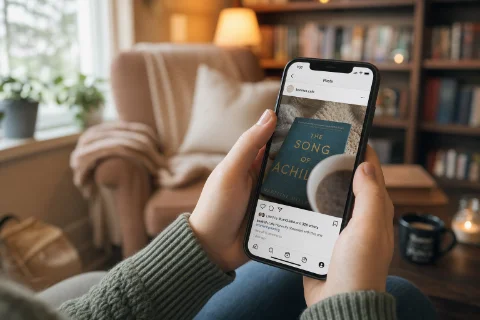
You finally have the cover. After months of waiting, it's done, and it's good, maybe the best one you've had. The temptation is to post it the moment it lands in your inbox, because you're excited and you want everyone else to feel that excitement too.
That instinct is exactly what flattens most cover reveals. The image goes up, gets a flurry of likes for a day, and then disappears into the scroll along with everything else posted that week. By the time the book actually launches, the reveal is old news and nobody remembers it happened.
A cover reveal that builds real anticipation isn't really about the cover at all. It's about the timeline around it, the slow build that makes people want to see it before they've seen it.
Why Most Reveals Peak Too Early
The standard approach is to treat the reveal as a single event. Announce a date, post the cover on that date, thank everyone for their kind comments, then move on. The problem with this structure is that it has nowhere to go. All the energy is spent in one post, and once that post has been seen, there's no reason left to keep talking about it.
Anticipation needs somewhere to grow. A single reveal gives readers a moment of interest and then immediately closes the door on it. There's no waiting involved, so there's nothing to be anticipating by the time the cover actually appears.
The Timeline That Works Instead
A reveal that builds real anticipation usually runs across two to three weeks, broken into distinct stages rather than one big moment. Each stage gives people a little more information while still withholding the thing they actually want to see.
Stage one: the announcement without the image. Roughly two to three weeks out, let people know a reveal is coming, without showing anything yet. This can be as simple as mentioning that you've just seen the final cover and you're not quite ready to share it, or that something about the new book is going to surprise people once they see it. The goal here isn't information, it's planting the idea that something is coming.
Stage two: a fragment, not the whole picture. About a week before the reveal, share a small piece of the cover rather than the full image. This might be a close-up of a single object, a texture, or a colour palette, cropped tightly enough that it doesn't give the composition away. People will guess, comment, and speculate, which does more for engagement than the full image ever could on its own.
Stage three: a hint at the story behind the cover. A few days before the reveal, share something about why the cover looks the way it does. Perhaps a detail from the book that the designer picked up on, or the reasoning behind a particular colour or symbol. This adds meaning to an image people still haven't fully seen, so that when they finally do see it, they're not just looking at a picture, they're looking at a payoff.
Stage four: the reveal itself. When the full cover finally goes up, it lands with more weight because people have been led there deliberately. This is also the point to make the next step obvious, whether that's a pre-order link, a release date, or simply an invitation to share their first reaction.
Stage five: the quiet follow-up. A day or two after the reveal, share something small that came out of it. A favourite comment, a piece of fan art, or your own honest reaction to finally seeing it out in the world. This stretches the moment a little further without overstaying it.
Why the Fragment Stage Matters Most
Of all these stages, the fragment is the one most authors skip, and it's usually the one doing the most work. A full image satisfies curiosity immediately. A fragment creates a small itch that can only be scratched by paying attention to what comes next.
This is also where a slightly odd detail helps more than a polished one. A close-up of a strange shape or an unusual colour invites questions in a way that a neat, recognisable crop doesn't. People comment to guess what they're looking at, and every comment puts your post in front of more people who haven't seen it yet.
What Noise Looks Like by Comparison
Noise is what happens when every post says roughly the same thing in roughly the same way. Reveal day tomorrow. Reveal day today. Here's the cover. Thanks everyone. Each post asks for attention without giving anything new in return, so engagement drops a little more each time.
Anticipation, by contrast, gives people a reason to keep checking back. Each post reveals slightly more than the last, which means each one earns its own moment of interest rather than competing with the others for the same one.
Adjusting the Timeline for a Smaller Following
If your audience is still small, the same structure works, just compressed. A week-long version still uses the same stages: announce, fragment, story, reveal, follow-up, simply spaced a few days apart instead of weeks. What matters isn't the length of the timeline, it's that there's a sequence at all, rather than one single post asking for attention all on its own.
The Part Worth Remembering
A cover reveal isn't really about showing people a picture. It's about giving them a reason to want to see it before they do. The image will do its job once it's in front of people. The timeline's job is to make sure more people are actually looking when it gets there.