You spend a whole Saturday at a book fair, a signing, or a library talk. It takes real effort, travel, setup, the actual hours of standing or sitting and talking to people. Then, by Sunday, you've posted one tired photo with a short caption thanking everyone for coming, and that's it. The event is over, and so, almost immediately, is its presence anywhere online.
That single post is a small return for a full day of effort. Most events generate far more usable content than authors realise in the moment, simply because everything that happened is still fresh on the day itself and easy to overlook as "just the event" rather than as a week's worth of material waiting to be used.
Why One Post Undersells the Day
A single recap post asks an entire day's worth of moments, conversations, and small details to be summed up in one image and a few lines of text. Almost everything else that happened, the odd question someone asked, the moment you nearly ran out of stock, the person who told you your book reminded them of their grandmother, gets lost simply because there was never a plan to use it beyond that first post.
Spreading the same event across a week doesn't mean inventing extra content from nothing. It means recognising that a single day already contains enough material for several distinct posts, each capturing a different angle rather than trying to capture everything at once.
Mapping a Week from a Single Day
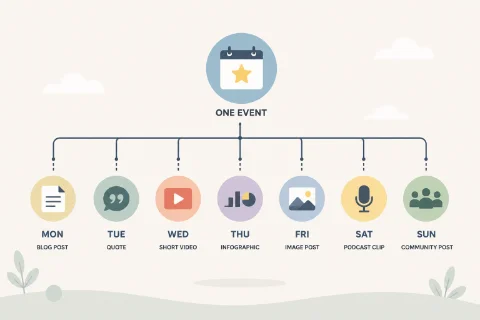
The day before: the anticipation post. Before the event even happens, a short post about what you're preparing, nervous excitement about an upcoming signing, a peek at how you're setting up your table, gives people a reason to think about the event before it's even occurred, and gives you content that exists entirely outside the event itself.
Day one: the moment, not the summary. Rather than trying to capture the whole event in one post immediately afterwards, share a single specific moment. One photo, one short story about something that happened, rather than a broad recap trying to cover everything at once.
Day two: the detail nobody would expect. Every event has at least one slightly odd or unexpected detail, a question you didn't anticipate, a coincidence, something a reader said that stuck with you. A short post built entirely around that one detail tends to perform better than a generic thank-you post, because it offers something specific rather than something generic.
Day three: a behind-the-scenes look. Share something about the preparation or the setup that people don't usually see, how you chose what books to bring, the slightly chaotic process of printing signs the night before, anything that pulls back the curtain a little on the work behind the polished version people saw on the day.
Day four: a reader's reaction, with permission. If someone said something memorable about your book during the event, and they're comfortable with it being shared, a short post quoting or describing their reaction gives the week a piece of social proof that a generic recap never could.
Day five: a lesson or reflection. A short, honest post about something you learned from the event, what you'd do differently next time, what surprised you about how the day went, adds a layer of genuine reflection that tends to resonate more than another straightforward photo.
Day six or seven: the thank you, done properly. By now, you've already shared several genuine moments from the event. A closing thank-you post, this time with more specific detail than a generic "thanks for coming," gives the week a clear finish while tying back to everything you've already shared.
Capturing the Material on the Day Itself
None of this works without gathering raw material during the event, not just after it. Take more photos than you think you'll need, including a few candid, slightly imperfect ones rather than only polished shots. Jot down a quick note on your phone whenever something interesting happens, a comment, a question, a small detail, since these moments are easy to forget within a day or two once the event has passed.
Why Spacing It Out Works Better Than Posting It All at Once
Posting everything from the event in one long carousel or one detailed recap might feel efficient, but it asks your audience to absorb everything at once, and most people will only properly engage with the first piece they see before scrolling on. Spreading the same material across a week gives each piece its own moment to be noticed, rather than competing with several others for attention within the same post.
It also keeps your event present in people's feeds for longer than a single afternoon, which matters more than it might seem. Someone who missed the original post on the day might still catch the behind-the-scenes piece three days later, giving the event a second or third chance to be seen by people who never noticed it the first time.
The Part Worth Remembering
An event doesn't end when you pack up the table. It ends when you've finished using everything it gave you, and most events give you far more than a single recap post can hold. Treating the day as a source of a week's worth of content, rather than a single moment to summarise, makes the effort of showing up worth considerably more than it would be otherwise.