Every good dystopia begins with a question the reader is not supposed to ask aloud: who is watching, and what does the watching cost?
The best writers in the genre understand that surveillance is not a plot device. It is a climate. It settles into the walls, the routines, and the small decisions a character makes before breakfast. Long before a boot kicks down a door, the reader should already feel the pressure of eyes that never blink. That pressure is what turns a story about oppression into a story readers cannot put down.
This guide walks through the architecture of the watched life. We will look at how surveillance becomes ritual, how buildings themselves become instruments of control, and how you can layer these elements into your own dystopian fiction without ever slipping into lecture mode.
The Original Panopticon and Why It Still Matters
The panopticon was a prison design proposed in the late eighteenth century by the philosopher Jeremy Bentham. A single guard tower sat at the center of a ring of cells. The prisoners could never tell whether the tower was occupied. They only knew it might be. Over time, they policed themselves.
The design was rarely built, but the idea became one of the most important metaphors in modern political thought. What matters is not the certainty of being watched. What matters is the possibility. That possibility is enough to reshape behavior, speech, and eventually the private thoughts a person is willing to have.
Every dystopian writer inherits this insight. The concrete panopticon is the modern version, and it does not need a central tower. It uses cameras, biometric scanners, neighborhood informants, algorithmic scoring, and the ordinary architecture of a city that has been redesigned around the act of watching.
Surveillance as Ritual, Not Event
Amateur dystopian fiction treats surveillance as a scene. A protagonist gets caught. Alarms sound. A chase begins. It is not wrong, but it misses the deeper machinery.
In strong dystopian writing, surveillance is a ritual repeated so many times a day that no one remembers when it started. Consider the small liturgies that make the watched life bearable:
The morning verification. A citizen presses their palm to a plate before the front door will unlock from the inside. The plate glows green. The day may begin.
The transit litany. Boarding public transport requires speaking one's name and destination aloud to a listening panel. The panel does not respond. It simply records. Passengers have learned to enunciate.
The evening review. Before bed, a household screen displays the day's compliance score. Green stars for behavior deemed cooperative. Amber flags for anomalies. A family that ends the day amber knows to speak more quietly tomorrow.
None of these moments contain drama on their own. That is exactly why they work. When surveillance becomes ritual, the reader absorbs the world's rules without being taught them, and the moment your protagonist finally breaks a ritual, the tension detonates.
The Architecture of Watching
The buildings in a dystopia should teach the reader as much as the dialogue. Ask yourself what a city designed around observation would actually look like.
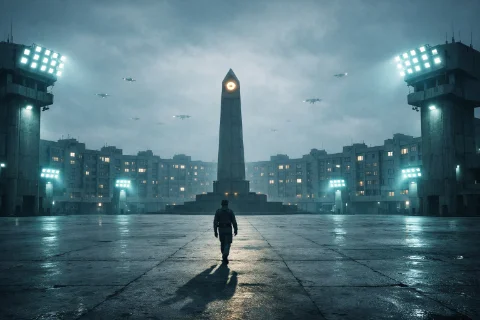
Wide, empty plazas replace narrow streets, because narrow streets have shadows and shadows have secrets. Windows on state housing face inward toward central courtyards, so neighbors watch neighbors as a matter of daily geometry. Public bathrooms have half-height doors. Bedrooms in newer construction include a mandatory acoustic sensor sold as a fire-safety feature.
The details matter because they suggest that the watching predates every character in the story. No one alive can remember choosing this. The concrete itself has already decided.
You do not need to explain any of it. A protagonist walking home through a plaza lit by seventeen floodlights, past benches too short to lie down on, past a public fountain with the water shut off to discourage lingering, has already told the reader more than a chapter of exposition ever could.
The Watchers Are Also Watched
The most sophisticated dystopian fiction refuses to draw a clean line between the watchers and the watched. The officer scanning your papers has a compliance score too. The judge issuing your sentence lives in the same housing block you do. Even the algorithm has an algorithm above it.
This vertical paranoia produces two useful things for a writer. First, it prevents the villains from becoming cartoons. A district enforcer who fears her own supervisor is a more frightening character than a district enforcer who enjoys her job, because her fear will make her less predictable, not more. Second, it opens the door to unlikely alliances. Two people on opposite sides of a surveillance ritual may share the same enemy one layer up.
When you build your hierarchy, ask who watches every watcher. Then ask what happens the first time someone in that chain stops.
The Rituals Your Protagonist Breaks
A dystopian plot is essentially the story of a character learning which rituals they can no longer perform.
Early in the book, your protagonist should perform the rituals flawlessly, perhaps with pride. Midway through, they should begin to notice the rituals as rituals, which is the first act of rebellion. By the end, they should either refuse a ritual outright or perform it while hiding something the ritual was designed to reveal.
That structural arc gives you a natural spine for the story. It also gives you a way to measure escalation without resorting to explosions. A character who deliberately mumbles their name at the transit panel is committing a small act of treason. The reader knows it. The reader has been taught by the world you built.
Writing the Watched Interior
The final and hardest layer is the interior life of a character who has never known privacy. Their thoughts have habits shaped by observation. They rehearse conversations before having them. They practice facial expressions in mirrors. They dream in the vocabulary the state approves of, and they wake up trying to remember what they actually felt.
Rendering this on the page requires restraint. Do not narrate every self-censored thought. Instead, let the reader catch the character correcting themselves midsentence, or notice when a private moment on the page suddenly reads like a public one because the character has forgotten how to write themselves any other way.
This is where dystopian fiction earns its emotional weight. The concrete panopticon does its worst damage not to the body but to the private voice, and a novel that lets the reader feel that damage is a novel readers remember.
Building Your Own Watched World
If you are drafting a dystopian project, use this quick checklist before you commit to your first scene.
Start with one ritual. Not the government, not the manifesto. A single daily act of compliance that everyone in your world performs without thinking. Everything else can be built out from there.
Design one piece of architecture that only makes sense if watching is the point. A door, a room, a public square. Show it once, then let the reader trip over it again later.
Give your antagonist a supervisor. If the person enforcing the rules is themselves being enforced, your hierarchy will feel real instead of drawn.
Track your protagonist's rituals across the manuscript. Perform, notice, resist, refuse. That arc alone will carry a book.
The concrete panopticon is not really about cameras. It is about the slow rearrangement of a life around the possibility of being seen. Get that pressure onto the page, and your dystopia will do the work no manifesto ever can. It will make the reader glance up from their own screen and, for one uneasy moment, wonder who else is in the room.
Write the ritual. Build the plaza. Let the reader feel the tower whether or not anyone is inside it.