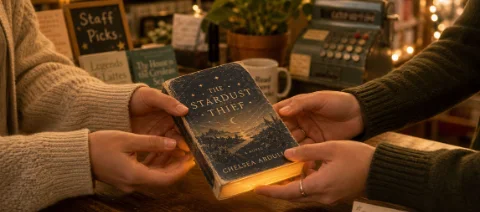
I still have the copy. It’s a self-published fantasy with a slightly too-glossy cover and a faint coffee stain on page 47—a mark left by the friend who read it before me. She had pressed it into my hands after a long dinner, not with a pitch, but with the kind of quiet urgency reserved for things that actually matter. “This book understands something about grief I’ve never seen in print,” she said. I took it home and read it in two days. By the end, I felt less alone in the world.
That book didn’t arrive on my radar through a six-figure marketing budget. It didn’t have a celebrity book club sticker or a front-table display in a chain bookshop. It came to me the way the best stories always have: passed down, person to person, one reader who was moved, telling another they trust.
Somewhere along the way, publishing became an industry of mass production. Stories are manufactured for trends, focus-grouped for broad appeal, and launched with coordinated campaigns that make bestsellers feel inevitable before anyone has even read them. But quietly, beautifully, a different model has been rising—one built on human connection, shared taste, and the radical act of recommending a book simply because it meant something. This is the rise of the indie reading community, and it’s changing not just how we find books, but why we read at all.
The Hollowing Out of the Bestseller Machine
I’m not here to trash traditional publishing. Some of my most cherished books sit on the bestseller shelf. But over the last decade, I’ve noticed a creeping sameness. The same tropes, the same cover styles, the same comp titles recycled in press releases. Books are often chosen not because an editor fell in love, but because a sales team believes they’ll move units. By the time a book reaches the reader, it has been smoothed and sanitised by dozens of hands, each trying to make it palatable to the largest possible audience.
The result is a product that’s competent but often hollow. I’ve read too many “unputdownable thrillers” that I put down and never thought about again. I’ve finished books and felt nothing—not because I’m a cynical reader, but because the story was designed to be liked, not to be unforgettable.
Mass production favours safety. It favours the familiar. And readers, especially the voracious ones, eventually start to crave something else. Something that feels like it was written by a human who needed to write it, not by a market analysis.
The Indie Reading Community: Where Stories Become Heirlooms
The indie reading community is the antidote I didn’t know I needed. It’s a sprawling, loosely connected web of readers who champion self-published and small-press books not because they’re told to, but because they genuinely fell in love. These communities exist in book clubs, Discord servers, cosy corners of Instagram, and platforms like StoryGraph. They gather around shared taste rather than shared marketing demographics.
What makes this movement so different is its foundation: stories passed down, not mass-produced. In these spaces, a book doesn’t succeed because of a billboard. It succeeds because someone stayed up until 3 a.m. finishing it and then immediately messaged three friends to say, “You have to read this.” That kind of organic, trembling enthusiasm can’t be manufactured. It’s contagious in the best way.
I’ve been part of these communities for years now, and I’ve observed a few things that make them special:
Trust replaces algorithms. When someone whose taste you’ve grown to trust says a self-published romance broke their heart and put it back together, you don’t need a star rating. You just buy the book. The recommendation is human-filtered, and that filter is built on a history of shared reading experiences.
Diversity thrives without permission. Indie authors don’t need a gatekeeper to greenlight their voice. In the communities I love, I’ve read queer joy that wasn’t framed as tragedy, neurodivergent protagonists written with lived nuance, and cultural stories that don’t explain themselves to an assumed default reader. These books exist because an author willed them into being, and a community embraced them.
Reading becomes a conversation, not a transaction. Mass-produced books often land in your life as a purchase. Indie books land as a conversation starter. Buddy reads, chapter-by-chapter discussions, and shared emotional devastation deepen the experience. You don’t just read an indie gem—you process it with others. The story lives beyond its final page.
My Own Journey from Consumer to Community Member
I used to read in isolation. I’d buy a book, consume it, shelve it, and move on. I rarely talked about what I’d read beyond a star rating and a brief review. Reading was a solo sport, and honestly, it felt a little hollow.
Everything changed when I joined an indie reading community for the first time. It was a small, welcoming group that did monthly buddy reads of self-published books. Suddenly, I wasn’t just reading—I was anticipating, discussing, and savouring. I was reading books I never would have found on my own: a quiet literary novella about a widowed beekeeper, a chaotic indie fantasy with footnotes that made me laugh out loud, a self-published memoir so raw I had to pause and breathe.
These books came to me through other readers. They were passed down like heirlooms—sometimes with sticky notes still attached, often with a message like, “I thought of you when I read this.” No algorithm had ever said something so personal to me.
How the Indie Reading Community Works (and How to Find Yours)
If you’re intrigued by this quieter, more human way of discovering stories, you might wonder where to start. The good news: the indie reading community isn’t an exclusive club. It’s everywhere, waiting for you to knock.
Join a dedicated space. Our own Indie Reading Community was built for exactly this purpose. We’re a group of readers who believe that the best stories often come without a giant marketing push. We share recommendations, host buddy reads, compile themed lists, and cheer each other on through reading slumps. There’s no algorithm, no sponsored content—just readers passing down the books that moved them.
Follow readers, not just authors. On social media, seek out accounts that talk about indie books with passion and specificity. Look for the people who post tear-stained selfies after finishing a novella, or who write long, rambling reviews about why a self-published mystery rewired their brain. Follow them. Their recommendations become your personal radar.
Participate in indie book events. Self-Published Fantasy Blog-Off (SPFBO), Indie Ink Awards, and countless readathons like #IndieAugust and #NovellaNovember are community-powered celebrations. Participating in these events plugs you into a network of readers who care deeply about independent stories.
Give and receive recommendations freely. The currency of the indie reading community is generosity. When you love a book, tell someone. Be specific about why. And when someone offers you a book they loved, receive it with openness. That exchange—that tiny, intimate handoff—is the heartbeat of this whole movement.
This Isn’t a Trend. It’s a Return to Something Older.
There’s a temptation to frame the rise of the indie reading community as a new phenomenon driven by technology and self-publishing platforms. And yes, those tools have made it easier. But at its core, this movement is a return to the oldest way stories have ever travelled: from hand to hand, from heart to heart.
Before there were publishing houses, there were people telling each other stories around fires. Before there were algorithms, there were friends pressing books into each other’s palms. The indie reading community is just a modern expression of that ancient tradition. It’s a refusal to let machines decide what stories matter. It’s a reclaiming of taste, connection, and the quiet magic that happens when someone says, “This one. Read this one.”
I no longer buy books based on bestseller badges. I buy them because someone I trust said, “I haven’t stopped thinking about it.” That shift has made my reading life richer, more surprising, and infinitely more personal.
The Story You Pass Down Next
Somewhere out there is an indie book that will crack you open in the best way. It might be a fantasy novella that sees your grief, a romance that makes you believe in love again, or a thriller that leaves you gasping. But you probably won’t find it on a promoted shelf. You’ll find it through a person. A friend, a bookish stranger online, a voice in a community that feels like home.
So here’s my question for you: What’s a book someone passed down to you—not recommended by an algorithm, not marketed to the masses, but genuinely handed over with love—that ended up changing you? Share the title and the story in the comments. Because that’s how we keep the fire going. One book, one conversation, one reader at a time.
And if you don’t have that kind of community yet, come find us. We’re saving you a seat.