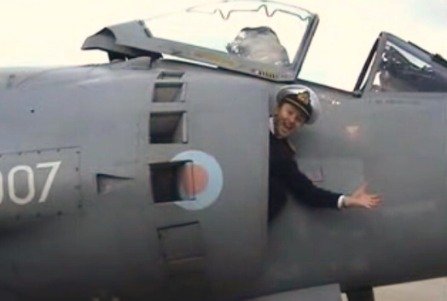
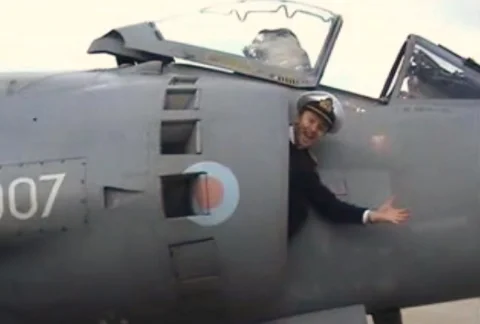
From the battle for the Falkland Islands to the skies above Colombia, Stephen Harrison-Thomas reflects on an extraordinary life in aviation and why some of the most compelling stories are those that actually happened.
There is an old saying that truth is stranger than fiction. Having spent much of my life in a cockpit, I would go one step further: sometimes, truth is more extraordinary than anything a novelist could convincingly invent.
When I was growing up in Yorkshire, England, I had no idea that my life would take me into aerial combat, experimental flight testing, the troubled skies of Colombia, across Africa and eventually into the world of commercial aviation.
Nor did I imagine that, decades later, I would sit down and turn those experiences into books.
Twenty Years Old and Going to War
In 1982, at just twenty years of age, I found myself flying the Royal Navy's Sea Harrier from HMS Invincible during the Falklands War.
I celebrated my twenty-first birthday in a war zone, thousands of miles from home.
While most young men of my age were beginning their careers, attending university or discovering what they wanted to do with their lives, I was flying combat missions over the South Atlantic.
There were moments of extraordinary excitement, periods of intense fear, friendships forged under unimaginable pressure and the ever-present knowledge that not everyone would be coming home.
I achieved three aerial victories during the conflict and was subsequently awarded the Distinguished Service Cross. But the story of those weeks is about far more than military achievements or decorations.
It is about the human experience of war.
What goes through a young man's mind before launching from an aircraft carrier into combat? How does someone reconcile the exhilaration of flying a fighter aircraft with the terrible realities of warfare? What happens when training gives way to survival?
These are some of the questions I explore in Falkland Skies, not as a military historian looking back through official documents, but as someone who was there.
Beyond the Battlefield
For many people, surviving a war might have been enough adventure for one lifetime. For me, it turned out to be only the beginning.
My subsequent career took me into the demanding world of flight testing, where the boundaries of aviation technology are pushed and where mistakes can have unforgiving consequences.
Combat flying and test flying present very different challenges. In one, the danger comes primarily from an adversary. In the other, it can come from the very machine in which you are placing your trust.
In Testing Skies, I explore this remarkable and often misunderstood profession, where engineering, courage, judgement and discipline must coexist.
It is a world rarely seen by the public, yet one upon which the safety of countless pilots and passengers ultimately depends.
When Reality Reads Like a Thriller
Perhaps one of the most unexpected chapters of my life unfolded in South America.
Colombia, with its extraordinary landscapes, complicated history and violent drug conflict, provided a setting that many thriller writers might envy.
Except that this was not fiction.
Cocaine Skies emerged from those experiences, reflecting a world where aviation intersects with organised crime, political instability and the darker realities of the international narcotics trade.
Writing about such experiences presents an interesting challenge. A novelist has the freedom to create suspense, manipulate events and invent characters. When writing from life, the responsibility is different. The extraordinary must be presented honestly, even when the truth seems almost unbelievable.
My experiences across Africa, described in African Skies, added another dimension to that journey, while Beckoning Skies explores the earlier years and the ambitions that first drew me towards aviation.
Civilian Skies continues the story into the world of commercial flying, a profession that appears remarkably routine to passengers but contains its own considerable challenges, responsibilities and unexpected adventures.
Together, these books trace a journey through different continents, cultures, conflicts and stages of life, connected by an enduring fascination with flight.
Why Write About It Now?
For many years, these experiences existed primarily as memories.
Pilots are accustomed to recording their flying hours, aircraft types and operational achievements in logbooks. But a logbook cannot capture the atmosphere inside a cockpit, the personalities of the people beside you, the tension before a dangerous mission or the humour that often emerges in the most unlikely circumstances.
Neither can it adequately explain how those experiences change the person living through them.
That is where writing becomes important.
I wanted to preserve not merely what happened, but what it felt like to be there. I wanted to record the uncertainty, the excitement, the mistakes, the friendships and the extraordinary privilege of seeing the world from a perspective that relatively few people experience.
Writing also forces you to revisit your younger self.
Looking back at the decisions I made at twenty, thirty or forty years of age is a fascinating exercise. The confidence of youth, the gradual accumulation of experience and the changing perception of risk all become considerably clearer with the passage of time.
Sometimes, the person you are writing about feels almost like a stranger, despite the fact that you were once him.
The Freedom of Being an Independent Author
One of the attractions of independent publishing is the freedom to tell a story in your own voice.
Life rarely follows the neat structure of a conventional novel. There are contradictions, unexpected diversions, unfinished conversations and events that only acquire significance many years later.
Independent authors have the opportunity to embrace that complexity without necessarily conforming to a particular commercial formula.
For me, writing is not about presenting a heroic version of my past. It is about capturing a life as it unfolded, with its successes and failures, its extraordinary opportunities and its moments of considerable uncertainty.
The most interesting stories are not necessarily about people who always got things right. They are often about ordinary human beings placed in extraordinary circumstances.
More Than Books About Aviation
Although aircraft provide the common thread throughout my books, I have never regarded them as being exclusively for aviation enthusiasts.
At their heart, they are stories about ambition, adventure, fear, resilience, friendship, survival and the consequences of the choices we make.
They are about a young man (boy, really) from Yorkshire who wanted to fly and discovered that the world was considerably larger, more complicated and more unpredictable than he had ever imagined.
If there is one thing that a lifetime in aviation has taught me, it is that the most remarkable journeys are rarely the ones we carefully plan.
And perhaps that is why real life makes such compelling reading.
Some stories simply are too extraordinary to invent.
Falkland Skies on Amazon A Young Sea Harrier Pilot’s Personal War in the South Atlantic
Cocaine Skies on Amazon How an Ex-Navy Fighter Pilot Found Adventures in Colombia's Cocaine War
Testing Skies on Amazon A young fighter pilot in the Dangerous World of Flight Testing
Beckoning Skies on Amazon How a working class boy became a British “Top Gun” with 3 Air to Air Victories at 21
Civilian Skies on Amazon A former fighter pilot’s search for adventure, love and his place in the civilian world
African Skies on Amazon How an Ex-Navy Top Gun Became Entangled in War, Coups and Diamonds in Africa
Stephen Harrison-Thomas is a former Royal Navy Sea Harrier fighter pilot, Falklands War veteran, Distinguished Service Cross recipient, test pilot, former commercial airline pilot, academic and independent author. His autobiographical Skies series chronicles a remarkable lifetime of aviation, adventure and international experiences.