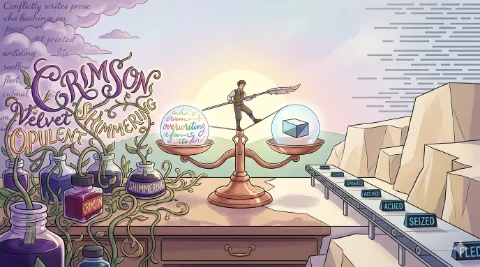
Writing balanced prose is a skill developed through consistent, targeted practice. It requires you to know exactly when to paint a vivid picture and when to let the action drive the story forward.
If you want to train your brain to naturally hit that stylistic sweet spot, integrate these specific writing routines into your daily creative workflow.
The Two-Step Translation Exercise
This practice drill forces you to experiment with both extreme ends of the spectrum so you can find the center. Take a boring, factual sentence from a daily news report or an instruction manual.
First, deliberately overwrite it. Add three adjectives to every noun, insert a complex metaphor, and turn it into full purple prose. Next, take that bloated version and strip away the fluff. Leave only the words absolutely necessary to convey both the physical action and the emotional undertone. This process trains your editing eye to catch excess decoration instantly.
Apply the One-In, One-Out Rule
When describing a new setting or character, limit yourself to exactly two striking sensory details. If you describe the sharp smell of ozone in a laboratory, skip the detailed description of the floor tile pattern.
If you highlight the nervous tremor in a character's hand, do not spend a paragraph explaining the fabric of their jacket. This rule forces you to choose the most high-impact descriptors rather than listing everything in the room.
Rely on Active, Specific Verbs
The fastest way to eliminate weak adjective-noun combinations is to swap them for single, powerful verbs. Instead of writing that someone walked very quietly and secretly down the hallway, use the word crept or slunk.
Strong verbs carry their own atmospheric weight. They push the plot forward smoothly without slowing down your reader's momentum.