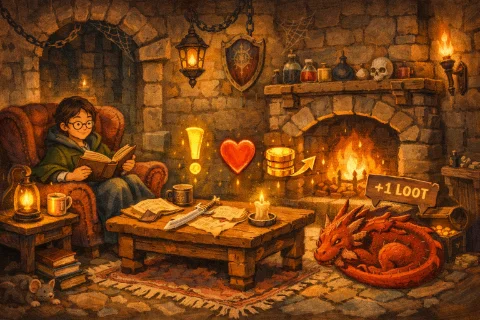
LitRPG stands for Literary Role Playing Game, and it does exactly what the name suggests. These novels bring the mechanics of video games and tabletop RPGs directly into the prose. Characters have stats. They gain experience points. They unlock skills, complete quests and check their inventory. Some are trapped inside virtual reality games. Others live in worlds where the game system is simply how reality works. Either way, the numbers on the page are part of the storytelling, not a distraction from it.
What Makes LitRPG Different
The genre took off in Russia in the early 2010s with authors like Vasily Mahanenko, then exploded worldwide with English-language hits such as Sufficiently Advanced Magic by Andrew Rowe and the Dungeon Crawler Carl series by Matt Dinniman. Progression fantasy sits close by, sharing the love of visible growth, but LitRPG commits fully to the game interface, complete with status screens, notifications and system messages.
Three things tend to mark a true LitRPG. First, explicit game mechanics that the character and reader both see. Second, a sense of progression that is measured, not just felt, as the hero climbs from weak to formidable. Third, a story that treats those mechanics as meaningful rather than window dressing. A well written LitRPG makes a new skill unlock feel as satisfying as a chapter cliffhanger.
Why Readers Love It
LitRPG delivers a specific pleasure no other genre matches: watching numbers go up. That may sound trivial, but it taps into something deeply satisfying about growth, mastery and reward. Every training session, every hard-won victory, every level gained feels earned in a concrete way.
The genre also scratches the itch of the games you do not have time to play. A busy adult who cannot sink eighty hours into a new RPG can spend an evening reading one instead and feel the same rush of discovery, buildcraft and adventure.
Where to Start
Dungeon Crawler Carl is the current fan favourite entry point, wildly popular and genuinely funny. Sufficiently Advanced Magic suits readers who love magic systems and puzzles. From there, dive into indie territory, because LitRPG is overwhelmingly an indie success story. Independent authors invented much of what the genre is doing today and continue to push it forward at a pace traditional publishing cannot match.