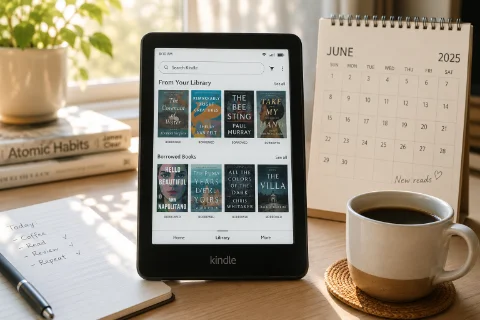
Most people use perhaps a tenth of what their Kindle can do. They buy a book, they turn the pages, and the rest of the device's toolkit sits quietly unopened. That is a shame for any reader, but it is a particular shame for indie readers, because nearly every one of the Kindle's overlooked features turns out to be most useful precisely when you are reading independently published books: long series with sprawling casts, ebooks bought directly from an author's own store, audio editions narrated by performers with cult followings, and files that quietly improve over time.
Here are the features worth switching on, and why each one matters more in the indie world than anywhere else.
X-Ray, the Built-In Companion Guide
Tap the screen while reading and open X-Ray, and the book unfolds into a reference of its own characters, places, and terms, showing you every passage where each one appears. For a slim literary novel this is a curiosity. For indie fiction, it borders on essential, because independent publishing specialises in exactly the kinds of books X-Ray was made for: epic fantasy sagas with forty named characters, LitRPG series dense with invented terminology, and space operas whose crews grow book by book. Forgotten who a returning character is in book six of a series you started last year? X-Ray answers without spoilers, without leaving the page, and without the indignity of searching a wiki at midnight.
Whispersync, for the Indie Audio Boom
Whispersync keeps your place synchronised across devices, so the chapter you finish on your phone in a queue is exactly where your Kindle opens at home. Its more remarkable sibling, Whispersync for Voice, syncs between an ebook and its audiobook edition, letting you read at night and listen on the commute without ever losing your place. Independent publishing has one of the richest audio cultures in all of books, with narrators whose performances have genuine followings of their own, and Whispersync for Voice is the feature that lets you live in both formats at once. For long indie series, the combination is quietly transformative: hundreds of hours of story, threaded seamlessly through the gaps in a life.
Send to Kindle, the Door to Buying Direct
A growing number of independent authors now sell ebooks directly from their own websites, keeping more of each sale and often bundling exclusive bonus content unavailable anywhere else. The bridge between those purchases and your device is Send to Kindle, which delivers files, including standard epubs, straight to your library, where they sync and behave like any other book. If you have ever hesitated to buy direct from an indie author because the file felt like homework, this feature removes the friction entirely. It takes a minute to set up, and it opens the healthiest corner of the indie economy: the one where the author keeps the largest share.
Popular Highlights, the Crowd Reading With You
Switch on popular highlights and faint underlines appear beneath the passages that thousands of other readers have marked, a quiet, communal layer running under the text. In indie romantasy and romance especially, where readers treat highlighting as a devotional practice, this feature doubles as a map of every line that made the community collectively stop breathing. It is also a surprisingly good quality signal when sampling an unknown indie book: a sample already carrying popular highlights is a sample other readers cared enough to mark.
Your Notes and Highlights, Collected and Exportable
Everything you highlight lives beyond the book itself, gathered in one place through the Kindle notebook, where your marked passages and notes can be revisited, and from which they can travel onward into reviews, reading journals, or book club notes. For indie readers this matters more than it first appears, because independent authors run on reviews the way traditional books run on marketing budgets. The distance between a highlighted passage and a helpful review is much shorter when the passages are already collected and waiting.
Collections, or Taming the Indie TBR
Indie reading habits produce enormous libraries. Ninety-nine pence deals, free series starters, and subscription borrowing all accumulate, and a library of five hundred unsorted titles is a library you stop browsing. Collections let you impose order: folders by genre, by series, by read and unread, by whatever taxonomy keeps your next book findable. Five minutes of sorting per month keeps a large indie library feeling like a bookshop rather than a landslide, and makes it far more likely the hidden gems you downloaded actually get read.
Book Updates, Because Indie Ebooks Improve
Here is a feature unique in the history of publishing: books that get better after you buy them. Independent authors control their own files and routinely update them, correcting typos, refreshing formatting, adding maps, bonus scenes, and improved back matter, and with automatic book updates enabled, those improvements flow silently into your library. A traditionally published book is frozen at its print date. An indie ebook is a living edition, and this single setting is how you keep yours current.
The Comfort Settings Nobody Regrets
Finally, the unglamorous features that change everything about long reading sessions: the warm light and dark mode that make late-night chapters gentler on the eyes, the font controls that let every reader tune a page to their own comfort, and accessibility options such as the OpenDyslexic font that quietly widen who gets to fall into a book at all. Indie reading skews toward the long haul, big series, deep backlists, one-more-chapter genres, and the readers who adjust their device to their body, rather than the reverse, are the ones still happily reading at book nine.
The Device Is Half the Experience
Independent publishing and the Kindle grew up together, and it shows: almost every feature above is at its best when pointed at indie books, their long series, their audio culture, their direct-sales economy, their living files. Learning the toolkit is the cheapest reading upgrade there is, and it compounds across every book you open afterwards.
The other half of the experience is knowing what to load the device with, and that is where Indie Reading Community comes in. Browse our book listings for independent ebooks across every genre, read author interviews with the writers whose books deserve a place in your collections, and join a community forum where readers trade both book recommendations and the occasional Kindle trick. Visit indiereadingcommunity.com, and put the whole toolkit to work.