There’s a moment in writing when you stop being the author and become the vessel. Your fingers move, but the voice isn’t quite yours. The character is thinking something you didn’t plan, noticing a detail you hadn’t outlined, reacting with an emotion that surprises you. You’re not constructing sentences anymore; you’re transcribing a mind.
That’s the moment I’m chasing every time I sit down to write. And it’s what I meant when I said: I always try to write my stories from “inside” of each character that I create while visualising what they would actually see, feel, and what the voice in their heads would say in that situation.
It sounds intuitive, maybe even obvious. But actually doing it consistently, across every scene, for every character, is one of the hardest and most transformative skills a fiction writer can develop. It’s the difference between a story that observes its characters and a story that inhabits them. It’s the difference between a reader who thinks that was a nice book and a reader who stays up until 3 a.m. because they’ve become someone else.
This is a guide to writing from a character’s perspective in the deepest possible way: learning to see through their eyes, feel through their skin, and hear the exact voice in their heads. It’s about mastering deep point of view writing, crafting authentic character interiority, and building immersive fiction writing that readers can’t shake.
The Difference Between Describing a Character and Inhabiting One
When I first started writing fiction, I thought a close third-person point of view was enough. I’d write things like:
Maya walked into the dark room. She felt afraid. She remembered the warning her grandmother had given her years ago.
That’s not bad writing, but it’s writing from the outside. The narrator is standing next to Maya, reporting her feelings and memories like a documentary voiceover. The reader is watching Maya, not living as her.
Now imagine the same moment written from inside Maya’s perspective, using character interiority, the rich, specific internal experience of being this particular person in this particular moment.
The door swung open, and the darkness pressed against her skin like cold breath. Her hand tightened on the doorframe. She could hear her grandmother’s voice, cracked and urgent, from all those years ago: “Never go in there alone, child. The shadows know your name.” But her grandmother was dead, and Maya was already stepping forward.
The first version tells you Maya is afraid. The second version makes you feel the fear alongside her. You see what she sees: the darkness pressing in. You feel what she feels her hand tightening, the memory surfacing unbidden. And you hear the voice in her head, grandmother’s warning, woven directly into the prose without quotation marks or “she remembered.” That’s writing from inside your characters, and it changes everything.
Step One: See What Your Character Sees (Not What You See)
The first discipline is to stop being a writer describing a scene and start being a person moving through it. Your character isn’t noticing the weather because you need to set the mood. They’re noticing the weather because it matters to them, right now, in a way that’s filtered through their history, their mood, their fears.
Ask yourself:
What would this specific character notice first upon entering this space?
What details would they miss entirely?
How does their past shape what they see?
A detective notices the unlocked window. A mother notices the child’s shoe lying abandoned. A soldier notices the exits. Your character’s perception is a portrait of their soul, not just a camera lens.
I once rewrote a scene from the perspective of a character who had recently lost her sense of taste after an accident. The original draft described the food on the table in lush, appetizing detail because I, the writer, love food. But inside that character’s head, the food was a memory of something lost. She noticed the colours and textures, not the flavours. She resented the steam rising from the soup. The scene became infinitely more powerful when I stopped writing what I would see and started writing what she would actually see.
Deep point of view writing demands this surrender. You’re no longer the tour guide; you’re the traveller. You see only what the character sees, notice only what they notice, and miss what they miss. That limitation is what creates intimacy.
Step Two: Feel What They Feel Physically and Emotionally
Feelings in fiction often go wrong in two directions. Either they’re named and tamed (“She was sad”), or they’re dramatised from the outside (“A tear rolled down her cheek”). Both approaches keep the reader at arm’s length.
Writing from inside your characters means rendering emotion as a physical, cognitive, and sensory experience. It’s not enough to say a character is anxious. You need to inhabit that anxiety: the tight chest, the spiral of worst-case scenarios, the way every sound feels louder, the irritation at the person who’s humming obliviously nearby.
I use a technique I call “The Body Check-In.” Before writing an emotional scene, I pause. I close my eyes and imagine I am the character. What’s happening in my body right now? Is my jaw clenched? My stomach churning? Are my hands cold? Then I write that physical experience directly, without labelling the emotion.
Instead of “He was furious,” I might write: His jaw locked so tight his teeth ached. A pulse hammered in his temple. He could feel the exact shape of the words he wanted to hurl across the room, solid as stones in his throat.
The reader doesn’t need to be told he’s furious. They feel it in their own body. That’s the power of immersive fiction writing rooted in visceral interiority.
Step Three: Hear the Voice in Their Head (It’s Not Your Voice)
Every character has an inner voice, a private, unedited monologue that narrates their life. It’s shaped by their education, their culture, their wounds, their sense of humour, their deepest insecurities. Capturing that voice authentically is what makes writing from a character’s perspective feel true.
The mistake I made for years was giving all my characters my own inner voice: literate, reflective, and vaguely anxious. It took a beta reader saying, “Your gruff old farmer and your teenage barista think in the exact same sentence structure” for me to realise the problem.
Now, before I write a character’s first scene, I free-write a page of their private thoughts. Not just for the novel, but for me. I ask: What’s the rhythm of their thinking? Do they speak to themselves in full sentences or fragments? Are they self-compassionate or brutally self-critical? Do they use irony, metaphor, hyperbole? What words would they never, ever think?
A fifty-year-old carpenter who left school at fourteen might think in terse, practical fragments. A seventeen-year-old poet might think in lush, dramatic metaphors. A character raised in a household where anger was forbidden might have an inner voice that immediately squashes any rising fury with guilt. Those differences create texture and authenticity.
When I finally nail a character’s inner voice, the dialogue and action often flow more easily too, because everything they do and say is consistent with the mind I’ve learned to inhabit.
The Danger of Author Intrusion (And How to Catch It)
Even when you think you’re deep inside a character, you can accidentally slip out. Author intrusion happens when the writer’s own knowledge, vocabulary, or need to explain something overrides the character’s perspective.
Signs you’re standing outside again:
You use phrases the character would never think (a medieval farmer thinking “the odds were stacked against him” like a sports commentator).
You describe the character’s appearance in a mirror because you, the writer, need the reader to know what they look like, but the character wouldn’t catalog their own features at that moment.
You insert backstory the character wouldn’t actively recall in that specific situation.
You describe emotions instead of experiencing them through the body.
The fix is simple and brutal: read every sentence and ask, Would this character, in this exact moment, think or notice this thing in these exact words? If the answer is no, cut it or reshape it until it fits.
Why This Matters So Much for Indie Authors
Indie authors have a superpower: we don’t have to smooth out our characters’ rough edges for a marketing team. We can write truly interior, idiosyncratic, unfiltered perspectives that traditional publishing sometimes sands down for “broad appeal.” Some of the most stunning examples of deep point of view writing I’ve ever read have come from self-published novels where the author refused to step outside their character’s skin, even for a moment.
In our Indie Reading Community, we often celebrate books that achieve that rare, immersive quality, the kind where you forget you’re reading and just live alongside the character. Members share passages that made them feel seen, techniques that helped them crack a stubborn character’s inner world, and encouragement for the difficult, invisible work of true interior writing.
If you’ve ever felt like your characters are somehow just out of reach, you’re not alone. This is a craft, and like any craft, it can be learned.
A Practice You Can Try Today
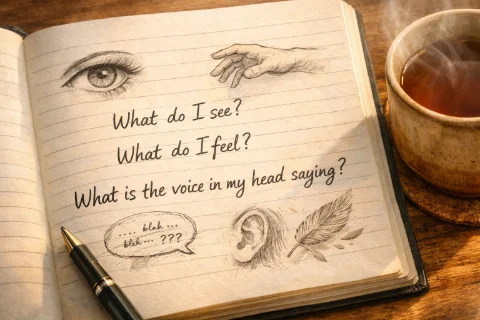
Here’s an exercise I return to whenever I feel like I’m slipping outside my characters. Take a scene you’ve already written. Pick a character who’s in it. Now, rewrite a few paragraphs from deep inside them, using only these three questions as your guide:
What do I see? (Filter every detail through their eyes, their history, their current state.)
What do I feel? (Body sensations first, then the swirl of emotion, never just a label.)
What is the voice in my head saying right now? (Exact words, exact rhythm, no translation for the reader.)
Don’t worry about beautiful prose. Just inhabit. You’ll likely find the scene comes alive in ways that surprise you.
Let’s Share the Voices We’ve Built
Writing from inside a character is a deeply intimate act. It requires empathy, curiosity, and a willingness to set aside your own perspective entirely. But when it works, it feels less like writing and more like listening. And the stories that emerge are the ones readers carry with them long after the final page.
Now I want to hear from you: Have you ever written a character whose inner voice surprised you, who started thinking things you hadn’t planned, and suddenly the whole story felt real? Or are you struggling to hear a particular character’s voice right now? Share your experiences, triumphs, and stuck points in the comments. Let’s help each other climb inside the minds that make our stories breathe.