
- Books Education & Academic › Textbooks
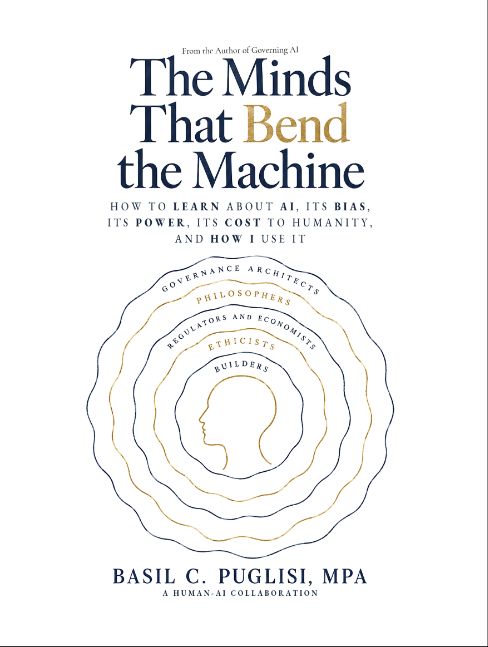
The Minds That Bend The Machine
 By: Basil C Puglisi
$19.99
$29.99
About the Book
How to Learn About AI, Its Bias, Its Power, Its Cost to Humanity, and How I Use It
The Minds That Bend the Machine is a guide to learning the full impact of artificial intelligence on countries, cultures, and humanity. It asks what the big picture is and how we begin to learn it. Understanding AI does not require becoming an engineer. It requires understanding the people, ideas, arguments, warnings, and decisions that shaped the technology in the first place. The author's earlier book, Governing AI: When Capability Exceeds Control, explored the threats of the technology. This book follows the journey of a retired law enforcement officer, former academic, and social media pioneer who studied the research on his own and applied it.
The book explores the builders who made modern AI possible, the ethicists who exposed the bias, labor, and power behind those systems, the economists and regulators trying to measure their cost to humanity, the philosophers asking where intelligence may ultimately lead, and the governance architects working to turn those lessons into systems people can actually use.
Geoffrey Hinton. Yoshua Bengio. Andrew Ng. Fei-Fei Li. Demis Hassabis. Timnit Gebru. Joy Buolamwini. Kate Crawford. Meredith Whittaker. Lina Khan. Stuart Russell. Nick Bostrom. Yann LeCun. Dario Amodei. And many others.
They do not agree. That is part of the point. Their disagreements reveal something important about artificial intelligence that gets lost when the conversation is reduced to whether AI is good or bad, safe or dangerous, revolutionary or overhyped. The real question is what each of us needs to understand before AI begins making more decisions around us, with us, and eventually for us.

Why This Book Matters
AI literacy is quickly becoming more than knowing how to use a chatbot. It is becoming the ability to recognize what a system knows, what it may be missing, who shaped its assumptions, when its confidence deserves scrutiny, and where human judgment still has to take responsibility. That matters whether you are running a company, advising an organization, teaching students, writing policy, raising children, creating content, managing employees, or simply trying to understand the systems entering everyday life.
This is not a book written from the sidelines. The research unfolds alongside the practical experience of building and governing with AI. The same questions raised by the people profiled in these pages are tested against real multi-AI workflows, human checkpoints, preserved disagreement, verification, and documented decision making. The result is not a book about having the right answer. It is a book about learning how to ask better questions before someone else, human or machine, answers them for you.
The Question Behind the Book
What do I not know? That question begins the journey. It may also be one of the most important questions anyone can learn to ask in the age of artificial intelligence.
Book Trailer
Language - English
Publisher Name - Digital Ethos
Publisher Year - 2026
ISBN-13 - 9798182969321