The research that nearly stopped me writing
I've always been a fairly prolific reader.
These days, most of my reading is done through Audible. I've got something like 350 books in my library, so although I've changed the way I consume literature, I certainly haven't lost my appetite for a good story.
When I was younger, I remember being fascinated by Ken Follett's historical novels, particularly The Pillars of the Earth and World Without End. Apart from the wonderful stories, what amazed me was the extraordinary amount of research that must have gone into writing them.
Follett could weave fictional characters into real historical events, people and places. You weren't just enjoying a great story. You were learning about history along the way.
And Follett was hardly alone. I've admired writers such as Stieg Larsson, Anthony Doerr, David Baldacci, Terry Hayes, Margaret Atwood, Tim Winton and Trent Dalton, all of whom bring remarkable depth and detail to their stories.
And don't get me started on the world-builders! Pierce Brown, Josiah Bancroft, Robert Jordan, Brandon Sanderson and others who create entire worlds, complete with their own histories, cultures and political systems. And a special mention for my all-time favourite, Stephen King's The Dark Tower series. Simply amazing.
I used to wonder how on earth they did it.
I'd always wanted to write. Somewhere in the back of my mind, I thought I might even be capable of producing something worth reading.
But the research was daunting. Where would I begin? How many months or years would I spend gathering information before I could even start telling my story?
So, like many ambitions, writing a novel remained something I intended to do one day.
Then along came AI
By the time I finally started writing in my sixties, something rather remarkable had happened.
Artificial intelligence had arrived.
When I began writing The Long Grass, set in Weipa in 1985, I quickly discovered just how much research was involved.
I'd lived and worked in Weipa. I knew the place and remembered much of what life was like there. But recreating it accurately forty years later was another matter.
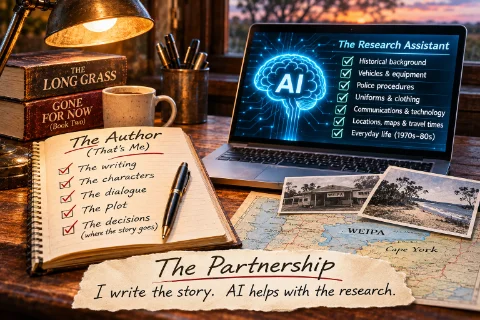
What vehicles were people driving? What weapons did Queensland police carry? What did their uniforms look like? How did they communicate? What roads existed, and what condition were they in?
Then there were all the little details. Clothing, footwear, telephones, buildings, distances and travel times. The questions seemed endless.
But suddenly I had a research assistant at my fingertips.
I could ask a question, follow it up with another and keep digging until I had enough information to get on with writing.
All of a sudden, a day's worth of research could be done in a few minutes.
Game changer doesn't begin to describe how valuable that is. Especially when I've still got a paying job to do as well. Gotta pay the bills, mate.
Of course, there's a catch
AI doesn't always get things right.
In fact, it can be remarkably confident about something that's completely wrong. I've caught it out plenty of times, which is why I treat it as a research assistant rather than an unquestionable authority.
When historical accuracy matters, I check the information against other sources. The good thing about writing fiction is that there's always room for artistic licence.
I'm now well into my second Annette Mollison novel, Gone for Now, set primarily in 1987, and the research continues. Old vehicles, police procedures, communications equipment, geography and countless other details about life in Far North Queensland during the 1970s and 1980s.
Some discoveries have even taken the story in directions I hadn't originally considered.
But who writes the book?
There's been plenty of discussion about AI in creative industries, and rightly so.
I don't want to read novels written by machines, and I certainly don't want to see talented writers replaced by them.
But there's an important distinction between using AI to create a story and using it to help research one.
The writing, the characters, the dialogue, the plot and the decisions about where the story goes are mine. That's the part I love, and that's how I want it to remain.
AI helps me find the information I need without spending weeks searching for it.
For someone who spent decades wanting to write but feeling intimidated by the research involved, that's been an extraordinary advantage.
Would I have written The Long Grass without it?
Yes, I think so, because it's a story I had to tell.
But having that fast and efficient research assistant at my fingertips certainly made it a lot easier.