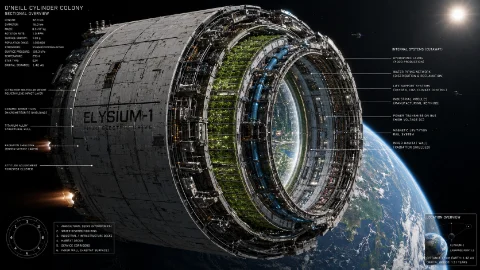
The illusion of permanent stability in space vanishes the moment an engineer calculates the true cost of environmental maintenance. Stationing a massive civilian population center at a Lagrange point provides a temporary gravitational harbor, but it does not grant immunity from cosmic decay. The environment within the habitat is a closed thermodynamic loop where every chemical reaction must balance perfectly against external degradation. The ultimate enemy is not mechanical failure, but the slow, predictable rise of systemic entropy known as the Orbital Decay Matrix.
The Mechanics of Lagrange Stability
While Lagrange points offer a theoretical oasis where gravitational forces cancel out, true orbital stability requires constant active correction. External factors like solar radiation pressure and planetary alignments introduce unpredictable forces into the habitat's path.
Station-Keeping Burn Limits: Reaction control thrusters must continuously execute micro-bursts to prevent the station from slipping down the steep gravitational well.
Mass Displacement Friction: The movement of internal mag-lev trains and industrial fluid networks introduces internal kinetic friction that shifts the habitat’s center of mass.
Debris Vector Management: Small micrometeorites constantly bombard the outer shell, subtly transferring kinetic energy and altering the station's orbital velocity.
If the station-keeping fuel reserves drop below a critical threshold, the entire structure will begin an irreversible slide toward atmospheric entry.
Radiative Bleed and Ecosystem Destruction
Beyond the mechanical challenges of maintaining a stable orbit lies the lethal problem of solar and cosmic radiation. The station’s protective shielding is subject to a phenomenon known as radiative bleed, where high-energy particles slowly degrade the physical properties of the hull material.
[Solar Flare Shockwave] ➔ [Hull Deflection Overload] ➔ [Radiative Bleed Penetration] ➔ [Hydroponic Biomass Collapse]
When background radiation penetrates the outer titanium shield, the delicate biological balance of the closed-loop life support system is instantly disrupted. Hydroponic crop variations suffer severe genetic degradation, leading to widespread agricultural blight within days. The water filtration systems become fouled with mutated microbial blooms, while the artificial atmosphere accumulates trace amounts of toxic heavy-metal isotopes. The engineering team must constantly choose between diverting power to the structural electromagnetic shields or starving the agricultural bays.
The Math of Zero-Sum Survival
The fundamental rule of a closed-loop habitat is that nothing is truly free, and every luxury carries a biological tax. A single human breathing oxygen requires a precisely calculated area of active plant life, which in turn demands a specific volume of filtered water and electrical power.
Human survival in the deep void is a zero-sum equation written in the language of advanced thermodynamics. To live among the stars is to accept that your entire existence is a desperate, calculated battle against the unyielding math of the universe.