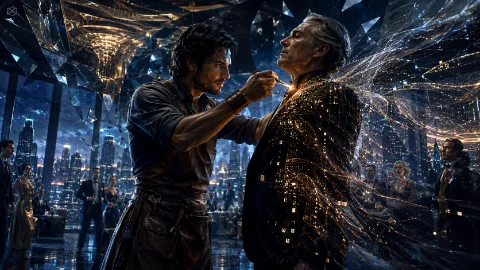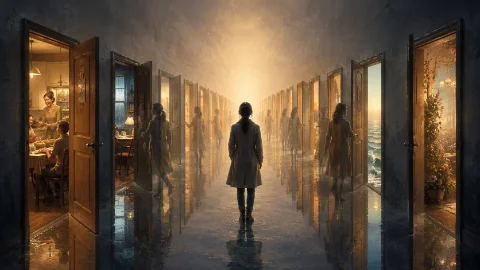
Every reader carries a private multiverse. It is made of the job not taken, the message never sent, the person they almost married, and the door they walked past without knowing it was a door at all.
The many-worlds interpretation of quantum mechanics takes that private ache and makes it cosmology. First proposed by the physicist Hugh Everett in 1957, it suggests that every quantum event with multiple possible outcomes does not choose one. It takes all of them. Reality branches, continuously and everywhere, into a vast tree of parallel worlds, each as real as this one, each containing a version of you who turned left where you turned right.
Physicists still argue about whether Everett was correct. Fiction writers do not need to wait for the verdict. The many-worlds interpretation is the single richest engine ever handed to storytellers, because it takes the oldest human question, what if, and gives it an address. This guide covers the science in plain language, then moves to the craft: the structures that work, the emotional core that makes branching stories land, and the mistakes that turn a multiverse into a mess.
The Science in One Sitting
You do not need equations to write this genre well, but you do need the core idea, because readers can tell when a writer is bluffing.
Quantum mechanics describes a world where particles exist in superpositions, holding multiple states at once, until a measurement forces a definite outcome. The traditional view says the act of measurement collapses all those possibilities into one result, and the others simply vanish. Everett asked an impertinent question: what if nothing vanishes? What if the universe itself splits at each of these events, so that every possible outcome actually occurs, each in its own branch?
Under this interpretation, branching is not rare and not dramatic. It is constant, silent, and unimaginably prolific. There is no master timeline, no original world from which the copies deviate. Every branch is equally real to its inhabitants, and no branch can normally communicate with any other. The version of you reading this sentence is one leaf on a tree whose trunk disappeared into the past long ago.
Three features of the real theory matter enormously for fiction. First, branches split forward only; the tree grows, it never ungrows, which means regret in a many-worlds story is permanent by physics. Second, branching is driven by quantum events, not human decisions, though human decisions ride on top of countless quantum events, which gives you license to branch on choices if you handle it with a light touch. Third, the worlds do not interact. Every story about crossing between them is a story about breaking the theory's one rule, and the best fiction knows it is trespassing.
The Core Insight: The Multiverse Is a Regret Engine
Here is what separates unforgettable branching fiction from content with portals in it. The many-worlds interpretation is not interesting because there are infinite realities. Infinity is numbing. It is interesting because it weaponises the road not taken.
In ordinary fiction, a character's regret is speculation. She wonders what her life would have been if she had stayed. In many-worlds fiction, the answer exists. Somewhere, provably, physically, is the woman who stayed, living out the consequences in full detail, and the story's power comes from making that abstraction concrete. The other life stops being a daydream and becomes a neighbour.
This is why the genre's strongest works are almost never adventures across a thousand flashy dimensions. They are intimate stories about one or two branches, chosen with surgical care. The husband who glimpses the world where his wife survived. The scientist who finds the branch where she published first. The man who meets the version of himself that his father would have been proud of, and discovers that this other self is not happier, only differently broken.
Before you build any machinery, choose the wound. Which single unlived life would devastate your protagonist to witness? That branch is your story. The other infinite worlds are set dressing, and most of them should stay off the page entirely.
Four Structures That Work
Branching fiction organises itself into recurring shapes. Master these before inventing your own.
The Window. The gentlest structure. Your character cannot travel between worlds, only observe another branch, through an experiment, an anomaly, a device, or something stranger like dreams that turn out to be accurate. Because nothing can be changed, the window structure is pure emotional pressure. The character watches the other life the way people watch old home videos, except the video is live and continuing without them. The plot becomes psychological: what does sustained sight of the unlived life do to the lived one? Windows corrode. That corrosion is your second act.
The Crossing. A character physically moves into another branch, usually one where a central regret went the other way. The craft rule of the crossing is that arrival is the beginning of the problem, not the solution. The world where his daughter lived is also a world with its own version of him, or a hole shaped like him, and either creates the story. Crossings are at their best when the visitor slowly discovers that the improved branch was purchased with a different loss, one invisible from home, because the theory's deepest honesty is that no branch is the good one. They are only differently priced.
The Bleed. The membrane between nearby branches thins, and two worlds begin to leak into each other. Objects appear that no one bought. A spouse remembers a holiday that never happened here. The bleed structure is the genre's gift to writers of literary fiction and quiet horror, because it can be played almost entirely in domestic scenes, and its central question is devastating: if two versions of a life merge, which memories win, and who does the surviving person love?
The Archive. A character gains access to information about many branches at once, a catalogue of their alternate selves, and the structure becomes an inventory of the soul. The archive works because it converts the multiverse into a mirror. Across a thousand branches, what does this person always do? What do they never do? The constants are their true character, and the variations are circumstance, and no protagonist survives that knowledge unchanged. The archive's natural climax is the discovery of the one branch that breaks the pattern, and the question of what made it possible there.
Branch on Character, Not on Coin Flips
The most common failure in many-worlds fiction is branching on trivia. A story that splits reality over which train the hero caught has confused mechanism with meaning, and readers feel the emptiness even if they cannot name it.
Strong branching stories split on moments of character, the decisions that were genuinely open because the person was genuinely divided. The night she almost told the truth. The morning he nearly did not get in the car. The audition, the confession, the door held or not held. These are the junctions where a reader believes both branches, because they have felt both pulls themselves.
A useful discipline: for every branch point in your outline, write one sentence for each side beginning with the words, and this was also truly her. If you cannot write the second sentence honestly, the branch is decoration, and the story does not need it.
This is also where you honour the physics with a light touch. Strictly, worlds branch on quantum events, not choices. But a choice made by a divided mind is the human face of an open outcome, and fiction lives at exactly that interface. You are not writing a physics paper. You are writing the leaf's-eye view of the tree.
Keeping Infinity From Eating Your Story
The multiverse is a hungry concept. Left unmanaged, it devours stakes, because a reader who is told all outcomes happen somewhere may reasonably ask why any single outcome matters. Every writer in this genre must solve the stakes problem, and there are three proven tools.
First, anchor the point of view. Your story follows one consciousness along one path through the tree. Whatever happens elsewhere, this person only gets to live one line of it, and their suffering is not diluted by a happier twin any more than your grief is comforted by a stranger's good day. State this early, through the character's own realisation if possible. It is the genre's essential move.
Second, ration the branches. Two worlds on the page are a tragedy. Twelve are a spreadsheet. The reader's heart can hold a small number of realities with full weight, and every additional branch divides the emotional budget. When in doubt, cut a world.
Third, make crossing or seeing cost something. If the window opens freely, it is a television. If the crossing is cheap, it is tourism. The classic prices are memory, identity, and belonging: each glimpse blurs which life is yours, each crossing makes home less like home. The many-worlds story is at bottom about the impossibility of being everyone you could have been, so the mechanics should enforce singleness. You can look, or you can go, but you cannot keep both lives. Choosing is the tax the multiverse charges, which is the whole theme wearing machinery.
The Mistakes to Avoid
Do not build a hierarchy of realness. The moment your story declares one branch the true timeline and the others copies, you have abandoned the interpretation's power and written a standard alternate-reality tale. Everett's tree has no trunk marked original. Every branch believes it is the story, because it is.
Do not let the multiverse absolve anyone. A character who forgives himself because somewhere a better version exists has learned exactly the wrong lesson, and if your book endorses it, the reader will feel cheated. The strongest works conclude the opposite: because you can only be this one, this one is the only one that counts.
Do not explain the mechanism at length. One page of theory, delivered by a character who half understands it, outperforms a chapter of lecture. The reader needs the rules, not the derivation.
A Working Checklist
Before drafting your many-worlds story, settle these six things.
Choose the wound: the single unlived life your protagonist cannot bear to witness.
Pick a structure: the window, the crossing, the bleed, or the archive, and know why the story needs that one.
Audit every branch point with the test, and this was also truly her.
Fix your rules for observation and crossing, and attach a real price to each.
Cap your worlds. Two with full weight beat ten in passing.
Decide what your story believes singleness means, because every many-worlds tale is secretly an argument about how to live one life.
The many-worlds interpretation may or may not describe the universe. It unquestionably describes the reader. Everyone lives at the trailing edge of a tree of unlived lives, and everyone has, at three in the morning, pressed a hand against the wall between branches and wondered.
Fiction built on Everett's idea works because it takes that hand and gives the wall a temperature. Write the one door that matters. Charge admission in memory and belonging. And when your character finally stands before the life they did not live, let the discovery be the genre's oldest and truest one: the other world was never the answer. It was only ever the question, wearing your face.