In the ancestral valley of Blackwood, legacy is not a matter of land, gold, or silver. It is a question of survival, tracked by a rhythmic, metallic ticking that echoes through the chest cavities of its inhabitants. In this isolated community, grief behaves like an aggressive congenital defect, mutating the physical structures of the human heart over subsequent generations. When a matriarch or patriarch dies under the weight of an unresolved sorrow, their bloodline inherits more than just a family home. They inherit a failing biological engine, forcing them to turn to an archaic, domestic art where the human heart must be systematically rebuilt using brass cogs and clockwork gears.
The Anatomy of the Stagnant Blood
Within the framework of magical realism, a broken heart is never a metaphorical state of mind. It is a literal, physical petrification. When an individual suffers a devastating, unexpressed loss, their arterial blood begins to cool and thicken, slowly depositing microscopic flecks of raw iron ore directly into their heart valves.
Over decades of mourning, the heart walls gradually calcify, transforming the flexible muscle tissue into a rigid, heavy lump of cold ironstone. This biological transformation is deeply hereditary. When a child is born to a family burdened by an ancestral curse, they do not enter the world with a normal pulse. They possess a sluggish, erratic rhythm known to local midwives as the "stagnant blood." Their heart cannot expand or contract naturally, leaving them perpetually cold, easily fatigued, and unable to process intense joy without experiencing severe, physical chest pains.
The Logistics of the Mechanical Fix
To prevent the total petrification of the bloodline, families must seek out the services of the local Organ Smiths. These artisans are part surgeon, part clockmaker, and part spiritual medium, specializing in an invasive, generational procedure known as the Clockwork Girding.
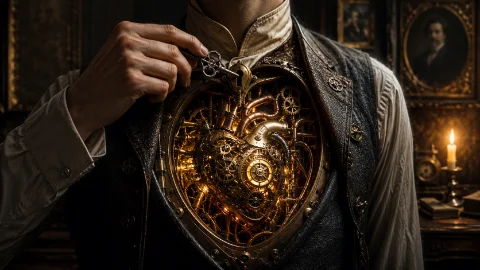
The operation requires opening the chest using silver-coated bone-saws and replacing the calcified, iron-choked valves with intricate assemblies of hand-tooled brass cogs, copper escapements, and miniature balance wheels. The clockwork organ is not a modern prosthetic; it is an archaic, spring-wound mechanism that must be manually wound every morning using a small silver key inserted directly into a keyhole hidden beneath the collarbone. As the gears turn, they artificially force the sluggish, heavy blood through the body, replacing the natural pulse with a rhythmic, continuous ticking sound that can be heard across an empty room.
The Weight of the Winding Key
While the mechanical heart saves the individual's life, it introduces a severe, existential restriction to their daily existence. A clockwork organ does not adjust its speed based on the body's natural emotional responses; it runs at a fixed, unyielding cadence dictated entirely by the tension of its internal mainspring.
The Emotional Barrier: Because the brass cogs cannot alter their rhythm, the individual is physically incapable of experiencing spontaneous bursts of passion, panic, or rage. If they attempt to fall in love, the heart cannot beat faster to accommodate the sudden rush of adrenaline, causing the gears to jam and trigger a localized cardiac seizure.
The Echo of Ancestral Tears: The clockwork mechanism acts as a literal amplifier for the family curse. Every sigh, every unspoken apology, and every teardrop shed by the previous generations is recorded as a microscopic scratch on the faces of the spinning cogs. When the individual sleeps in a quiet house, the rhythmic ticking of their own chest does not bring comfort. It plays a faint, mechanical lullaby of their ancestors' regrets, ensuring that while their body continues to function, their soul remains permanently anchored to a history that is not entirely their own.