Here is the secret that separates cosmic horror from every other kind: the monster is not hunting you. The monster does not know you exist.
Vampires want your blood. Werewolves want your throat. Even the shambling dead want something, in their ruined way. But the Great Old Ones, the vast sleeping entities at the heart of cosmic horror, want nothing from humanity because humanity has never once crossed their attention. We are not their prey. We are not their enemies. We are the microbial film on a pebble at the bottom of an ocean they have never bothered to look at.
That indifference is the engine of the entire genre, and it is also the hardest thing for new writers to get right. This guide walks through the rules of entities that do not see us. We will look at why sleep is scarier than wakefulness, how dreams became the genre's most dangerous frontier, and how to write cults, scholars, and doomed narrators who orbit a truth that was never meant to be survivable. Master the indifference, and you will understand why this genre has haunted readers for a century.
The First Rule: Scale Is Not Size, It Is Irrelevance
New writers approach cosmic horror as a problem of magnitude. Make the entity bigger, older, more tentacled, and surely the dread will follow. It never does. A creature that is merely enormous is a kaiju, and kaiju are adventure, not horror.
The true scale of a Great Old One is measured in irrelevance. The entity predates the concept of Earth. Its lifespan makes geological time look like an afternoon. Its concerns, whatever they are, operate on axes that human language has no nouns for. When your protagonist finally grasps some fragment of what the entity actually is, the horror is not that it might destroy humanity. The horror is that destroying humanity would not register as an event.
The craft technique here is comparison by accident. Do not describe the entity directly. Describe what its incidental existence does to our world. A dead city rises from the sea floor because something beneath it shifted in its sleep, the way a sleeper's arm might dislodge a blanket. Whales beach themselves by the hundreds along one specific meridian, decade after decade, avoiding something no sonar can find. Deep-sea cables in one trench fail every eleven years, always in the same month, and the engineers have learned to simply budget for it.
None of these are attacks. That is the point. They are the weather patterns of an unconscious god, and your characters live in the climate.
The Second Rule: Sleep Is the Mercy, Not the Threat
The sleeping god is the genre's most famous image, and most writers misread it. They treat the sleep as a countdown, a bomb waiting for its timer, and build their plots around preventing the awakening. That structure can work, but it hides the more disturbing truth the genre offers.
The sleep is not the threat. The sleep is the only reason we exist at all.
Human history, in the cosmic horror framework, is not a story unfolding under the gaze of the divine. It is the brief, unlikely quiet between one turn of the sleeper and the next. Every city we have built, every language, every love affair and cathedral and library, fits inside a single interval of divine unconsciousness, the way an entire civilization of mayflies might rise and fall during one human nap.
Let your characters discover this and you will have written the genre's signature wound. The scholar who assembles the timeline and realizes that recorded history aligns perfectly with a single sleep cycle. The mathematician who finds the interval and cannot stop calculating how much of it remains. They are not afraid the god will wake angry. They are afraid the god will wake at all, because waking does not require malice to end us. It only requires rolling over.
Write the sleep as mercy, and every small disturbance of it, every tremor and tide and inexplicable season, becomes a held breath.
The Third Rule: Dreams Are the Border That Leaks
If the entity sleeps, then its dreams are the one place where its existence touches ours, and this is where cosmic horror does its most intimate damage.
The dreams of a Great Old One do not stay contained. They leak. They seep upward through the membrane of sleep into the minds of sensitive humans, the way groundwater seeps into a basement, and the humans who receive them are never chosen. They are simply low-lying.
This gives the writer a magnificent set of tools. Artists across three continents, unknown to one another, begin sculpting the same impossible geometry in the same feverish week. A composer wakes with a melody in a scale that should not resolve and does. Children in coastal towns share a recurring dream of a city whose angles hurt to remember, and pediatricians in those towns quietly compare notes and then quietly stop.
The leak is not communication. This distinction is everything. The entity is not sending messages, recruiting servants, or issuing warnings. It is simply dreaming, and we are close enough to get wet. When your dream-touched characters search the visions for meaning, for instruction, for any sign that they were selected for a purpose, let them find nothing. The visions have all the intentionality of a stain spreading through a ceiling. The human need to be meant is the thing the genre exists to break.
The Fourth Rule: The Cult Misunderstands Everything
Every cosmic horror story eventually produces a cult, and the standard version gets the cult wrong in a revealing way. The standard cult believes it serves the entity, communes with it, and will be rewarded at the awakening. Write that cult if you like. But the truly disturbing cult is the one your story proves wrong.
The entity does not know its worshippers exist. The rituals do nothing. The chants, assembled from leaked dream-fragments and mistranslated stone, are a human attempt to build a relationship with a phenomenon, no different from dancing for rain. The sacrifices accomplish exactly as much as shouting at the ocean. And the promised reward, the seat at the right hand of the risen god, is a story the cultists tell because the alternative, that they have given their lives to something that will never once perceive them, is the actual horror of the book.
The richest cult characters are the ones who begin to suspect this. The high priest who has performed the rite for forty years and admits, in one devastating scene, that nothing has ever answered. The young initiate who realizes the sacred text is a transcription of nonsense, dream-noise mistaken for scripture by desperate people. Their faith is not evil. It is the most human thing in the story, the same instinct that has always made us insist the vast dark must be looking back.
It is not looking back. Write the cult as a mirror for the reader's own need to matter, and the book will follow them home.
The Fifth Rule: Knowledge Is the Wound That Cannot Close
Cosmic horror's famous madness is widely misunderstood as fragility, as if its scholars faint at the sight of a tentacle. The madness of the genre is not shock. It is arithmetic.
The doomed scholar is doomed because the pieces they have assembled cannot be disassembled. Once the timeline is seen, it cannot be unseen. Once the pattern in the whale strandings, the cable failures, the shared dreams, and the sleeping interval clicks together, the scholar's mind holds a fact too large for a human frame, and the frame does what frames do under loads they were not built for. It bends. It buckles at the joints. It continues functioning in every room except the one where the fact is kept.
Write this degradation with restraint. Your scholar does not rave. They reorganize their life around the wound. They stop attending conferences in coastal cities. They sleep with the lights on, not out of fear of the dark, but because they have begun to distrust their own dreams and want to wake quickly. They become gentle, distracted, and generous with their possessions, the way people do when they know something about the calendar that others do not.
The reader should realize the scholar has stopped planning for the future before the scholar ever says so. That quiet arithmetic is the genre's deepest register.
The Sixth Rule: The Ending Withholds
The temptation in the final act of cosmic horror is revelation. Show the entity. Wake the sleeper. Give the reader the full face of the thing after three hundred pages of glimpses. Resist it with everything you have.
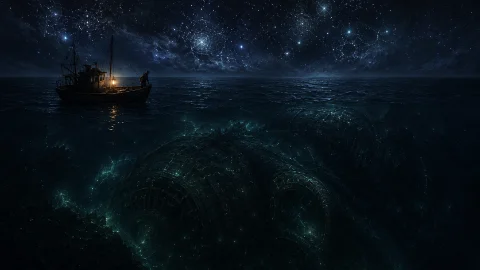
The genre's endings work by withholding. The manuscript ends mid-sentence. The expedition's last photograph shows only water, and a shadow under the water, and the shadow's edge exits the frame on all four sides. The narrator finishes their account, seals it, and instructs that it be opened only if a certain star returns to a certain position, and the document you have been reading, the reader realizes, has therefore already been opened.
The strongest ending of all is the one where nothing wakes and nothing changes. The sleeper sleeps on. The world continues. Your surviving character returns to their life, their job, their family, carrying the single fact that everything they love exists inside a parenthesis, and the closing mark is already written, and no one else can see it. The horror walks out of the book inside the reader, which is the only place it was ever going to live.
Building Your Own Sleeping God
Before you draft your cosmic horror project, work through this quick checklist.
Measure your entity in irrelevance, not size. Write three incidental effects of its existence, none of which are attacks.
Make the sleep the mercy. Decide what interval of history fits inside it, and let one character do the arithmetic.
Let the dreams leak without meaning. Give the visions to characters who were never chosen, and let their search for purpose find nothing.
Build a cult that is wrong. Let its most devout member begin to suspect that nothing has ever been listening.
Wound your scholar with knowledge that cannot be unlearned, and show the damage as quiet reorganization, not raving.
Withhold the ending. The sleeper does not wake. The reader does.
The Great Old Ones endure as figures of horror because they answer humanity's oldest question, does anything out there see us, with the one reply we cannot bear. Not hatred. Not hunger. Just an unbroken, dreaming indifference, vast enough that our whole history fits inside its nap.
Write the sleep as mercy. Write the dreams as leakage. Write the cult as our own reflection, chanting at an ocean that has never once noticed the shore. The entities that do not see us are the ones we cannot stop watching, and that, in the end, is the whole terrible genius of the genre.