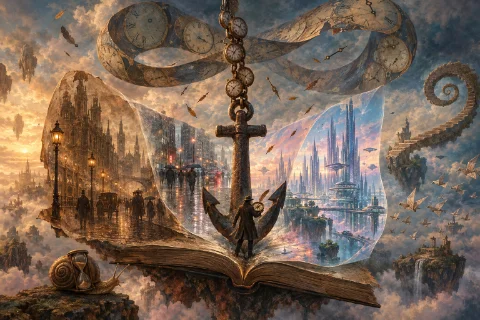
Every writer who attempts a dual timeline, a generational saga, or a time loop runs into the same wall around the midpoint. The structure that looked so elegant in the outline starts to feel like a shuffle. Readers lose the thread. Chapters that should land with weight land with a shrug because nobody remembers what came before in that particular era.
The usual advice is to add chapter headers with dates. That helps a little. It does not fix the pacing problem, because dates tell the reader when they are, not why they are there.
What fixes it is an anchor.
What a Chronological Anchor Actually Is
A chronological anchor is a fixed point in the story that every timeline, era, or loop iteration is measured against. It can be an event, an object, a place, a question, or a single line of dialogue. The reader does not need to know its full significance yet. They only need to feel it pulling.
In a dual timeline novel, the anchor is often the moment the two threads will finally touch. In a generational saga, it might be a house, a letter, or a crime that each generation inherits differently. In a time loop, it is almost always the loop's reset point, the one scene the character keeps returning to whether they want to or not.
Without an anchor, a nonlinear story is just a series of chapters that happen to be set in different years. With one, every jump in time becomes a measurable movement toward or away from something. That movement is what readers experience as pace.
Why Nonlinear Stories Feel Slow
Here is the quiet truth about pacing. Readers do not measure speed by how much happens. They measure it by how clearly they can feel progress toward something they care about.
A linear novel gets this for free. Scene follows scene, cause follows effect, and the reader's sense of progress is built in. Nonlinear structures break that chain on purpose. Every time you cut from 1890 to 2024, you reset the reader's momentum to zero and ask them to rebuild it.
If you make that cut without an anchor, the reader has nothing to rebuild toward. The chapter may be beautifully written and still feel like a detour. Multiply that by thirty chapters and your book feels long no matter how tight your sentences are.
The anchor solves this because it gives the reader a constant. The eras change, but the question does not. Who sent the letter. What happened in the basement. Why does the loop always end at 3:17. Each chapter, regardless of its era, either adds pressure to that question or releases some of it. The reader can feel the needle move.
Setting the Anchor Early
An anchor only works if it is planted before the reader needs it. That means the first chapter of a multi-era novel has a job beyond introducing a character and a setting. It has to point at the thing every other timeline will orbit.
You do not have to explain it. In fact you should not. A door that stays locked. A photograph with one face cut out. A grandmother who refuses to say a certain name. The anchor is a promise that the structure will pay off, and the reader will tolerate a surprising amount of time jumping if they trust that promise.
For time loops, the first loop is the anchor itself. Write it clean, write it fully, and make it specific. Every later iteration will be read against this version, so the small details of the original matter more than you think. The coffee that spills. The song on the radio. The stranger who bumps a shoulder. These become the reader's reference points, and later you will pace entire chapters by which of them change.
Pacing Multi-Era Narratives
Once the anchor is set, you control pace in a multi-era story by controlling proximity. How close is this chapter to the anchor, in time and in meaning?
Early in the book, keep your timelines far from the anchor. Let them circle it. The reader senses the gravity but cannot see the center yet. This is where you build character, texture, and the separate stakes of each era.
Through the middle, tighten the orbit. Chapters from different eras should start echoing each other. A gesture repeats across a century. A phrase one character says in 1952 appears in a diary someone reads in the present. These echoes are your acceleration. They tell the reader the timelines are converging without stating it.
Near the end, let the eras collapse into each other. Shorter chapters. Faster cuts. Sometimes a single chapter that moves through all timelines at once. The anchor is finally in view and the reader should feel pulled toward it hard.
One practical rule: never cut away from a timeline at a moment of calm. Cut at the point of maximum tension in that era, then open the next era at a point that answers or complicates what was just left hanging. The reader carries the unresolved tension across the cut, and that carried tension is what keeps a nonlinear book feeling fast.
Pacing Time Loops
Time loops have a different problem. The danger is not confusion. It is repetition fatigue. Readers understand the structure quickly and start skimming any iteration that feels like a replay.
The anchor here is the reset, and pacing is controlled by how much of each loop you show.
The first loop gets full treatment. The second loop can be nearly full, because the reader is still learning what the character knows. By the third loop, you should be cutting hard. Show only what changed. If the character wakes up, spills the coffee, hears the song, and bumps the stranger exactly as before, do not write those beats again. Write one sentence that acknowledges them and get to the new thing.
As the loops go on, each one should be shorter in page count but larger in consequence. The character stops reacting and starts experimenting. They skip the routine, break a rule, say the thing they could never say. These are the moments that justify the structure, and they land harder when the reader has felt the weight of the repetition without being forced to read it.
Then, somewhere past the midpoint, break your own pattern. Give the reader one long loop again. Slow down. Let the character sit in a moment they have rushed through twenty times and finally see it. This contrast is the emotional center of most great loop stories, and it only works because you compressed everything before it.
Managing Reader Memory Across Eras
A nonlinear book asks readers to hold more in their heads than a linear one. You can lighten that load without dumbing anything down.
Give each era a distinct sensory signature. Not just a different setting but a different texture on the page. One timeline might lean on long sentences and interior thought. Another might be clipped and external. Readers will recognize where they are within a paragraph, before any date is mentioned.
Return to the anchor object or image at the start of each new section. Not the same way every time, but enough that it works like a landmark. The reader orients, then moves.
Resist the urge to recap. Trust that the echoes you have planted are doing the work. If a chapter cannot stand on its own without a summary of what happened three chapters ago in that era, the problem is usually that the chapter is not close enough to the anchor yet.
A Quick Diagnostic
If you are deep in a draft and the structure feels loose, try this.
Write down your anchor in one sentence. If you cannot, that is the problem.
Then go through your chapter list and, for each chapter, write whether it moves the reader toward the anchor, away from it, or neither. Chapters marked neither are where the pace dies. Either cut them, merge them, or find the thread that connects them to the center.
Most writers discover that the chapters they loved most are the ones marked neither. That is normal. The chapters you keep are not the ones you enjoyed writing. They are the ones that pull.
Nonlinear structure is not a license to wander. It is a promise that wandering will mean something. The chronological anchor is how you keep that promise, chapter after chapter, era after era, loop after loop.
Set it early, circle it with intent, tighten the orbit as you go, and let the reader feel the pull the whole way down. That pull is pace. Everything else is just chapter headers.