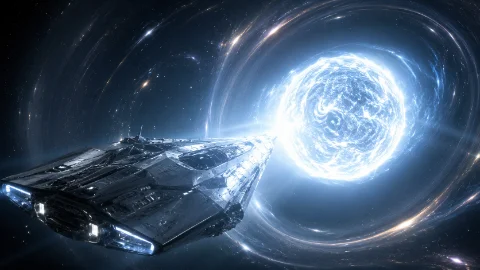
The scale of intergalactic space presents a permanent barrier to conventional interstellar propulsion frameworks. To bridge the millions of light-years separating galaxies within a human lifetime, astrodynamics must abandon flat-space mechanics entirely. The ultimate solution lies in utilizing the extreme gravitational wells of dense stellar remnants as kinetic sling-pumps. Navigating these dense environments requires an absolute mastery of the Chandrasekhar threshold, where the slightest mathematical deviation can reduce a starship to subatomic dust.
The Dynamics of Electron Degenerate Matter
To achieve the velocity necessary for extragalactic transit, deep-space vessels must execute tight gravitational maneuvers around white dwarf stars. These dense remnants are supported entirely by electron degeneracy pressure, a quantum mechanical effect that resists gravitational collapse.
Mass Limits: The target white dwarf must remain strictly below 1.44 solar masses to prevent it from collapsing into a black hole during transit operations.
Tidal Compression: The vessel's hull must withstand extreme gravitational shearing forces as it skims the outer boundary of the degenerate core.
Quantum Drag: Interacting with the star's highly compressed magnetic field introduces significant quantum friction into the ship's propulsion matrices.
Navigators must constantly calculate the exact mass of the stellar remnant, as skimming a star that is too close to its critical limit triggers instant collapse.
Relativistic Time Dilation and Transit Mathematics
As a starship approaches the dense perimeter of a degenerate star, the extreme gravitational field introduces massive relativistic time dilation effects.
[Target White Dwarf Approach] ➔ [Gravitational Velocity Peak] ➔ [Time Dilation Acceleration] ➔ [Extragalactic Trajectory Ejection]
While the ship executes its high-speed sweep, time inside the vessel slows down drastically relative to the rest of the universe. This temporal compression allows the crew to survive the subjective passage of what would otherwise be thousands of years of deep-space travel. However, balancing this time dilation against the kinetic energy required for extragalactic ejection demands real-time adjustments to the vessel's trajectory. A microscopic calculation error will either fling the ship into empty space too early or pull it past the event horizon of a newly formed singularity.
The Equation of the Intergalactic Leap
The final phase of transit involves utilizing the kinetic energy gained from the white dwarf to break free from the home galaxy's gravitational grip. The math governing this exit trajectory is absolute, leaving zero room for structural failure or engineering slack.
Humanity's expansion across the cosmic void is not driven by colonial ambition, but by the cold calculations of quantum mechanics. Surviving the leap between galaxies requires treating the crew, the ship, and the stars as variables in a singular, immutable equation.