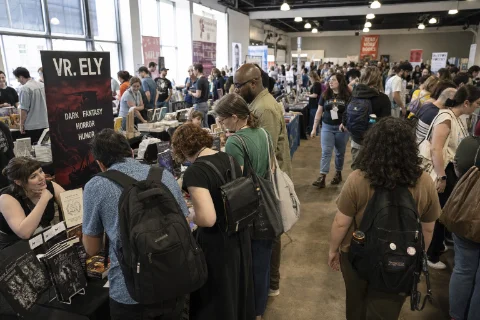
You've seen it happen at every book fair you've ever attended. One table draws a small crowd all day, people leaning in, picking things up, chatting with the author. The table next to it, sometimes with an equally good book, sits mostly untouched.
It's tempting to put this down to luck, or to the book itself, or to who happened to walk past first. Often, though, the real difference is something far less interesting than any of that. It's the layout of the table.
A book fair table is doing a job before you ever open your mouth. It's telling people, in the space of a glance, whether to slow down or keep walking. Most authors never think about that job at all, which is exactly why so many tables get walked past.
What "Stops Foot Traffic Cold" Actually Means
This isn't about people glancing over and deciding not to stop. That happens constantly and isn't really a problem, since most people at a fair are browsing dozens of tables and can't stop at all of them. The real problem is a table that people's eyes skip past entirely, without even registering it as something worth a second look.
That's what a flat, cluttered, or overly busy layout does. It doesn't repel people so much as it fails to register at all, and a table nobody notices empties out just as thoroughly as one people actively avoid.
The Layout Mistake Most Tables Make
The most common mistake is treating the table as storage rather than display. Every book gets placed out, often in tidy rows facing straight up, because it feels efficient and shows off the full catalogue. From a few feet away, though, rows of flat covers all look the same, and the eye has nothing to land on. Nothing is positioned to catch attention, so nothing does.
The second common mistake is overcrowding the table with everything at once. Bookmarks, postcards, a sign, a banner, a bowl of sweets and six different titles all competing for the same six square feet. A table like this asks a passerby to process too much in the half second they have to decide whether to stop, and most people simply won't bother.
The Layout That Works Instead
A table that stops foot traffic does the opposite of both of these things. It gives the eye one clear place to land, and it keeps everything else simple enough to support that one thing rather than compete with it.
Lead with one book, not the whole catalogue. Choose your strongest or most visually striking title and give it the most prominent position on the table, ideally propped upright on a small stand rather than lying flat. A single book standing up draws far more attention than a dozen lying down, simply because it interrupts the flat line of the table and gives the eye something to focus on.
Angle the table, don't square it off. A table set up dead straight along the aisle blends into the row of identical tables beside it. Angling your display slightly, even just the stand or a small sign, breaks that uniform line and makes your table look different enough to notice.
Use height in layers. Rather than spreading everything across the surface at the same level, build a little height. A stand at the back, books at a middle level, and a single open book or a small card at the front creates depth, which reads as more inviting than a flat spread, even with the exact same number of items.
Leave visible empty space. A table that looks slightly uncluttered feels approachable. A table packed edge to edge, even if everything on it is appealing, signals busy and unclear, and people tend to move past anything that looks like it needs deciphering.
Keep your sign short enough to read while walking. A sign with a full blurb takes too long to read from six feet away. A single short line, a genre, a tagline, or even just a striking phrase from the book, gets read in the time it takes someone to walk past.
Why the Open Book Trick Works So Well
One of the simplest additions to a table is a single physical copy left open, propped on a small stand, rather than every copy closed and stacked. An open book signals that this is something to be read, not just bought, and it invites a glance at an actual page rather than just a cover. It's a small detail, but it shifts the table from a sales display to something that feels like an invitation to look closer.
Testing Your Own Layout Before the Event
You don't need a fair to test this. Set your table up at home exactly as you plan to display it, then walk away and approach it again from a few feet off, the way a stranger would. Notice where your eye lands first. If it lands nowhere in particular, or everywhere at once, that's the layout doing the same thing to everyone walking past your actual table.
The Part Worth Remembering
Nobody stops at a table because the books on it are good. They stop because something on the table caught their eye long enough to make them curious about whether the books are good. The layout's only job is to earn that first half second of attention. Everything else, the conversation, the pitch, the sale, only gets a chance to happen once that's done.