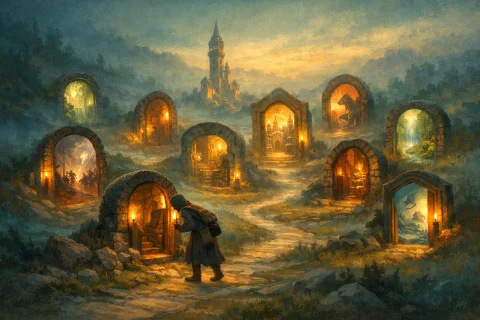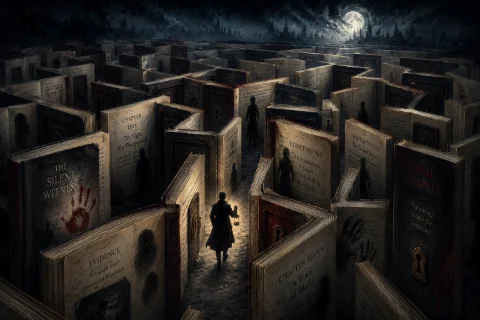
Here is a quietly damning fact about the last century of publishing: the industry did not reject any particular novella so much as it rejected the novella, wholesale, as a business proposition. A story of twenty or thirty thousand words was too long for magazines and too thin for a bookshop spine, so with rare prestige exceptions, the length was simply not acquired. Generations of stories that wanted to be novellas were inflated into novels or never written at all.
Then the Kindle arrived, delivery costs fell to zero, and independent authors walked straight into the space traditional publishing had spent decades declining to occupy. The novellas below are the result: born digital, published independently, and in several cases now regarded as some of the finest short fiction of the modern era. This is what the industry passed on, and what readers gained because somebody else said yes.
Wool by Hugh Howey
The most consequential indie novella ever published. Wool began in 2011 as a single self-published story about a sheriff in an underground silo who asks to go outside, a request that in his world is a death sentence. Howey wrote it at a length no traditional house would have looked at twice, priced it at pocket change, and watched readers demand more until the novella had grown into the Silo saga, a bestselling series and a major television adaptation. The legend is completed by what happened next: when traditional publishers finally came with chequebooks open, Howey famously refused to hand over his ebook rights, signing a print-only deal instead. The novella they would have passed on became the one they could not buy.
Sour Candy by Kealan Patrick Burke
If Wool proves the novella's commercial power, Sour Candy proves its artistic ruthlessness. Bram Stoker Award winner Kealan Patrick Burke self-published this lean nightmare about a man whose life is rewritten by a single encounter with a screaming child in a supermarket, and it has become one of the most recommended horror novellas of the digital era. At full novel length its trap would loosen; at this length there is no slack in the rope at all. It is the kind of story the old print economics would have asked to become something longer and therefore lesser, and its existence in exactly this form is an argument all by itself.
Things Have Gotten Worse Since We Last Spoke by Eric LaRocca
Told entirely through emails and chat transcripts documenting an online relationship that curdles from intimacy into obsession, Eric LaRocca's viral sensation emerged from a tiny independent horror press and conquered the internet one horrified recommendation at a time. Everything about it is native to the screen: its epistolary digital format, its single-sitting length, its word-of-mouth ascent. It is very difficult to imagine a traditional acquisitions meeting in a previous decade saying yes to a novella this strange, this dark, and this short, which is precisely the point. The infrastructure that finally said yes was independent, and the result reshaped modern horror's sense of what a novella could do.
Minor Mage by T. Kingfisher
Ursula Vernon, writing as T. Kingfisher, has been open about the fact that this story of a twelve-year-old mage with exactly three spells, sent alone to bring back the rains, was considered essentially unpublishable by traditional standards, too dark for children, too young for adults, and far too short besides. So she published it herself through Argyll Productions, and readers of every age promptly ignored the categories that had made it unsellable. It is funny, frightening, and wise about courage in a way few books twice its size manage, and it stands as perhaps the clearest single example of a wonderful book that existed outside every box the industry had available.
The Length Nobody Wanted Became the Length Everybody Reads
Notice what these four books have in common beyond their brevity. Each one is exactly as long as its story requires, no padding, no trilogy scaffolding, no subplot installed to justify a spine width. That discipline was the novella's gift all along, and it took an ecosystem with no printing costs and no acquisition committees to let readers rediscover it. Traditional publishing has since crept back toward the form, but the modern novella renaissance was built on Kindle screens by independent authors, and its masterpieces remain overwhelmingly indie.
If you have an evening and a screen, you have everything these books require. Indie Reading Community can supply the rest: browse our book listings for independent fiction at every length, read author interviews with the writers keeping the short form sharp, and join a community forum where readers trade single-sitting recommendations for exactly the nights that need them. Visit indiereadingcommunity.com, and read something perfect by midnight.