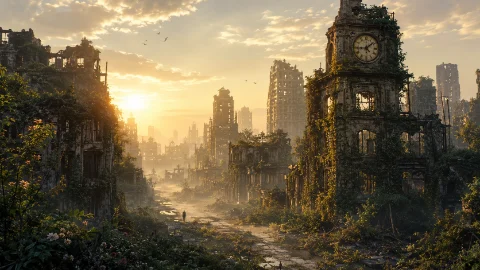
Most post-apocalyptic stories treat the ruined world as scenery. The rusted overpass, the flooded subway, the collapsed shopping mall with weeds pushing through the tile. It looks great on the page for about a paragraph, and then the characters walk through it on their way to the next plot point. The ruins become wallpaper.
But some of the best fiction in this genre does something braver. It lets the landscape carry the story. The setting stops being a stage and starts behaving like a protagonist, one that holds memory, keeps secrets, and grieves in its own strange way. When you write ruins that remember, you are not just describing a place. You are giving your reader a second character to fall in love with.
Here is how to do it.
Why the Landscape Deserves a Larger Role
Think about the places that stay with you long after you finish a book. Often it is not a person at all. It is a house, a road, a drowned town, a station at the edge of nowhere. These places feel alive because the author treated them with the same care usually reserved for a lead character.
A ruin is honest in a way people rarely are. It cannot lie about what happened to it. A scorched wall tells you there was fire. A child's shoe in the dust tells you there was a family. When you let the environment speak, you can reveal history, emotion, and tension without a single line of dialogue. That is a powerful tool, especially for indie authors who want their worldbuilding to feel deep without slowing the pace with heavy exposition.
The goal is simple to state and hard to master. Make the reader feel that the land itself is watching, waiting, and remembering.
Give Your Ruins a Memory
Memory is the quality that separates a living setting from a dead one. A place that remembers holds evidence of everything it has been through, and it offers that evidence to the people passing through.
Start by asking what your landscape has witnessed. A hospital remembers the last patients who were never discharged. A highway remembers the traffic jam of the final evacuation, cars still nose to tail, doors hanging open. A library remembers the readers who kept coming even as the world ended, because where else would they go.
You do not have to explain any of this to the reader in plain terms. Let them find it. Layer the details so that a careful reader assembles the history piece by piece. A dry fountain filled with prayer notes. A wall of tally marks that stops suddenly. A dining table set for six with the food long turned to dust. Each object is a sentence in a story the place is telling on its own.
The trick is restraint. Trust your reader to feel the weight of what they are seeing. Overexplaining kills the effect faster than anything.
Techniques for Writing Landscape as Character
Once you accept that the setting is a character, you can use the same craft tools you would use for any person in your book.
Give it a mood that shifts
A character is never in the same emotional state throughout a novel, and neither should your world be. The ruins might feel mournful in the rain, menacing at dusk, almost peaceful under snow. Let the mood of the landscape rise and fall alongside the emotional beats of your human characters. When your protagonist feels hunted, the buildings can seem to lean in. When they find hope, a shaft of light through a broken roof can carry real meaning.
Let it act on the characters
Real characters push back. So should your world. The landscape should shape decisions, block paths, offer shelter, and take things away. A river that changes course strands a group of survivors. A collapsing floor separates two friends. When the environment actively influences the plot, readers stop seeing it as background and start treating it as a force.
Use sensory memory, not just sight
New writers describe ruins almost entirely through what they look like. Living settings work through every sense. The smell of wet ash weeks after a fire. The sound a wind makes moving through empty window frames. The taste of dust that never fully settles. The strange silence of a city with no engines. These sensory details are what make a place feel remembered rather than merely observed.
Give it a voice through repetition
Places develop character through recurring motifs. Maybe a certain kind of vine keeps reclaiming everything it touches. Maybe every building your character enters has the same brand of clock stopped at the same hour. Repetition turns a detail into a signature, and a signature makes a landscape feel like a single coherent presence rather than a series of unrelated locations.
Balancing the Ruins With Your Human Story
A word of caution. Making the landscape a protagonist does not mean drowning your human characters in scenery. The most moving post-apocalyptic fiction works because the living world and the human world reflect each other. The ruins externalize what your characters feel inside.
A grieving character walking through a grieving city creates a resonance that neither could achieve alone. That is the real reason to write landscape as character. Not for the spectacle of destruction, but for the emotional mirror it holds up to the people still trying to survive inside it.
Keep asking one question as you write. What does this place reveal about the person standing in it? If the setting is only impressive, you have a nice description. If the setting deepens your character, you have a story.
A Simple Exercise to Try Today
Pick one ruined location from your work in progress. Write a single page from the imagined point of view of that place, as if the landscape could narrate what it has seen. You will almost certainly throw the page away, and that is fine. The point is that you will discover details, griefs, and secrets you did not know the place was holding. Bring even one of those discoveries back into your actual chapter, and the location will feel different on the page. It will feel like it remembers.
Post-apocalyptic fiction is having a long moment, and readers have seen a thousand collapsed skylines. What they have not tired of is a world that feels genuinely alive, a landscape that carries memory and grief and meaning. When you treat your ruins as a protagonist, you give readers something rare. You give them a place they will remember long after they forget the plot.
So the next time you write a broken world, do not just describe the damage. Ask what the land remembers. Then let it speak.