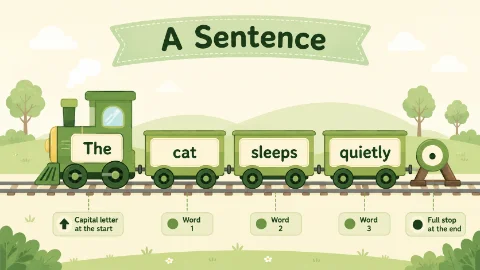
A good English sentence is like a good cup of tea. Simple ingredients, correct order, nothing extra.
Many beginners believe good writing means long, complicated sentences. The opposite is true. Short, correct sentences are the mark of clear English, and they are far easier to write than most learners think.
This guide shows you how to build simple English sentences correctly, step by step, from the basic pattern to small upgrades that add detail without adding mistakes.
The Golden Rule: One Sentence, One Idea
Before any grammar, learn this rule:
Every sentence should carry one clear idea.
- Weak: I went to the market and I saw my friend and we talked and then it rained so we went to a shop and drank tea.
- Strong: I went to the market. I met my friend there. We talked for a while. Then it started raining, so we drank tea in a shop.
Short sentences break less. When in doubt, use a full stop and start again.
The Basic Pattern: Subject + Verb + Object
Almost every simple English sentence follows this order:
- Subject: who or what does the action. I, she, the dog, my brother.
- Verb: the action or state. Eat, like, is, went.
- Object: who or what receives the action. Rice, music, the ball.
Examples:
- I drink tea.
- She reads books.
- The dog chased the ball.
Some sentences need no object at all. Subject and verb alone can be complete:
- He sleeps.
- The baby cried.
- It rained.
If your sentence has a subject and a verb in the right order, you already have a correct English sentence.
The Three Mechanical Rules
Writing has three small rules that speaking does not:
- Start with a capital letter. the shop is open becomes The shop is open.
- End with a full stop, question mark or exclamation mark.
- Capitalise names, places and the word I. My friend anita lives in chennai becomes My friend Anita lives in Chennai.
These rules cost nothing to follow and instantly make writing look correct.
Upgrade 1: Add a Describing Word
Take a correct simple sentence and place an adjective before the noun:
- I drink tea. becomes I drink hot tea.
- She has a bag. becomes She has a small blue bag.
- We watched a film. becomes We watched a funny film.
One or two adjectives are enough. Piling up five describing words makes sentences heavy, not better.
Upgrade 2: Add Time and Place
Time and place details usually sit at the end of a simple sentence, place before time:
Pattern: Subject + Verb + Object + Place + Time
- I drink tea at home every morning.
- She reads books in the library on Sundays.
- We played cricket in the park yesterday.
You can also move time to the front for variety: Yesterday, we played cricket in the park.
Upgrade 3: Join Two Ideas with Small Words
Once single sentences feel easy, join two of them with a connector:
- And adds: I like tea and she likes coffee.
- But contrasts: The shop was open, but it was empty.
- Because explains: We stayed home because it rained.
- So shows result: It rained, so we stayed home.
One warning: join two ideas at most. Three or more joined ideas is where beginner sentences start to collapse. Two ideas, one connector, then a full stop.
Making Negatives and Questions
Negatives use do not, does not or did not, and the main verb returns to its base form:
- I do not like coffee.
- She does not work on Sundays.
- They did not come yesterday.
Questions move the helper in front of the subject:
- Do you like coffee?
- Does she work here?
- Did they come yesterday?
Notice that in both cases the main verb stays simple: not She does not works and not Did they came. The helper word carries the grammar.
5 Sentence Mistakes to Avoid in Writing
- The missing verb. My brother a doctor. Every sentence needs a verb: My brother is a doctor.
- The run-on sentence. Two full ideas glued with only a comma: It was late, we went home. Fix with a full stop or a connector: It was late, so we went home.
- The lost capital and full stop. Especially in messages and comments. Formal or casual, correct writing keeps them.
- Word-by-word translation. Write the short English pattern you know, not a translated copy of your own language's sentence shape.
- Fear of short sentences. Short is not childish. Short is clear. Professional writers use short sentences constantly.
A Daily Writing Routine That Works
Ten minutes a day builds real writing skill:
- Write five sentences about your day. Use the basic pattern: I woke up early. I made breakfast. I called my mother.
- Upgrade two of them. Add an adjective, a place or a time: I made hot breakfast in the kitchen.
- Join two of them. Use and, but, because or so.
- Read everything out loud once. Your ear will catch mistakes your eye misses.
- Keep it all in one notebook. In a month, compare page one with page thirty. The progress will surprise you.
Correct English writing does not begin with big vocabulary or complex grammar. It begins with one honest pattern: subject, verb, object, capital letter, full stop.
Build that habit first. Then upgrade slowly, one describing word, one time phrase, one connector at a time. Keep sentences short, keep ideas single and read your work aloud.
Write five small sentences today. Tomorrow, five more. Clear writing is not a talent, it is a routine, and yours starts now.