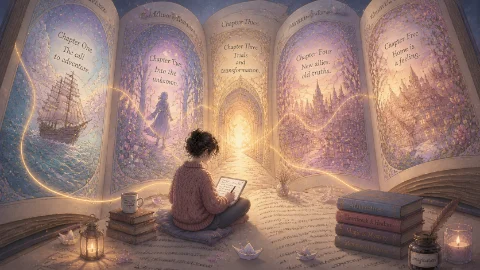
Ask ten published novelists how they outline and you will get ten different answers, many of them contradictory. Some write nothing but a handful of notes on a single index card. Some produce fifty-page documents before they type a single word of the actual novel. Some start with a character and wait to see what happens. Some know the ending before they know anything else.
What almost none of them do, at any level of commercial success, is simply start writing chapter one with no idea of the larger shape and trust that it will work itself out. Even the writers who describe themselves as pure discovery writers tend, on closer examination, to be carrying a rough structural instinct they have absorbed through years of reading, even if they cannot articulate it as a formal method.
This article is about the structural methods that are most useful in practice: where they came from, how they work, what kinds of stories they suit best, and how to adapt them so your outline becomes a tool that serves your specific novel rather than a template you're forcing it into.
Why outlining is not the enemy of good writing
The resistance many writers feel toward outlining usually comes from a particular fear: that knowing what happens next will kill the joy of finding out. That the spontaneity of discovery is where the best writing comes from, and that planning it in advance removes the electricity from the process.
This fear is understandable and, in practice, mostly unfounded. What kills the joy of writing is not knowing your structure too well. It is sitting at your desk in chapter twelve with no idea where the next thirty thousand words are going, watching the novel you cared about start to feel impossible. The outline is not what you write instead of the novel. It is what you build so that writing the novel stays possible all the way through.
The other thing worth understanding early is that no outline survives contact with the actual writing entirely intact. Characters develop in directions you did not predict. A scene reveals something that changes what has to happen three chapters later. The outline is a living document, not a contract. Its job is to give you enough direction that when those organic discoveries happen, you have a framework to integrate them into rather than a void to get lost in.
The three-act structure: the oldest map in the room
Almost every narrative structure used in Western storytelling is, at some level of abstraction, a version of the three-act structure. Beginning, middle, end. Setup, confrontation, resolution. It is ancient, and it has survived because it maps, broadly, onto the way human beings process narrative: we need to be oriented, we need something to be at stake, we need that stake resolved.
For a novel, the three acts function roughly as follows. The first act, typically around the first quarter of the book, establishes the world, the protagonist, and the status quo before introducing the event that disrupts it. This disrupting event, often called the inciting incident, is what the whole novel grows out of. It is the moment the protagonist's life is pushed out of its ordinary shape and cannot simply be pushed back.
The second act, which makes up roughly half the novel, is the protagonist's attempt to deal with the disruption, usually through escalating complications that make a simple resolution impossible. This is the act where most novels run into trouble, because "escalating complications" is a structural description rather than a plot, and without knowing specifically what those complications are, the middle becomes the place where momentum goes to die.
The third act, the final quarter, brings the complications to a head and drives toward resolution. The protagonist must face the central problem of the novel in its most concentrated form and either overcome it or fail to, and the reader must feel that the outcome was the only possible conclusion of everything that came before.
A practical example: in Jane Eyre, the first act establishes Jane's life at Lowood and her arrival at Thornfield, the inciting incident being her employment there and her growing involvement with Rochester. The second act escalates through the developing relationship, the revealed complications, and the discovery that prevents the resolution Jane wants. The third act brings Jane to the point of final decision and delivers the resolution that satisfies because it was earned rather than granted.
Save the Cat: the beat sheet that changed commercial fiction
Blake Snyder's Save the Cat beat sheet was written for screenwriters but has been widely adopted by novelists, particularly in commercial and genre fiction, because it offers something the three-act structure does not: specific, named story beats at specific percentage points in the narrative, which gives writers a much more granular map to work from.
Snyder's structure identifies fifteen beats, from the opening image through the theme stated, the catalyst, the debate, breaking into the second act, the fun and games section, the midpoint, the dark night of the soul and the final image. Each beat has a specific function and a rough location in the manuscript by page or percentage.
The midpoint is particularly useful as a structural concept. In Save the Cat, the midpoint is not simply the middle of the story. It is a specific shift in what the protagonist wants or understands, a moment where the false goal of the first half of the second act gives way to the real stakes of the second half. Without a strong midpoint, second acts tend to meander because they lack the internal pivot that gives them direction.
For a commercial thriller like Gone Girl by Gillian Flynn, the midpoint is structural dynamite: the moment the novel's entire premise is inverted and what seemed to be the story reveals itself to be a different story entirely. Everything before the midpoint was setup for a reversal that reorients the reader's relationship to every character and event. Snyder's framework identifies that kind of structural pivot as a requirement rather than an option, which is one reason the beat sheet has proved so useful for writers working in genres where pace and momentum are paramount.
The Snowflake Method: building complexity from a single sentence
Randy Ingermanson's Snowflake Method approaches outlining from the smallest possible starting point: a single sentence that describes the entire novel. From that sentence, the writer expands outward in stages, each stage adding more detail and complexity, until the outline is complete enough to draft from.
The opening sentence has a specific requirement: it must name the protagonist, describe their situation, state what they want, and establish what is stopping them, all in fewer than twenty words. This is harder than it sounds, and that difficulty is the point. If you cannot describe your novel in one precise sentence, you probably do not yet know what your novel is actually about.
From that sentence, the method expands to a paragraph, then to a page-long summary of each character's arc, then to a scene-by-scene spreadsheet. Each expansion forces the writer to fill in specific detail that was implied but unstated in the previous stage. The Snowflake Method is particularly useful for writers who find they have a strong premise but struggle to generate plot, because the step-by-step expansion gives the plot time to grow organically out of the premise rather than being invented separately and bolted on.
An example of the single sentence applied: for a literary novel about a woman who returns to her childhood home after her mother's death and discovers that her family's history of silence was hiding a specific act of harm she has to decide whether to expose. That sentence contains character, situation, want and obstacle in roughly twenty words, and every element of the eventual novel would have to connect back to that core.
The Seven-Point Story Structure: working backwards from the ending
Dan Wells developed the Seven-Point Story Structure explicitly for genre fiction writers, and its most distinctive feature is that it asks writers to start at the end rather than the beginning. The logic is that you cannot know what your opening should look like until you know where the story is going, because the opening's job is to be the mirror image of the ending.
The seven points are: the hook, the first plot point, the first pinch point, the midpoint, the second pinch point, the second plot point, and the resolution. Each pinch point is a moment where the antagonist or the opposing force of the story is shown at its most powerful, reminding both the protagonist and the reader of what is actually at stake.
The hook is defined as the state opposite to the resolution. If your resolution is a character who has found belonging and peace, your hook must show a character who is isolated and in conflict. This mirror structure gives the novel a satisfying completeness that readers feel as inevitability: the ending feels like it could not have been any other way because it is the direct product of where the character started.
For a fantasy novel, working backwards from the resolution might look like this. The protagonist defeats the thing that has been threatening their world and accepts a form of responsibility they have spent the whole novel running from. Working backwards, the second plot point must be the moment they commit to that acceptance. The second pinch point must show the threat at its most overwhelming. The midpoint must be the shift from passive resistance to active engagement with the problem. And the hook must show a character who is irresponsible, avoidant, and comfortable with not being the person anyone needs them to be.
The Hero's Journey: myth structure for character-driven stories
Joseph Campbell's Hero's Journey, popularised as a story structure by Christopher Vogler's The Writer's Journey, describes a pattern of narrative stages that appears across mythologies and folk tales from cultures that had no contact with each other, which suggests it maps onto something deep in how human beings process stories of transformation.
The stages move from the ordinary world through the call to adventure, the refusal of the call, the meeting with the mentor, the crossing of the first threshold, the tests and allies and enemies of the special world, the approach to the innermost cave, the ordeal, the reward, the road back, the resurrection and the return with the elixir.
The Hero's Journey is most useful not as a rigid sequence to follow but as a diagnostic tool for understanding what function different story elements serve. The mentor figure exists to give the protagonist what they need to enter the special world but cannot provide what they will need to survive the innermost cave, because the deepest transformation has to be achieved alone. Understanding that function helps a writer build mentor characters who empower without removing agency, and exit the story at the right point.
The Hero's Journey is also scalable. Tolkien's The Lord of the Rings follows it at the epic scale across three volumes. A literary short story can contain the same structure in ten pages, with the special world being nothing more than a difficult conversation at a family dinner and the elixir being a single piece of self-knowledge the protagonist carries home.
Building a hybrid outline that fits your novel
The mistake writers make when they first encounter structural frameworks is treating them as competing options, assuming they have to choose one and apply it faithfully. In practice, most working novelists use a personal hybrid that draws on several frameworks depending on what their specific novel needs.
A useful starting point is to apply the three-act structure first, identifying your inciting incident, your midpoint and your climax, because these three points give you the spine. Once the spine exists, use the Save the Cat beat sheet to populate the second act specifically, identifying the beats that will keep the midpoint connected to both the act one break and the act two climax. Use the Snowflake sentence to stay anchored to what the novel is fundamentally about when the detail of outlining starts to pull you away from the core.
Then, before drafting, write a brief character arc outline separately from the plot outline: where your protagonist starts, what false belief is driving them at the opening, what they have to lose and what they have to gain, and what specific event will force them to give up the false belief in favour of something true. Plot and character arc should feel like the same thing viewed from different angles. If your character arc outline and your plot outline seem to be describing two different stories, one of them needs to change.
How much outline is enough
There is no universal answer to this, and anyone who tells you there is has not worked with enough different writers. What the research on writing process suggests, and what most published novelists confirm through experience, is that the optimum amount of outline is the amount that allows you to draft without losing the thread, without being so constrained that you cannot follow the story where it wants to go.
For some writers this is a two-page document with the main beats named and the chapter sequence sketched. For others it is a spreadsheet with every scene described in a sentence, every character motivation noted, every chapter's purpose specified. Both can produce excellent novels and both have produced terrible ones. The variable that matters is not the length of the outline but whether it contains the specific information that writer needs to stay moving through the difficult parts of the draft.
The one thing that outlining consistently does, regardless of method or length, is make revision significantly more efficient. A writer who understands the structure of their novel before they draft it tends to produce a first draft that requires structural revision in fewer places, because the structural decisions were made in the outline rather than being discovered, often incorrectly, during the draft. And structural revision, moving scenes, cutting whole subplots, reconceiving acts, is the most expensive kind of revision in time and effort. An hour spent on the outline at the planning stage is often worth a week saved in revision.
The outline as permission to write badly
There is a final benefit of outlining that is rarely mentioned in craft discussions, perhaps because it sounds counterintuitive. A detailed outline gives you permission to write a genuinely rough first draft, because you are not trying to discover the story and write beautifully at the same time.
Discovery and expression are different cognitive modes and they compete with each other. When you are figuring out what happens next, the part of your mind responsible for beautiful sentences is largely unavailable. When you know exactly what happens next because the outline already decided it, the discovery work is done and the expressive work can have your full attention.
This is not to say that writers who outline produce better prose than those who do not. But it does mean that the outlining writer can show up to the blank page with one job instead of two, which tends to make the blank page feel considerably less like an enemy.