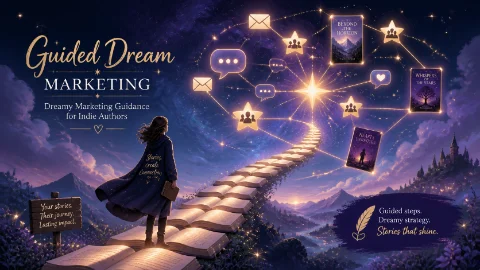
Guided Dream Marketing starts from the idea that your writing is a guided dream, and your marketing should extend that same dream into the world. You are not just selling products. You are inviting readers into a continuing experience.
Instead of thinking in isolated actions (post here, send an email there), you think in story arcs. A launch becomes a three act journey. A newsletter sequence becomes a character relationship. Your entire author brand becomes the “world” where your guided dream lives.
Step 1: Clarify the Core Dream of Your Brand
Every indie author has an underlying dream that runs through all their work, even across genres.
Ask yourself:
- What emotional experience sits at the heart of my books.
- What kind of promise do readers feel when they see my name.
- What inner world do they enter when they follow me for the long term.
Maybe your core dream is “found family in dangerous worlds,” “quiet hope in messy lives,” or “beautiful terror in ordinary places.” Once you name it, every marketing choice can harmonize with that core dream.
Step 2: Turn Your Reader Journey Into a Story Arc
Guided Dream Marketing treats the reader journey like a narrative:
- Act One: Discovery
The reader first glimpses your dream. This is your cover, your tagline, your social bio, your top website headline. It should hint at the emotional promise and genre flavor. - Act Two: Immersion
The reader takes their first step inside. This is your free story, sample chapters, email welcome sequence, first book in a series. Your job here is to deepen trust and curiosity. - Act Three: Belonging
The reader chooses to stay. This is your newsletter, your social presence, your behind the scenes updates, your next books. Here you foster a sense of ongoing relationship and shared world.
If you map your marketing to this arc, you stop spamming and start guiding. Each touchpoint has a narrative purpose.
Step 3: Align Channels With the Dream, Not Just Trends
Instead of trying to be everywhere, Guided Dream Marketing asks: which spaces can carry my dream clearly.
- If your work is intimate and character driven, email and a calm blog might be your strongest channels.
- If your work is visual and high concept, short video and image driven platforms might carry your dream more powerfully.
- If your work thrives on deep discussion and themes, long form posts, podcasts, or communities may be the natural extension.
You choose channels based on how well they can hold the mood, themes, and tone of your stories, not just on what is currently popular.
Step 4: Make Each Marketing Piece a Tiny Story
Every marketing asset becomes a micro guided dream.
- A social post is a mini scene, not a shout.
- A newsletter is a letter from inside your world, not just a sales notice.
- A launch announcement is the opening of a new “episode” in the ongoing dream.
Give each piece:
- A clear emotional beat (anticipation, wonder, relief, curiosity).
- A tiny narrative shape (setup, something interesting, a hint of what comes next).
- A gentle path back to your books or list.
When your marketing feels like storytelling, it is easier to make and easier for readers to receive.
Step 5: Build Routines That Protect Your Dream Energy
Marketing can drain the same creative energy you use for writing. Guided Dream Marketing respects that by designing routines that protect you.
- Cluster marketing tasks in small, focused sessions so they do not bleed into your drafting time.
- Use templates that match your brand dream, so you are not reinventing tone and style with every new post.
- Decide in advance what “enough” looks like each week, so you do not chase endless metrics.
The goal is a rhythm you can sustain for years, not a sprint that burns out your creativity.
Step 6: Let the Dream Grow With Your Catalog
As you release more books, your guided dream becomes more complex. Marketing should reflect that growth instead of staying stuck at the debut mindset.
- Update your brand statement and tagline as patterns in your work become clearer.
- Create themed entry points into your world, such as “start here if you love slow burn romance” or “start here if you love bleak cosmic horror.”
- Offer series specific dreams (for example, a “hopeful apocalypse” series) within your larger brand dream.
This helps new readers find the right doorway, and long term readers feel the expanding scope of your universe.
Step 7: Listen for How Readers Describe Your Dream
Guided Dream Marketing is not just about what you project. It is also about what readers reflect back.
Pay attention to:
- The words they use in reviews and messages.
- The comparisons they make to other authors and stories.
- The emotions they say they felt before, during, and after reading.
You can adopt their language into your marketing copy, refine your brand description, and sharpen your core promise. Over time, your guided dream becomes a shared language between you and your audience.
Step 8: Treat Data as Feedback, Not Judgment
Metrics are part of marketing, but in Guided Dream Marketing they act as feedback on clarity, not verdicts on your worth.
- If an email has low opens, ask if the subject line expressed the dream clearly.
- If a launch post underperforms, ask if it carried a strong emotional beat or just information.
- If a platform feels dead, ask if it matches your dream and your energy, rather than forcing yourself to stay.
You adjust your guidance based on what helps readers find and stay inside the dream, instead of chasing numbers for their own sake.
The Long View: A Career Built on Guided Dreams
For indie authors, the ultimate value of Guided Dream Marketing is longevity. A single book campaign ends. A single viral post fades. A guided dream can support a lifetime of stories.
You are building:
- A world readers recognize and return to.
- A voice that feels consistent across books and channels.
- A presence that feels human, imaginative, and trustworthy.
Your marketing becomes the continuation of the thing you love most, which is telling stories. When that happens, it stops feeling like a separate job and starts feeling like part of the creative arc.