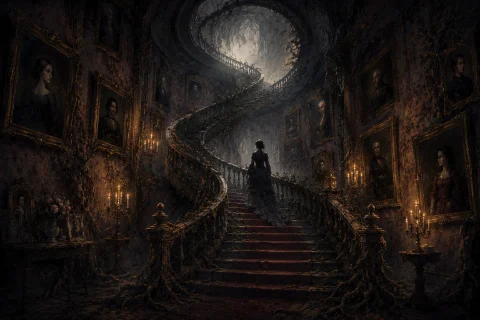
Gothic fiction has never needed jump scares. It needs a house with a bad memory, a family with something buried, and a narrator who is not entirely sure what is real. That formula has stayed remarkably stable since the eighteenth century, and it remains one of the hardest moods in fiction to sustain. Dread that builds slowly is far harder to write than a shock that lands all at once, which is part of why gothic fiction has always rewarded patient, meticulous authors over flashy ones.
It also means gothic fiction has never been the easiest genre to break into through self-publishing, where fast series and immediate hooks tend to dominate. But a small number of independent authors have committed to the genre's slower burn anyway, and the results deserve real attention. Here are the indie gothic fiction gems worth seeking out, set alongside a few of the genre-defining classics that taught them how the atmosphere is built in the first place.
The Reddening by Adam Nevill
After years publishing through major houses including Pan Macmillan, Adam Nevill made the decision in 2019 to self-publish The Reddening through his own imprint, Ritual Limited, seeking more creative control over how his work looked and reached readers. The novel follows two women whose lives become entangled after ancient remains are unearthed near an English coastal town, remains that seem to be waking something that was never meant to surface. It went on to win the August Derleth Award for Best Horror Novel, proof that stepping outside traditional publishing cost Nevill nothing in terms of craft or recognition.
Cunning Folk by Adam Nevill
A second entry for Nevill is well earned. Cunning Folk, also self-published through Ritual Limited, follows a young family who move into a rundown house next door to a pair of unsettling, secretive neighbours practising something that looks increasingly like folk ritual in the surrounding woodland. It is claustrophobic in the way the best gothic fiction always is, building dread out of proximity and suspicion rather than spectacle, and it shows an author who has only sharpened his instincts since leaving the traditional publishing system behind.
An Altar on the Village Green by Nathan Hall
Independently published and drawing inspiration from the Dark Souls video game series, An Altar on the Village Green is a genuinely strange, atmospheric piece of horror fiction that reviewers have singled out as deserving far more attention than it has received. Its blend of folkloric dread and creeping, unexplained wrongness places it comfortably in gothic territory, and it stands as one of the clearest examples of an indie author finding an audience through pure atmosphere rather than marketing muscle.
Litany of the Destroyer by Chaz Lebel
A self-published novel that surprised even seasoned horror reviewers, Litany of the Destroyer is set in medieval France and blends historical fiction, horror, and mystery with research the author clearly did not skimp on. Its slow-building sense of dread, tied to a setting already primed for gothic atmosphere, has drawn comparisons to some of the genre's more historically grounded classics, and it is a strong reminder that gothic horror does not need a Victorian manor to work. A crumbling medieval world does the job just as well.
Mexican Gothic by Silvia Moreno-Garcia
No modern gothic reading list is complete without this one. Set in 1950s Mexico, Mexican Gothic follows Noemí Taboada into a remote, decaying mansion to check on her newly married cousin, only to find a house that seems to be rotting from the inside out, along with a family harbouring secrets that go far beyond bad manners. Moreno-Garcia's ability to fuse classic gothic atmosphere with a sharp, modern feminist edge has made this one of the genre's most influential recent touchstones, and it is a useful benchmark for any indie author working in similar territory.
The Haunting of Hill House by Shirley Jackson
First published in 1959, The Haunting of Hill House remains one of the most controlling demonstrations of atmosphere in the genre's history. Jackson never needs to show the reader anything definitively supernatural. The house's wrongness lives entirely in suggestion, in doors that will not stay shut and cold spots that arrive without explanation, and in the fraying psychological state of Eleanor, the novel's fragile, unreliable centre. It remains the gold standard for restraint in haunted house fiction.
We Have Always Lived in the Castle by Shirley Jackson
A second entry for Jackson is essential, since this novel demonstrates gothic fiction's other great trick: making the reader sympathise with characters who, by any objective measure, should not be sympathetic at all. Narrated by Merricat Blackwood, who lives in a crumbling, isolated house with her sister after the rest of their family died under suspicious circumstances, the novel builds a genuinely strange intimacy between reader and narrator that few gothic novels have matched since.
Rebecca by Daphne du Maurier
Few novels have shaped the genre's modern shorthand as thoroughly as Rebecca. An unnamed narrator arrives at Manderley as the second wife of a brooding widower, only to find the house, the staff, and her husband himself still entirely in the shadow of his first wife. Du Maurier's genius is in never needing an actual ghost. Rebecca haunts the novel purely through absence, and that structural trick has been borrowed by nearly every gothic novel written since.
The Fall of the House of Usher by Edgar Allan Poe
The house is the point. Poe's short, hallucinatory tale of the crumbling Usher estate and the twin siblings dissolving along with it established one of gothic fiction's most enduring ideas: that a building can be as psychologically unstable as the people living in it. Its influence runs through nearly every haunted house novel that followed, indie and traditionally published alike.
Wuthering Heights by Emily Brontë
Set on the wind-scoured Yorkshire moors, Wuthering Heights is gothic romance at its most feral, built around the destructive, all-consuming bond between Heathcliff and Catherine Earnshaw. Its landscape does as much narrative work as its characters, and its refusal to offer either of its central figures much redemption has made it one of the most unsettling love stories in the English canon, gothic or otherwise.
Where the Next Gothic Gem Is Hiding
What separates the genre's classics from its weaker imitators has never been budget or platform. It has always been patience, the willingness to let dread accumulate room by room rather than announcing itself all at once. The independent authors on this list are proof that self-publishing has not lowered that bar. If anything, working outside the pressure of a traditional release schedule has given writers like Nevill more room to let a story breathe exactly as long as it needs to.
If you want to find more of that patient, atmospheric fiction before it gets the recognition it deserves, Indie Reading Community is built for exactly that. Browse our book listings for gothic and horror fiction from independent authors, read author interviews from the writers building these unsettling worlds one house at a time, and join a community forum where readers are already trading the gothic gems the algorithms haven't caught up to yet.