From Hokusai to Monet & Beyond: How 36 Views Shaped Impressionism
If you are an otaku or an amateur impressionist connoisseur, you probably know that the art of Katsushika Hokusai (dob) had great influence on the proto-modern European art of the 1830s. Monet’s famous water lilies mirror the ideals of mindfulness and Zen that diffused from Japan into France in the 19th century. The 1800s were years of both commercial and cultural expansion, equally for Asia and the West. Although Japan maintained an isolationist policy in prior centuries, contact with the Netherlands in the mid-18th century encouraged greater intellectual curiosity about the Netherlands and Europe in general. Efforts to decipher European art and technological inventions like the telescope gave rise in Japan to a field known as “Dutch Studies,” leading to innovations in the art world such as copperplate engraving.

Figure 1. Shiba Kōkan, A View of the Mimeguri Shrine from the Sumida River, 1783. Public Domain. An example of Dutch Studies engraving. The divisionism of the waves would become increasingly popular in impressionism and beyond.
The commercial association between Japan and the Netherlands further flourished onwards 1810, when a pigment known as Prussian Blue began to be imported in Japan. Prussian blue, known in Japan as bero-ai or Berlin Blue, was prized among ukiyo-e artists for its bright, enduring hues. Prior to painting with bero-ai, artists used special plant-based dyes to reach rich—but more quickly fading—hues of indigo and ceremonial blues. The enthusiasm was such that it gave rise to an artistic movement known as azuri-e or blue paintings. Japanese art experiencing a Renaissance of sorts, these visions in blue also derived inspiration from Classical Chinese art and perhaps, with their intricate azure swirls, from Chinese porcelain.
 |  |
Figure 2. Left: Katsushika Hokusai, Print #17 from 36 Views of Mt. Fuji, ca. 1830. Woodblock print. Right: Claude Monet, Wheatstack (Sun in the Mist), 1891, oil on canvas.
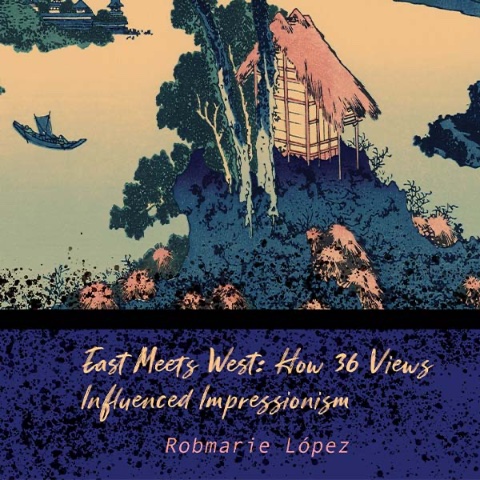
In East Meets West: How 36 Views Influenced Impressionism, Robmarie López explains how Hokusai—an aficionado of the telescope as well as the microscope, and other European technologies—enthusiastically experimented with bero-ai in his seminal work, 36 Views of Mt. Fuji to create a series of impressions about the brisk evolution of Japanese life into modernity during the mid-19th century. For instance, print no. 17, of which there is more than one version, is an example of increasing concern with temporality—a foundational trait of Monet’s impressionism, as seen in works like Haystacks. In fact, the composition in one of Monet’s Haystacks also evokes that of Hokusai’s print no. 17. That the latter has an azuri-e version evocative of dusk is also worthy of an allusion to the effect of the Western world on the already-fleeting landscape “timestamped” by Hokusai.

Figure 3. Katsushika Hokusai, Print #17 (Alternative Version) from 36 Views of Mt Fuji, c. 1830, azuri-e woodblock print. Hokusai made several versions of this print and others in the series--a technique that would also be embraced by impressionists like Monet and post-impressionists like Seurat and Gauguin.
***
To learn more about the reciprocal Eastern-Western influence that “took off” in the 19th century, check out the East Meets West: How 36 Views Influenced Impressionism, available as a paperback or Kindle e-book at https://inkbrushmood.com/hokusai36. You can also get the book as an e-pub through Apple Books and other mediums over at books2read.com/hoku36.