Most horror flatters us, even as it frightens us. The demon wants your soul. The killer stalks you specifically. The haunted house has chosen your family. However terrifying these threats are, they share a strangely comforting assumption. You matter. Something out there cares enough to hunt you.
Cosmic horror strips that comfort away entirely. Its central terror is not that the universe is out to get us, but that the universe does not notice us at all. We are not the heroes of the story. We are not even the villains. We are a brief, insignificant accident on a small rock, and the vast forces that move through reality are no more aware of us than we are of the bacteria on a doorknob. This is the horror of cosmic indifference, and it produces a dread unlike anything else in fiction. Here is how to write it.
Why Indifference Frightens Us More Than Malice
There is a strange logic to why an indifferent universe is more disturbing than a hostile one. Malice, for all its menace, confirms our importance. If something wants to destroy us, then we are worth destroying. We are significant enough to provoke a reaction. Even a monster that hates us is, in a sense, paying attention to us.
Indifference denies us that dignity. It tells us that the great forces of existence do not hate us because hating us would require noticing us, and we are far too small to notice. This is a deeper wound than any threat. It attacks not our survival but our meaning. We like to believe that human life is central to the story of the universe, that our loves and struggles matter on some grand scale. Cosmic horror whispers that they do not, that the cosmos would proceed exactly as it does whether we existed or not.
That is the true source of the dread. It is not fear of death, which every horror story trades in. It is fear of insignificance, the suspicion that we were never important to begin with. And because that fear speaks to something most people quietly wonder about at three in the morning, it lands with a weight that fanged monsters rarely achieve.
Building a Universe That Does Not Care
To write cosmic indifference convincingly, you have to resist every storytelling instinct that puts humanity at the center. This is harder than it sounds, because narrative naturally revolves around its characters. Your task is to constantly remind the reader, subtly, that the story they think they are in is not the real story at all.
Make the vast forces genuinely unaware
The moment your cosmic entity acknowledges humanity, even to threaten it, you have lost the effect. The most chilling cosmic horrors do not attack people. They simply move, and people happen to be in the way. A god that steps on a city the way we step on an anthill, without cruelty and without notice. The devastation should feel like a byproduct, a side effect of something enormous doing something incomprehensible for reasons that have nothing to do with us. When the catastrophe is not even aimed at the characters, the reader feels the full horror of their irrelevance.
Use scale to overwhelm
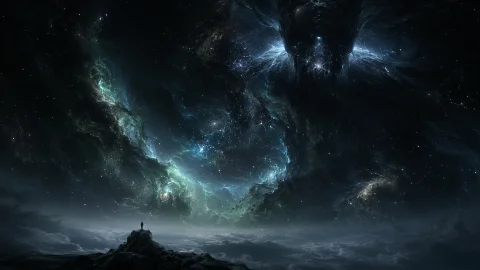
Cosmic horror lives in scale, in distances and durations so vast that the human mind cannot hold them. Ages of time that make all of human history a single blink. Distances that make our entire world a mote of dust. Entities so large or so old that our lifespans are beneath their perception. Deploy this scale deliberately, letting the reader feel the crushing smallness of everything they know. The goal is vertigo, the dizzying sense of standing at the edge of something too big to comprehend.
Withhold explanation
We make things small by understanding them. Once we can name and explain a threat, we have, in a sense, mastered it. Cosmic horror refuses that mastery. The forces at work must remain fundamentally incomprehensible, their purposes unknowable, their nature beyond human categories. Resist the urge to explain your cosmic entity. Every answer you provide shrinks it to human size. The dread lives in the questions that can never be answered, in the vast blank where understanding should be.
The Human Response to an Indifferent Cosmos
A common mistake is to think cosmic horror has no room for character, that the human element is drowned by the vast and the incomprehensible. In fact, the human response is where the story actually lives. The cosmic forces provide the dread, but your characters provide the meaning, precisely by struggling against a universe that offers none.
The most powerful device in the genre is the moment of realization. Watch a character come to understand their true place in the cosmos, and watch what that knowledge does to them. This is often the real climax of a cosmic horror story, not a physical confrontation but an epiphany. The mind confronting a truth it was never built to hold. Some characters break under it, sliding into madness. Some retreat into denial. A rare few find a strange, terrible peace in their own smallness. How your characters respond to their insignificance tells the reader everything about who they are.
There is room, too, for a quiet defiance. There is something profoundly human, even beautiful, in continuing to love, create, and care in the face of a universe that does not care back. A character who knows they are insignificant and chooses to live meaningfully anyway is not a contradiction of cosmic horror. They are its most moving expression, a small light insisting on itself in an infinite, indifferent dark.
Balancing Awe With Terror
Cosmic horror has a special ingredient that separates it from other frights. Awe. The vast and indifferent is not only horrifying. It is also, in a strange way, magnificent. The best writing in this genre holds terror and wonder together, so the reader is frightened and dazzled at the same time.
Let your reader feel the beauty of the vast alongside its horror. The sublime terror of standing before something infinitely greater than yourself carries a kind of dark grandeur, the same feeling people describe at the edge of an ocean or beneath a sky full of stars. This awe is not a break from the horror. It deepens it, because it makes the indifference feel not merely frightening but true. A universe that is only horrible is a haunted house. A universe that is horrible and beautiful and utterly uncaring is something far more convincing, and far harder to forget.
A Simple Exercise to Try Today
Take a moment of genuine human importance from your work in progress, a birth, a death, a desperate act of love or courage, something that feels enormous to the characters. Now write the same moment from an impossibly distant vantage, from so far away in space or time that the human drama becomes invisible, a flicker too small to register against the vast machinery of the cosmos. Hold both views in your mind at once, the moment that means everything and the perspective from which it means nothing. That gap, between how much it matters to us and how little it matters to the universe, is the exact place cosmic horror is born.
Other horrors frighten us by promising that something out there wants us. Cosmic horror frightens us with the opposite, and far lonelier, idea. That nothing out there wants us at all, that the universe is vast beyond imagining and supremely uninterested in whether we live or die. It is a fear that cannot be fought or fled, only faced, and that is what gives it such lasting power.
Write the indifferent cosmos. Make your forces genuinely unaware, let scale crush the reader with vertigo, refuse the comfort of explanation, and then set fragile human characters against it all. Do that, and you will give your reader something rare in horror. Not the thrill of being hunted, but the deeper, quieter terror of looking up at the enormity of everything and realizing, for one cold moment, just how small they truly are.