I still have the notebook I filled during the summer I read my first proper craft book. The margins are dense with frantic scribbles, exclamation marks, and the word “YES” written so hard the pen dented the paper. Before that book, I didn’t know what I didn’t know. I thought “good writing” was a mystical gift you either had or didn’t. I didn’t understand that story structure could be studied, that point of view was a choice with consequences, that dialogue had architecture.
That summer changed everything. I stopped waiting for inspiration and started learning the craft. And because I’m an indie author, no in-house editor, no publishing mentor, those books became my teachers. They still are.
I’ve since discovered that nearly every fiction author I admire, whether traditionally published or indie, has a short stack of dog-eared craft books that shaped their voice. In our Indie Reading Community, we constantly swap recommendations, and certain titles keep surfacing like old friends. These are the best writing craft books that I believe every fiction author should read, not because they’ll give you a formula, but because they’ll give you tools, courage, and a deeper understanding of the art you’re building.
Why Craft Books Matter, Especially for Indie Authors
Indie authors carry more weight than their traditionally published counterparts. We are the writers, but we’re also the quality control. We don’t have a publishing house assigning us a developmental editor who gently points out that our middle act sags. We have to develop that editorial eye ourselves, or hire freelancers and know enough to communicate with them effectively.
Books on writing fiction bridge that gap. They demystify what works on the page and why. They name problems you’ve sensed but couldn’t articulate. A great craft book doesn’t tell you what to write; it shows you how to see your own work more clearly. And when you finish a chapter and immediately want to revise everything you’ve ever written, you know it’s a keeper.
The Craft Books That Shaped My Writing (and Our Community’s Favourites)
Every writer’s journey is different, so I’ve gathered a mix of titles. Some focus on the macro (structure, plot, character arcs), others on the micro (sentences, voice, rhythm). All of them have left fingerprints on my work.
1. Story Genius by Lisa Cron
Best for: Understanding why story is about internal change, not just plot.
This book rewired my brain. Cron argues that a story isn’t what happens, it’s how what happens changes the protagonist internally. She walks you through building a character’s “third rail” (the emotional core that drives every decision) before you even outline a scene. I read Story Genius and finally understood why some of my perfectly plotted chapters felt hollow. The characters weren’t being transformed. They were just moving through events. This is one of the best writing craft books for authors who want their fiction to resonate on a deeper level.
2. Save the Cat! Writes a Novel by Jessica Brody
Best for: Learning story structure without feeling boxed in.
Based on Blake Snyder’s screenwriting classic, this adaptation maps fifteen story beats onto novels across every genre. Was I skeptical at first? Surely not every story fits a beat sheet? But Brody uses wildly diverse examples, and the beats are flexible enough to inspire rather than constrain. When I’m stuck in a saggy middle, I pull out my worn copy and ask, “What beat should I be hitting around here?” It’s a compass, not a cage.
3. The Emotional Craft of Fiction by Donald Maass
Best for: Making readers feel something on every page.
Maass is a legendary literary agent, and this book is a masterclass in emotional resonance. He teaches you how to move beyond surface-level feelings and create layered, surprising emotional arcs. The exercises are brilliant and often painful. I’ve cried while doing them. But the scenes that emerged are the ones my readers remember. If you’ve ever been told your writing feels “distant,” this is the book on writing fiction you need.
4. Steering the Craft by Ursula K. Le Guin
Best for: The sentence-level artistry of prose, rhythm, and voice.
Le Guin’s slim volume is a quiet, fierce education in the music of language. She covers point of view, tense, syntax, and sound with the precision of a poet and the warmth of a grandmother who wants you to do better. The exercises are deceptively simple but deeply challenging. Every time I return to this book, I become a more attentive writer. It’s essential reading for any fiction author who cares about the beauty of a sentence.
5. On Writing by Stephen King
Best for: A shot of courage and a reminder of why we do this.
Part memoir, part craft guide, this book is the one I reach for when I feel like quitting. King’s advice is practical (adverbs are not your friend, the first draft is just for you) but his real gift is making you believe that writing matters. His honesty about rejection, addiction, and the sheer stubbornness required to keep going is a lifeline for indie authors who are often working alone. It’s not the most technically dense craft book, but it’s one of the best writing craft books for the heart.
6. The Anatomy of Story by John Truby
Best for: Writers who want to understand story architecture at the deepest level.
Truby’s book is dense, demanding, and utterly transformative. He breaks down premise, character web, moral argument, and story world in a way that feels almost philosophical. I won’t pretend I understood everything on a first read. But the sections on “thematic opposition” and designing a character’s fundamental weakness have changed how I develop every new project. If you’re ready for a deeper dive, this is a book on writing fiction that rewards revisiting.
7. Self-Editing for Fiction Writers by Renni Browne and Dave King
Best for: Learning to revise your own work like a professional.
This is the book that taught me to see my drafts with an editor’s eyes. It covers dialogue mechanics, point-of-view consistency, showing versus telling, and the rhythm of a scene. Every chapter ends with exercises, and I’ve worked through them multiple times. For indie authors who can’t afford a full developmental edit, this book is a survival tool.
How the Indie Reading Community Uses Craft Books
One of my favourite things about our Indie Reading Community is the craft conversations. We don’t just talk about what books we love; we talk about how they work. Members share passages that stunned them, analyse opening pages together, and recommend craft books that illuminated a specific technique.
A few months ago, we did a community deep-dive into The Emotional Craft of Fiction. Members posted their attempts at the exercises, and we cheered each other on. Some of those exercises became seeds for published short stories. That collaborative, generous approach to learning is rare, and it’s one of the reasons I treasure this space.
If you’re an author who’s ever felt isolated with your craft questions, there’s a seat for you here. We believe that becoming a better writer doesn’t have to be lonely.
A Small Shelf That Holds a Universe
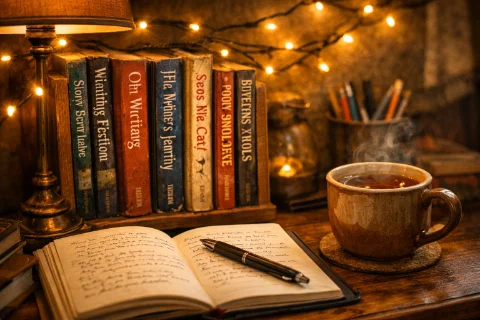
I can look at my tiny shelf of craft books and trace my growth as a writer. Each spine holds a moment where the fog cleared, where a concept clicked, a problem dissolved, or a story suddenly found its shape. The best writing craft books for fiction authors aren’t just manuals. They’re mentors printed on paper, patient and waiting for you to be ready.
So now I want to hear from you: What’s the one craft book that changed everything for you? Was it a classic everyone knows, or a hidden gem you stumbled upon by accident? Drop the title and what it taught you in the comments. Let’s build a reading list for writers, curated by the people who actually use these books to make art.